


Table of Contents
Overview
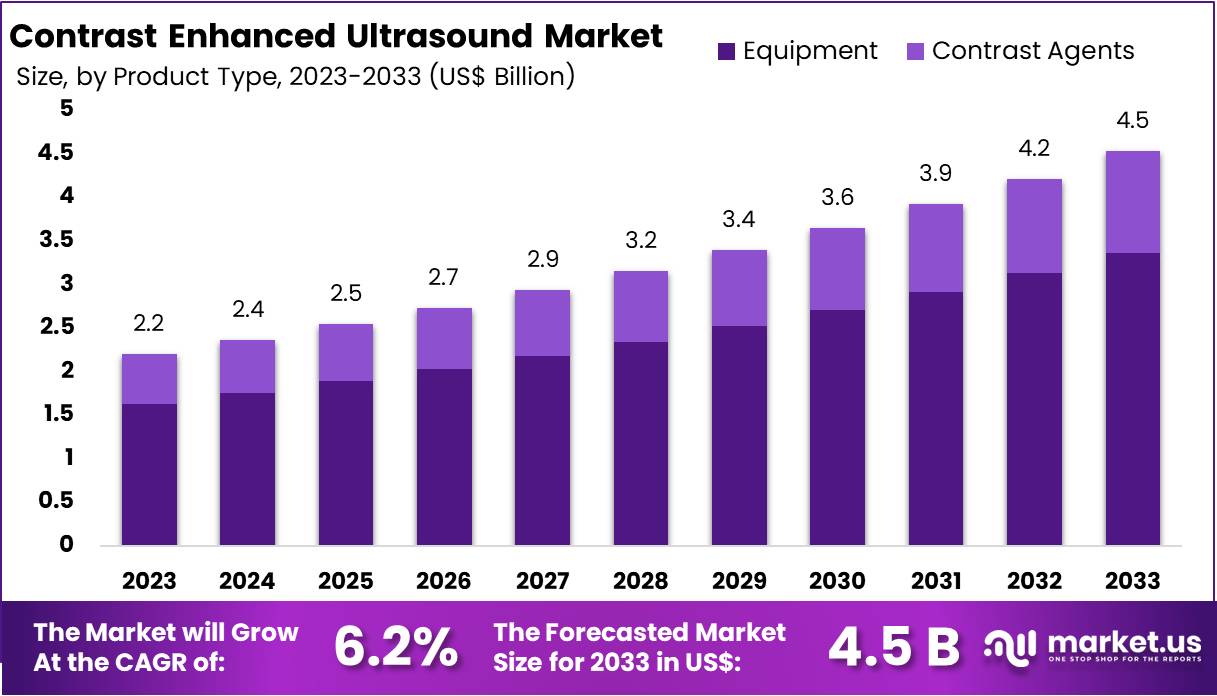
New York, NY – Feb 11, 2026 – The Global Contrast Enhanced Ultrasound Market size is expected to be worth around US$ 4.5 Billion by 2033, from US$ 2.2 Billion in 2023, growing at a CAGR of 6.2% during the forecast period from 2024 to 2033. North America dominated the market with a 35.2% share. The region’s market value reached US$ 0.8 billion during the year.
Contrast Enhanced Ultrasound (CEUS) is an advanced diagnostic imaging technique designed to improve the visualization of blood flow and tissue vascularity in real time. This method is based on the intravenous administration of microbubble contrast agents, which are gas-filled microspheres encapsulated within a biocompatible shell. After injection, these microbubbles circulate exclusively within the vascular system, enhancing the reflection of ultrasound waves and enabling detailed assessment of microvascular structures.
The formation of contrast in CEUS occurs when ultrasound waves interact with the microbubbles. Unlike conventional ultrasound, where imaging is generated by echoes from tissue interfaces, CEUS relies on the nonlinear oscillation of microbubbles in response to low mechanical index ultrasound signals. This oscillation produces strong harmonic signals that can be selectively detected, allowing clear differentiation between blood flow and surrounding tissues. As a result, enhanced visualization of lesions, organ perfusion, and vascular patterns is achieved.
CEUS has been widely adopted in the evaluation of liver, kidney, and cardiovascular conditions due to its safety profile and absence of ionizing radiation. The technique supports improved diagnostic confidence, facilitates early disease detection, and contributes to more precise treatment planning across multiple clinical applications.
Key Takeaways
- The global Contrast Enhanced Ultrasound market is expected to increase from US$ 2.2 billion in 2023 to approximately US$ 4.5 billion by 2033, reflecting sustained long-term expansion.
- North America accounted for 35.2% of the global market in 2023, with revenues reaching nearly US$ 0.8 billion, supported by well-established healthcare infrastructure and high adoption of advanced imaging technologies.
- The equipment segment represented 74.2% of total market revenue in 2023, driven by continuous technological advancements aimed at improving diagnostic accuracy and imaging efficiency.
- Non-targeted contrast agents captured 75.9% of the type segment share in 2023, primarily due to their widespread use in enhancing vascular visualization across cardiology, oncology, and radiology applications.
- Hospitals led the end-use segment with a 75.9% market share in 2023, supported by their ability to handle large patient volumes and offer comprehensive diagnostic services.
- In March 2024, Lantheus received FDA approval for DEFINITY for use in pediatric echocardiography, supported by clinical evaluation involving 189 pediatric participants, addressing critical diagnostic requirements in children.
- In September 2023, Philips introduced a super-resolution CEUS application delivering up to 200% improvement in spatial resolution, strengthening capabilities in cancer imaging.
- In May 2023, Bracco Diagnostics secured FDA approval for POSLUMA® injection, demonstrating an 83% lesion detection rate in prostate cancer cases and improving diagnostic confidence.
Regional Analysis
In 2023, North America maintained a leading position in the Contrast Enhanced Ultrasound Market, accounting for over 35.2% of global revenue, valued at approximately US$ 0.8 billion. Market dominance has been supported by a highly developed healthcare system that incorporates advanced imaging technologies into standard diagnostic practices.
A high prevalence of chronic disorders, particularly cardiovascular diseases and cancer, has significantly increased the demand for precise and real-time imaging solutions. Accurate disease detection and monitoring remain critical factors supporting regional growth.
Continuous investment in research and development by both public institutions and private organizations has strengthened technological capabilities and improved clinical outcomes. A well-structured regulatory framework further enhances market expansion, as streamlined approval processes facilitate faster commercialization of innovative contrast agents and ultrasound systems.
In addition, strong awareness regarding early diagnosis and non-invasive imaging methods has promoted wider clinical adoption. Elevated healthcare expenditure per capita continues to enable access to advanced and high-cost diagnostic technologies across the region.
Emerging Trends in Contrast-Enhanced Ultrasound
- Molecularly Targeted Imaging: Molecularly targeted microbubble agents are being engineered to selectively bind tumor-specific cellular receptors. In a first-in-human investigation involving breast lesions, computationally enhanced VEGFR2-targeted CEUS increased the contrast ratio between malignant and normal tissues by more than tenfold across 18 patients. Improved lesion delineation was achieved under real-world clinical conditions, supporting its translational potential in oncologic diagnostics.
- Integration of Artificial Intelligence: Advanced machine learning algorithms and adaptive beamforming techniques are being incorporated into CEUS platforms to improve image clarity and diagnostic yield. An adaptive aberration-correction framework applied in transcranial CEUS demonstrated a 4 dB improvement in image contrast and a 38% increase in detected microbubble tracks. Enhanced visualization of cerebral microvasculature was observed in adult populations, indicating significant progress in neurovascular imaging applications.
- Transition Toward Quantitative Perfusion Imaging: CEUS is progressively advancing from qualitative interpretation toward standardized quantitative perfusion analysis. Dynamic imaging protocols now document early arterial phase enhancement (10–15 seconds post-injection) and extended parenchymal phases (up to 120 seconds). This approach enables absolute measurement of microvascular blood volume and flow in organs such as the liver and kidneys, strengthening its role in disease characterization and therapeutic monitoring.
- Real-Time 4D Imaging with Position Tracking: The adoption of optical tracking systems during 4D CEUS acquisitions has enhanced operator feedback and positional stability. Probe displacement was reduced from 4.58 mm during blind acquisition to 3.48 mm with tracking assistance. Improved reproducibility of perfusion parameters has been reported during prolonged imaging sessions, supporting greater consistency in longitudinal assessments.
Use Cases of Contrast-Enhanced Ultrasound
- Detection and Staging of Abdominal Trauma: In adult patients presenting with low-energy blunt abdominal trauma, CEUS demonstrated 96% sensitivity in identifying solid organ injuries (81 of 84 lesions) and 99% specificity in detecting free fluid (41 of 45 cases). An overall diagnostic accuracy of 98% was achieved, comparable to contrast-enhanced CT, supporting its utility in emergency settings.
- Pediatric Trauma Assessment: In pediatric blunt abdominal trauma cases, conventional ultrasound yielded a sensitivity of 45.2%. The application of CEUS increased sensitivity to 85.7%, while specificity remained high at 96.4%. These findings indicate substantial improvement in injury detection without exposure to ionizing radiation.
- Echocardiographic Enhancement: The U.S. FDA-approved contrast agent Lumason (sulfur hexafluoride microbubbles) is widely utilized to enhance left ventricular chamber opacification and improve endocardial border definition in adult and pediatric echocardiography. Its application supports more accurate cardiac function evaluation and diagnostic confidence.
- Assessment of Microvascular Perfusion in Inflammatory Disorders: CEUS techniques are being investigated for evaluation of microvascular alterations in inflammatory conditions such as Crohn’s disease and atherosclerosis. Targeted imaging of adhesion molecules expressed on activated endothelium enables real-time assessment of inflammatory activity and therapeutic response, expanding CEUS applications beyond traditional structural imaging.
Frequently Asked Questions on Contrast Enhanced Ultrasound
- How does Contrast-Enhanced Ultrasound (CEUS) work?
CEUS operates through intravenously administered microbubble agents composed of inert gas encapsulated in a lipid or protein shell. These microbubbles reflect ultrasound waves, allowing real-time visualization of microvascular perfusion and dynamic blood flow within tissues and organs. - What are the key clinical applications of CEUS?
CEUS is widely used in liver lesion characterization, trauma assessment, echocardiography, renal imaging, and pediatric diagnostics. It is increasingly applied in oncology, inflammatory disease monitoring, and vascular imaging due to its ability to evaluate microvascular perfusion accurately. - Is CEUS safer than CT or MRI contrast imaging?
CEUS is considered safer compared to CT and MRI contrast imaging because it does not involve ionizing radiation and carries a lower risk of nephrotoxicity. Microbubble agents remain intravascular and are eliminated through respiration, minimizing systemic exposure. - What are the advantages of CEUS over conventional ultrasound?
CEUS provides enhanced lesion detection, improved characterization of focal abnormalities, and real-time perfusion assessment. It significantly increases sensitivity and specificity compared to conventional ultrasound, particularly in abdominal trauma, oncology, and cardiac imaging. - Which regions are leading in CEUS market adoption?
North America and Europe lead the CEUS market due to regulatory approvals, established reimbursement frameworks, and advanced healthcare systems. Asia-Pacific is witnessing accelerated growth driven by healthcare infrastructure expansion and increasing diagnostic demand. - What role does technological innovation play in the CEUS market?
Technological advancements such as molecularly targeted microbubbles, 4D imaging, AI-powered image processing, and adaptive beamforming are enhancing diagnostic precision. These innovations are expanding clinical indications and strengthening the commercial viability of CEUS systems.
Conclusion
Contrast-Enhanced Ultrasound (CEUS) has emerged as a transformative diagnostic modality, delivering real-time visualization of microvascular perfusion with high safety and clinical precision. Sustained market expansion is anticipated, with global revenues projected to reach approximately US$ 4.5 billion by 2033, supported by technological innovation, regulatory advancements, and expanding clinical indications.
Strong adoption across hospitals and advanced healthcare systems, particularly in North America, continues to reinforce market leadership. Ongoing developments in molecular targeting, artificial intelligence integration, and quantitative imaging are expected to further enhance diagnostic confidence, broaden application areas, and strengthen the long-term commercial outlook of the CEUS industry.
Discuss your needs with our analyst
Please share your requirements with more details so our analyst can check if they can solve your problem(s)




