


Table of Contents
Overview
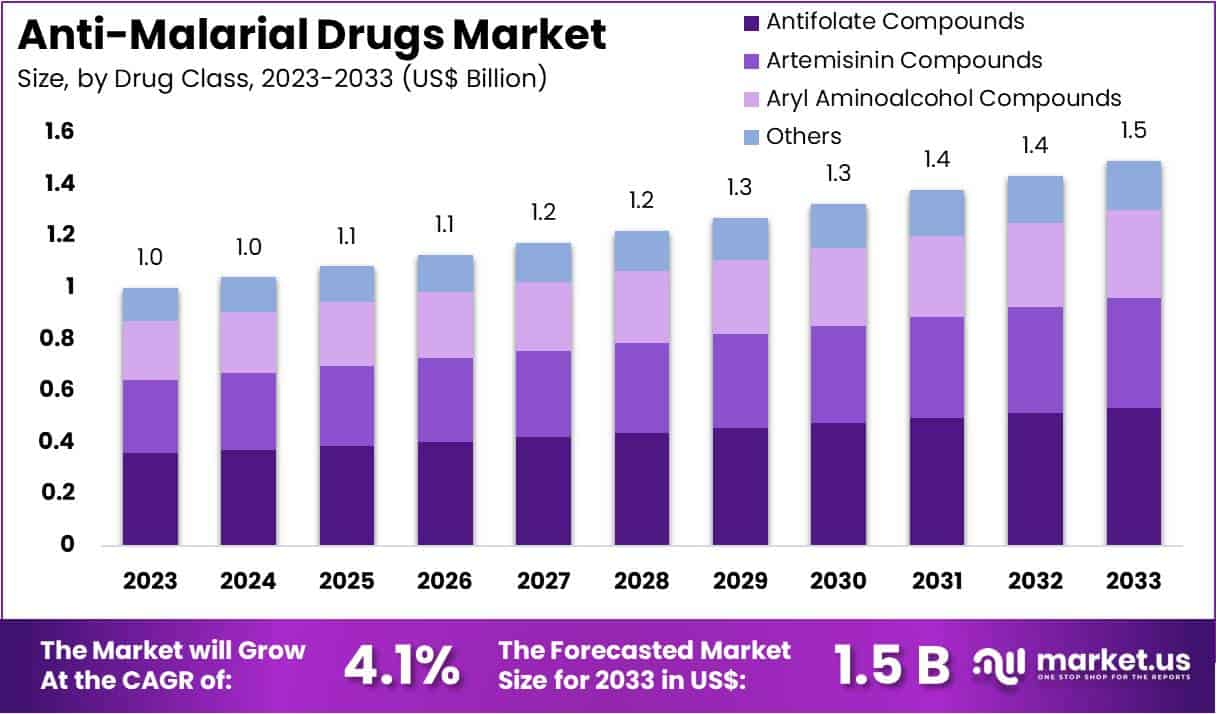
New York, NY – March 04, 2026 – The Global Anti-Malarial Drugs Market size is expected to be worth around US$ 1.5 Billion by 2033, from US$ 1 Billion in 2023, growing at a CAGR of 4.1% during the forecast period from 2024 to 2033. North America led the market with a 39.8% revenue share due to approved artesunate injections for severe malaria.
The global anti-malarial drugs market plays a critical role in addressing the ongoing burden of malaria, particularly across tropical and subtropical regions. Malaria remains a major public health concern in parts of Africa, Asia, and South America, where climatic conditions support the transmission of the disease. The demand for effective anti-malarial drugs continues to increase due to sustained infection rates, government-led eradication programs, and rising healthcare investments.
Anti-malarial drugs are formulated to target different stages of the malaria parasite lifecycle. Common drug classes include artemisinin-based combination therapies (ACTs), chloroquine, quinine, and antifolate drugs. Among these, ACTs are widely recommended as first-line treatment in many endemic countries due to their high efficacy and reduced resistance profile. Continuous research and development efforts have been focused on improving drug safety, minimizing resistance, and enhancing patient compliance through fixed-dose combinations.
Market growth is supported by international health initiatives and funding programs led by organizations such as the World Health Organization and the Global Fund to Fight AIDS, Tuberculosis and Malaria. Increased distribution networks, public-private partnerships, and expanded access to healthcare services are further strengthening market penetration in rural and underserved regions.
Looking ahead, the anti-malarial drugs market is expected to witness steady expansion, driven by innovation in drug development, improved diagnostic capabilities, and sustained global commitment toward malaria elimination goals.
Key Takeaways
- In 2023, the global anti-malarial drugs market generated revenue of US$ 1.0 billion and is projected to reach US$ 1.5 billion by 2033, registering a CAGR of 4.1% during the forecast period.
- Based on drug class, the market is segmented into antifolate compounds, artemisinin compounds, aryl aminoalcohol compounds, and others. Antifolate compounds accounted for the largest share in 2023, representing 35.8% of total revenue.
- By malaria type, the market is categorized into plasmodium falciparum, plasmodium malariae, plasmodium vivax, and plasmodium ovale. Among these segments, plasmodium falciparum dominated the market with a share of 42.5%.
- In terms of distribution channel, the market is divided into hospital pharmacy, e-commerce, retail pharmacy, and others. The hospital pharmacy segment emerged as the leading channel, capturing 46.7% of the overall market revenue.
- Regionally, North America held the dominant position in 2023, accounting for 39.8% of the global anti-malarial drugs market share.
Regional Analysis
North America accounted for the largest revenue share of 39.8% in the anti-malarial drugs market in 2023. Market leadership has been supported by the regulatory approval and availability of artesunate injection for the treatment of severe malaria.
The approval granted by the U.S. Food and Drug Administration in May 2020 strengthened treatment protocols for both adult and pediatric patients, thereby improving clinical outcomes. Increased international travel and immigration from malaria-endemic countries have contributed to a rise in imported cases, supporting demand for effective therapies. However, the relatively low regional disease burden has moderately constrained overall expansion.
The Asia Pacific region is projected to register the fastest CAGR over the forecast period. Growth is driven by high malaria prevalence, expanding healthcare infrastructure, and strong government-led elimination initiatives. Regulatory approval of tafenoquine in collaboration with Medicines for Malaria Venture and GlaxoSmithKline has further strengthened treatment options, supporting sustained market development.
Emerging Trends
- Focus on Single-Dose Treatments: Single-dose anti-malarial therapies are being developed to improve patient compliance and reduce incomplete treatment risks. These formulations aim to eliminate parasites rapidly, enhance cure rates, and support malaria control programs, particularly in remote and resource-limited settings.
- Growth in Pediatric Formulations: Pediatric-specific anti-malarial formulations, including syrups and dispersible tablets, are expanding to address high infection rates among children. These child-friendly options improve dosing accuracy, treatment adherence, and clinical outcomes across malaria-endemic regions in Africa and Asia.
- Long-Acting Drug Development: Long-acting injectable anti-malarial drugs are under clinical evaluation to provide seasonal protection with a single administration. These therapies enhance compliance, reduce repeat dosing requirements, and offer strategic benefits for populations in remote, high-transmission zones.
- Targeting Drug-Resistant Strains: Novel anti-malarial agents are being designed to combat drug-resistant parasite strains by targeting alternative biological pathways. Advanced combination strategies and optimized dosing approaches are intended to preserve therapeutic efficacy and sustain long-term malaria control efforts.
- More Combination Therapies: Combination drug therapies are increasingly adopted to enhance treatment effectiveness and delay resistance development. Artemisinin-based combinations remain the standard, while new multi-drug regimens are being tested to improve parasite clearance and maintain long-term drug performance.
Use Cases
- Treatment of Uncomplicated Malaria: Artemisinin-based combination therapies are widely utilized for uncomplicated malaria management, ensuring rapid parasite clearance within 48 to 72 hours. These first-line treatments are integrated into national malaria programs and significantly reduce disease progression and transmission rates.
- Severe Malaria Management in Hospitals: Severe malaria cases are managed in hospitals using injectable therapies such as artesunate, which rapidly lower parasite levels. Immediate intervention under medical supervision is essential to prevent organ failure, neurological complications, and mortality.
- Preventive Use for Travelers: Preventive anti-malarial medications are prescribed for travelers visiting endemic regions in Africa, Asia, and South America. Prophylactic regimens, selected based on risk assessment, effectively reduce infection incidence and support safe international mobility.
- Mass Drug Administration in High-Risk Areas: Mass drug administration programs involve distributing anti-malarial medicines to entire communities in high-transmission zones. This public health strategy reduces asymptomatic parasite reservoirs, controls outbreaks, and contributes to regional malaria elimination initiatives.
- Military and Aid Workers in Endemic Zones: Military personnel and humanitarian workers operating in malaria-endemic regions follow extended prophylactic drug regimens. Combined with vector control measures, these preventive strategies protect workforce health and maintain operational continuity in high-risk environments.
Frequently Asked Questions on Anti-Malarial Drugs
- How do anti-malarial drugs work?
Anti-malarial drugs function by targeting specific stages of the parasite life cycle within human hosts. Certain drugs disrupt parasite metabolism in red blood cells, while others prevent replication in the liver, effectively controlling infection progression and minimizing complications. - What are the major types of anti-malarial drugs available?
The major classes include artemisinin-based combination therapies, chloroquine, quinine, mefloquine, and primaquine. Treatment selection is influenced by parasite resistance patterns, infection severity, patient health status, and regional clinical treatment guidelines established by health authorities. - Why is drug resistance a concern in malaria treatment?
Drug resistance occurs when Plasmodium parasites adapt to survive despite drug exposure, reducing treatment efficacy. This challenge has increased healthcare costs and treatment failures, necessitating combination therapies and ongoing pharmaceutical research to develop novel therapeutic agents. - Are anti-malarial drugs safe for all populations?
Safety profiles vary depending on patient age, pregnancy status, and underlying medical conditions. While most modern therapies are considered effective and safe under medical supervision, careful dosage regulation and adherence to guidelines are essential to minimize adverse effects. - What factors are driving market growth?
Market growth is primarily attributed to increasing disease burden in sub-Saharan Africa and South Asia, strong funding from global organizations, expansion of generic drug manufacturing, and continuous research investments aimed at overcoming drug resistance challenges. - Which regions dominate the anti-malarial drugs market?
Sub-Saharan Africa dominates the market due to high malaria incidence rates and large-scale procurement programs supported by global health agencies. South Asia also represents a significant share, driven by population density and ongoing public health interventions. - Who are the key players in the anti-malarial drugs market?
Key market participants include multinational pharmaceutical companies and regional generic manufacturers engaged in large-scale production and distribution. Partnerships with international organizations and government bodies play a crucial role in strengthening supply chains and ensuring affordability.
Conclusion
The global anti-malarial drugs market remains strategically important in addressing persistent malaria burden across endemic regions. Steady revenue growth, supported by strong funding mechanisms and regulatory advancements, reflects sustained global commitment toward disease control. Dominance of key drug classes, expanding hospital distribution channels, and rising regional investments continue to shape market dynamics.
Emerging innovations, including single-dose therapies, pediatric formulations, and long-acting injectables, are expected to enhance treatment adherence and clinical outcomes. Despite challenges such as drug resistance and uneven disease distribution, continued research, partnerships, and healthcare expansion are projected to support stable long-term market development.
Discuss your needs with our analyst
Please share your requirements with more details so our analyst can check if they can solve your problem(s)




