


Table of Contents
Overview
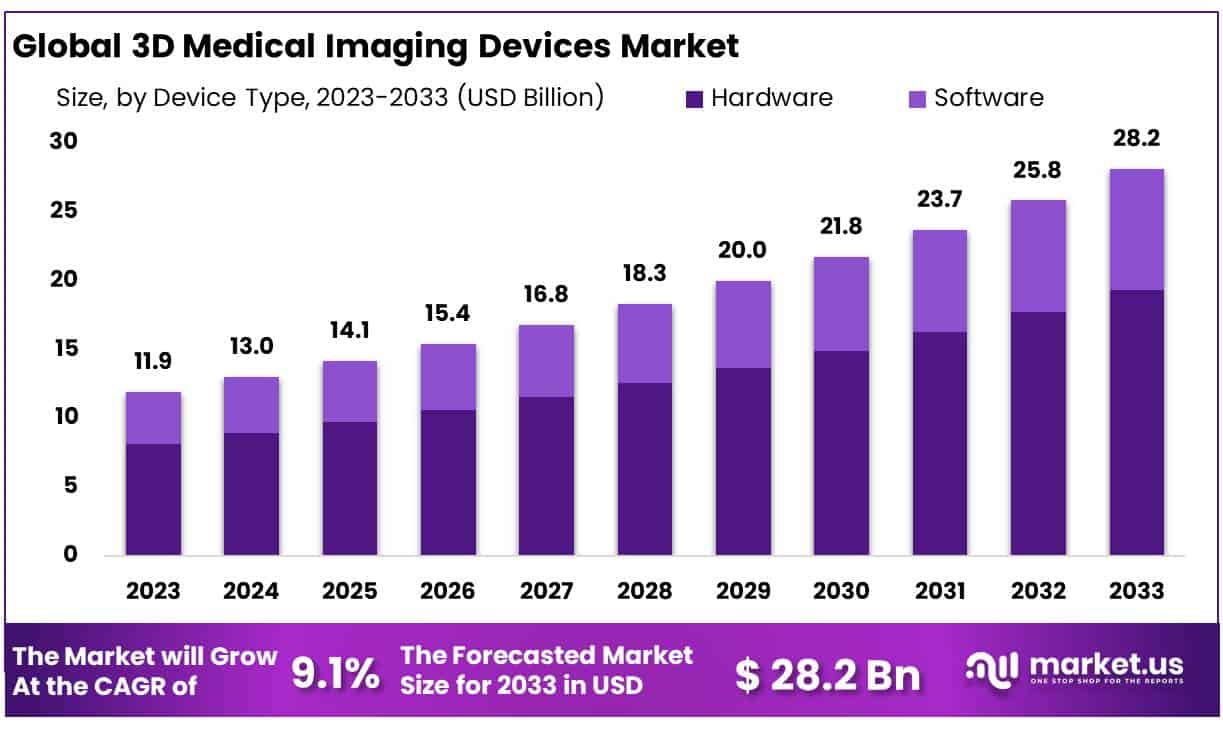
New York, NY – Jan 28, 2026 – The Global 3D Medical Imaging Devices Market size is expected to be worth around USD 28.2 Billion by 2033 from USD 11.9 Billion in 2023, growing at a CAGR of 9.1% during the forecast period from 2024 to 2033.
The global market for 3D medical imaging devices is being steadily formed by the rising demand for accurate diagnostic solutions, technological advancements in imaging systems, and the growing burden of chronic diseases. Three-dimensional imaging devices provide enhanced visualization of anatomical structures, enabling improved diagnosis, treatment planning, and monitoring across multiple medical specialties.
3D medical imaging devices integrate advanced modalities such as computed tomography (CT), magnetic resonance imaging (MRI), ultrasound, and positron emission tomography (PET). These systems generate detailed volumetric images that support higher diagnostic precision compared to conventional two-dimensional imaging. The adoption of these devices is being supported by continuous innovation in detector technology, image processing software, and artificial intelligence-based reconstruction techniques.
The market formation is primarily driven by increasing applications in oncology, cardiology, neurology, and orthopedics, where detailed imaging is critical for clinical decision-making. Hospitals, diagnostic centers, and specialty clinics represent the major end users, supported by rising healthcare infrastructure investments in both developed and emerging economies. In addition, the growing preference for minimally invasive procedures has reinforced the need for high-resolution 3D imaging during pre-operative and intra-operative stages.
Regulatory approvals, reimbursement policies, and compliance with medical imaging standards play a significant role in shaping market entry and product development strategies. Manufacturers are focusing on improving image quality, reducing radiation exposure, and enhancing system interoperability.
Key Takeaways
- Market Size: The 3D Medical Imaging Devices Market is projected to reach approximately USD 28.2 billion by 2033, rising from USD 11.9 billion in 2023.
- Market Growth: Market expansion is anticipated at a compound annual growth rate (CAGR) of 9.1% over the forecast period spanning 2024 to 2033.
- Device Type Analysis: The hardware segment accounted for the largest share of the market in 2023, representing 68.6% of total revenue.
- Application Analysis: Oncology remains the leading application area, contributing nearly 34% of the overall 3D Medical Imaging Devices Market share.
- End-Use Analysis: Hospitals dominate the end-user landscape, capturing approximately 49% of the total market share due to high patient inflow and advanced imaging infrastructure.
- Regional Analysis: North America holds a dominant position with a 36.9% market share, supported by well-established healthcare systems, including hospitals and long-term care facilities.
- Technological Advancements: Advancements such as 3D mammography, 3D ultrasound, and 3D MRI are improving diagnostic precision and operational efficiency, thereby supporting enhanced patient outcomes.
- Future Outlook: The market is expected to maintain steady growth momentum, supported by rising healthcare demand, continuous technological innovation, and the widening adoption of 3D imaging across medical diagnostic applications.
Regional Analysis
Geographically, the market is segmented into five key regions: North America, Europe, Asia Pacific, South America, and the Middle East & Africa (MEA). Among these, North America holds the leading position with a market share of 36.9%, supported by advanced healthcare systems, including hospitals and long-term care facilities.
The region is expected to witness sustained growth, driven by its well-established healthcare infrastructure, which remains more developed than that of emerging regions. In addition, favorable reimbursement frameworks further support the adoption of advanced 3D medical imaging technologies.
The Asia Pacific region is projected to record notable growth by 2033, primarily due to ongoing improvements in healthcare infrastructure and the rising prevalence of medical tourism. Expanding access to diagnostic services and increasing investments in healthcare facilities are contributing to market expansion in the region.
However, market growth is constrained by the high cost associated with 3D medical imaging devices and a relatively low adoption rate across certain developing economies. Despite these challenges, continued infrastructure development is expected to create long-term growth opportunities.
Emerging Trends
- Artificial Intelligence (AI) Integration: The integration of artificial intelligence into 3D medical imaging systems is enhancing diagnostic precision and operational efficiency. AI-based algorithms support the interpretation of complex imaging data, streamline radiological workflows, and reduce diagnostic variability. As a result, improved clinical decision-making and better patient outcomes are being achieved.
- Portable Imaging Solutions: The development of portable 3D imaging systems is enabling point-of-care diagnostics, particularly in remote and underserved healthcare settings. These compact and mobile solutions support timely clinical assessments while minimizing dependence on centralized imaging infrastructure.
- Cloud-Based Data Management: The increasing adoption of cloud-based platforms is transforming the storage, analysis, and exchange of large medical imaging datasets. Cloud computing facilitates seamless data sharing across healthcare institutions, supports collaborative care models, and enhances access to imaging records for clinicians and patients.
- Expansion of 3D Printing Applications: Advancements in 3D printing technologies are supporting the production of patient-specific anatomical models, customized surgical guides, and prosthetic devices. These applications are improving preoperative planning accuracy and enabling more personalized and effective treatment approaches.
- Enhanced Image Quality Through Photon-Counting CT: The introduction of photon-counting computed tomography (CT) scanners is delivering ultra-high-resolution imaging with reduced radiation exposure. This technology is particularly valuable in cardiology and oncology, where improved image clarity supports earlier detection and more precise disease assessment.
Key Use Cases
- Oncological Imaging: 3D medical imaging plays a critical role in oncology by enabling accurate tumor localization, characterization, and staging. For example, the adoption of 3D mammography has increased breast cancer detection rates by approximately 27% compared to conventional 2D imaging techniques.
- Cardiovascular Diagnostics: Advanced 3D imaging modalities provide comprehensive visualization of cardiac anatomy, supporting the diagnosis of coronary artery disease and structural abnormalities. The use of 3D echocardiography has enhanced the detection of heart valve disorders by nearly 25%.
- Orthopedic Surgical Planning: In orthopedic care, 3D imaging is widely used to assess bone anatomy and plan surgical interventions. This approach has contributed to reductions in surgical duration of up to 20% and has lowered the risk of postoperative complications.
- Neurosurgical Navigation: 3D imaging technologies assist neurosurgeons in detailed mapping of brain structures, enabling precise tumor resection while preserving critical neurological functions. The application of 3D-guided surgical systems has improved tumor resection accuracy by approximately 15%.
- Dental Implant Procedures: In dental implantology, 3D imaging enables precise evaluation of jawbone anatomy, supporting accurate implant placement. This enhanced precision has resulted in implant success rates of up to 98%.
- Prenatal Imaging: The use of 3D ultrasound in prenatal care provides detailed fetal visualization, supporting early and accurate diagnosis of developmental anomalies. Compared to traditional 2D ultrasound, 3D imaging has improved fetal anomaly detection rates by approximately 15%.
Frequently Asked Questions on 3D Medical Imaging Devices
- What are 3D medical imaging devices?
3D medical imaging devices are advanced diagnostic systems that generate three-dimensional visual representations of internal body structures, enabling improved accuracy in diagnosis, treatment planning, and disease monitoring across multiple clinical specialties. - What factors are driving the growth of the 3D medical imaging devices market?
Market growth is driven by increasing demand for precise diagnostic tools, rising prevalence of chronic diseases, technological advancements in imaging modalities, and expanding applications in oncology, cardiology, neurology, and minimally invasive surgical procedures. - Which device type dominates the 3D medical imaging devices market?
The hardware segment dominates the market due to its essential role in imaging systems, including scanners and detectors, and sustained investments by healthcare facilities in upgrading diagnostic infrastructure for improved imaging accuracy and workflow efficiency. - Why does oncology hold a major share in market applications?
Oncology leads market applications because 3D imaging enables detailed tumor visualization, accurate staging, and effective treatment planning, supporting early cancer detection and monitoring, which are critical for improving clinical outcomes and survival rates. - Which end users contribute most to market demand?
Hospitals represent the primary end-user segment, supported by high patient volumes, availability of advanced imaging infrastructure, and increased adoption of 3D imaging technologies for diagnostics, surgical planning, and post-treatment assessment.
Conclusion
The global 3D medical imaging devices market is being shaped by the growing need for precise diagnostics, continuous technological innovation, and the increasing burden of chronic diseases. Advanced 3D imaging modalities are improving clinical accuracy across oncology, cardiology, neurology, and orthopedic applications, while supporting minimally invasive procedures and personalized care.
Strong demand from hospitals, supportive reimbursement frameworks in developed regions, and expanding healthcare infrastructure in emerging economies are reinforcing market growth. Despite cost-related barriers, ongoing advancements in artificial intelligence, image quality, and system efficiency are expected to sustain steady market expansion through 2033.
Discuss your needs with our analyst
Please share your requirements with more details so our analyst can check if they can solve your problem(s)




