


Table of Contents
Overview
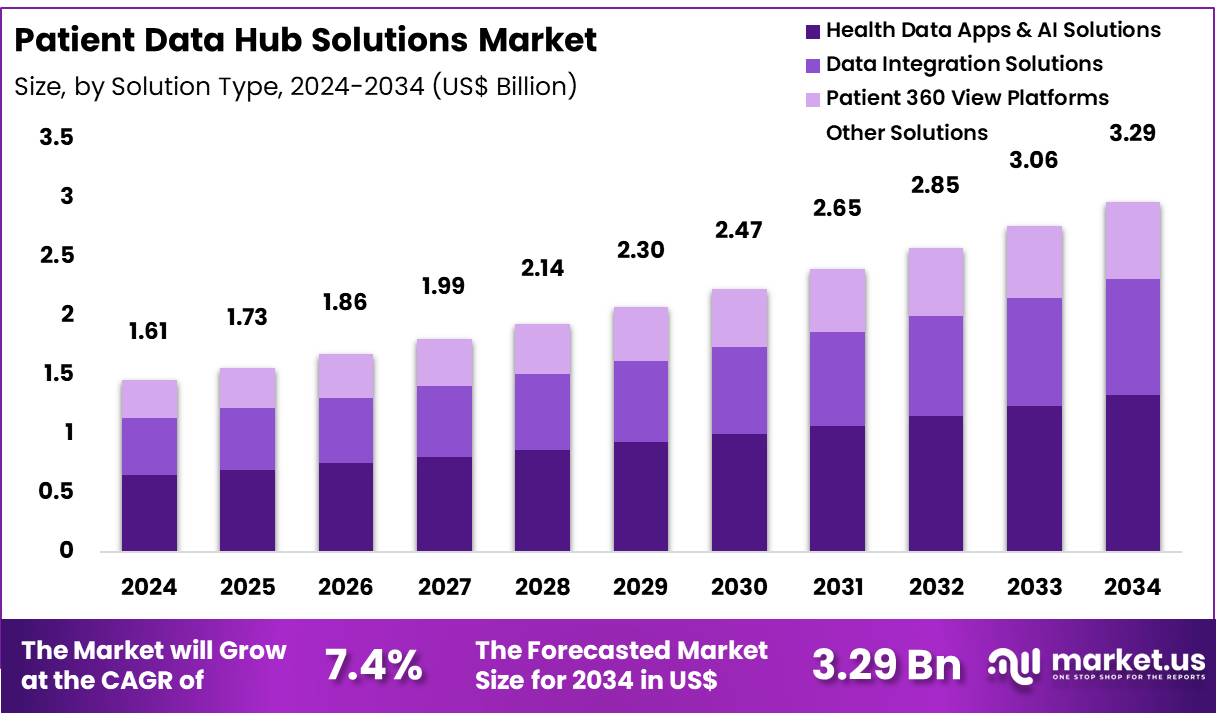
New York, NY – Dec 22, 2025 – Global Patient Data Hub Solutions Market size is expected to be worth around US$ 3.29 Billion by 2034 from US$ 1.61 Billion in 2024, growing at a CAGR of 7.4% during the forecast period 2025 to 2034. In 2024, North America led the market, achieving over 41.5% share with a revenue of US$ 668.2 Million.
Patient Data Hub Solutions has been formally established with the objective of supporting healthcare organizations in managing, integrating, and utilizing patient data more effectively. The formation of the company reflects the growing need for structured, secure, and interoperable data platforms across the healthcare ecosystem.
The increasing volume of clinical, administrative, and patient-generated data has created complexity for providers, payers, and life sciences organizations. Patient Data Hub Solutions has been formed to address this challenge by offering centralized data management frameworks that enable consistent data access, improved data quality, and enhanced interoperability across disparate systems.
The company’s core focus is on enabling seamless aggregation of patient data from multiple sources, including electronic health records, diagnostic systems, and digital health platforms. By supporting standardized data models and compliance-driven architectures, Patient Data Hub Solutions aims to facilitate informed clinical decision-making, operational efficiency, and regulatory alignment.
Data security and patient privacy have been positioned as foundational principles in the company’s approach. Solutions are designed to align with prevailing data protection standards and healthcare regulations, ensuring that sensitive patient information is handled with the highest level of integrity and confidentiality.
With its formation, Patient Data Hub Solutions seeks to contribute to the broader digital health transformation by supporting data-driven care delivery, population health management, and value-based care initiatives. The company is positioned to collaborate with healthcare stakeholders as the demand for integrated, reliable, and scalable patient data infrastructure continues to expand.
Key Takeaways
- In 2024, the Patient Data Hub Solutions market generated revenue of US$ 61 billion and is projected to grow at a CAGR of 7.4%, reaching US$ 3.29 billion by 2034.
- By Solution Type, the market is segmented into Health Data Apps & AI Solutions, Data Integration Solutions, Patient 360 View Platforms, and Other Solutions. Among these, Health Data Apps & AI Solutions led the market in 2024, accounting for a 40.3% share.
- Based on Deployment Mode, the market is categorized into Cloud-based and On-premise solutions. Cloud-based solutions dominated the market in 2024, holding a 72.1% market share.
- By End-Use, the market includes Healthcare Companies, Healthcare Providers, Healthcare Payers, and Others, with Healthcare Providers maintaining a leading position at 44.5% market share in 2024.
- North America emerged as the leading regional market in 2024, capturing 41.5% of the global market share.
Regional Analysis
North America represents the leading region in the Patient Data Hub Solutions Market, accounting for more than 41.5% of the global market share. This leadership is primarily supported by the United States, which holds the dominant share due to its well-established healthcare infrastructure and sustained investments in health information technology.
Market growth in the region is further supported by rapid technological advancements. The integration of artificial intelligence and machine learning into patient data hub platforms is improving data processing capabilities, enabling predictive analytics, and supporting the development of personalized treatment pathways. These innovations are strengthening clinical decision-making and operational efficiency across healthcare systems.
Regulatory initiatives also play a critical role in market expansion. Policies such as the 21st Century Cures Act encourage data interoperability and secure information exchange, accelerating the adoption of centralized data hub solutions. In parallel, the strong growth of the healthcare analytics sector in North America is increasing demand for integrated data platforms that can deliver actionable insights.
The strong presence of leading market participants focused on continuous product innovation further contributes to regional dominance. For instance, in September 2022, Equifax launched the TotalVerify™ data hub, a centralized platform designed to deliver comprehensive data insights for social service agencies, lenders, employers, and background screening organizations.
The solution supports trust building, risk assessment, and information verification. TotalVerify™ was developed over several years and was further strengthened by Equifax’s acquisition of Appriss Insights in 2021. The platform operates as a secure, multi-dimensional data and analytics hub, underpinned by extensive employment and income databases and supported by cloud-based infrastructure.
Overall, the combination of advanced technology adoption, supportive regulatory frameworks, expanding analytics demand, and active innovation by key players continues to reinforce North America’s leading position in the Patient Data Hub Solutions Market.
Emerging Trend
- National-scale data exchange is being designed into hubs.
- Patient data hubs are increasingly being built to connect across networks , not only inside one hospital system. This is being driven by TEFCA go-live and the growth of QHIN-based exchange.
- TEFCA went live in December 2023 with five QHINs ready for exchange, which is pushing hubs to support “network-to-network” routing and trust controls.
- In the US, over 60% of hospitals in 2023 were aware of and planned to participate in TEFCA (up from 51% in 2022 ). This indicates rising demand for hub platforms that can aggregate and normalize data from multiple exchange paths.
- API-first “hub” architecture is accelerating, with FHIR R4 as the practical baseline
- Patient data hubs are increasingly being implemented as API platforms (not only ETL warehouses), so that patient apps, care teams, and partners can pull the same patient record through standard interfaces.
- HL7 shows that FHIR R4 (v4.0.1) is a stable, long-lived published version and that newer versions exist, but R4 remains a major anchor for implementations.
- US federal interoperability references also describe FHIR Release 4 as the first release with “normative” content , supporting more consistent implementations—this pushes hubs toward “one standard layer” for multi-source patient data.
- Payer-to-payer exchange is forcing hubs to handle “switching health plans” data fast (5-year lookback + tight response windows)
- Hubs are being expanded beyond provider EHR data to include claims and encounter history , because payer rules are making data exchange operational (not optional).
- CMS states that impacted payers are only required to share patient data with a date of service within 5 years of the request for payer-to-payer exchange.
- CMS materials also state that the previous payer must provide the data within 1 day of receiving the request (and the data must be incorporated into the new payer’s patient record). This pushes hub designs toward near-real-time ingestion, deduplication, and identity matching.
- Patient access expectations are becoming “SLA-driven” (30 days, with limited extensions), so hubs must support faster fulfillment
- Patient data hubs are increasingly being used as the operational system for fulfilling patient record requests (digital delivery, audit logs, identity verification, and tracking), because the compliance clock is clear.
- HHS guidance states access must be provided no later than 30 calendar days from the request, and a denial (or an extension for denial timelines) can extend to 60 calendar days when an extension is properly used.
- This is causing hub roadmaps to prioritize measurable turnaround (for example, “days-to-fulfill”), standardized exports, and plain-language workflows for patients.
- Security-by-design is becoming a buying requirement (ransomware pressure + stronger controls around sensitive data)
- Patient data hubs are being required to embed stronger security controls because they concentrate high-value data (clinical + claims + identity signals) in one place.
- Reported legal and compliance analysis notes a 264% increase in ransomware attacks in 2024 , with intensified attention on security programs and risk analyses this directly increases demand for hubs with encryption, access controls, monitoring, and strong audit trails.
- In practical terms, hub vendor selection is increasingly being influenced by measurable security capabilities (for example, encryption coverage, logging depth, and incident response readiness), because the hub is treated as a “system of record for exchange,” not just a reporting layer.
Frequently Asked Questions on Patient Data Hub Solutions
- What are Patient Data Hub Solutions?
Patient Data Hub Solutions centralize, normalize, and govern clinical, administrative, and patient-generated data across systems. They enable interoperability, real-time access, analytics readiness, and compliance, supporting coordinated care, population health management, and operational efficiency. - What are the core components of Patient Data Hub Solutions?
Key components typically include data ingestion, master patient indexing, terminology management, consent management, data quality services, and analytics layers. These components ensure accurate identity resolution, standardized vocabularies, privacy controls, and scalable insights delivery. - What benefits do healthcare organizations gain from these solutions?
Implementation benefits include reduced data silos, improved clinical decision-making, faster care coordination, and enhanced patient experiences. Centralized hubs also lower integration costs, improve reporting timeliness, and support value-based care initiatives through reliable longitudinal records. - How are data security and regulatory compliance addressed?
Security and compliance are addressed through role-based access, encryption, audit trails, and consent enforcement. Patient Data Hub Solutions are designed to align with healthcare regulations, ensuring confidentiality, integrity, and availability of sensitive health information. - Who are the primary users of Patient Data Hub Solutions?
Healthcare providers, payers, life sciences firms, and digital health companies commonly adopt these solutions. Adoption is driven by interoperability mandates, analytics needs, and the requirement to manage growing volumes of structured and unstructured patient data. - Which deployment models dominate the market?
Cloud-based deployments dominate the market, offering scalability, faster implementation, and lower upfront costs. Hybrid models are also gaining traction as organizations balance data residency concerns with the flexibility and analytics capabilities of cloud platforms. - Which regions lead the Patient Data Hub Solutions Market?
North America holds a significant market share, driven by advanced health IT adoption and regulatory initiatives. Europe follows with strong interoperability programs, while Asia-Pacific shows the fastest growth due to digital health investments and expanding patient populations. - What are the key drivers supporting market growth?
Key growth drivers include electronic health record integration, population health management needs, and regulatory compliance. Market expansion is further supported by artificial intelligence adoption, real-time analytics demand, and healthcare organizations pursuing data-driven clinical and operational strategies.
Conclusion
The establishment of Patient Data Hub Solutions reflects the accelerating demand for secure, interoperable, and scalable patient data infrastructure across the healthcare ecosystem. Market growth is being driven by rising data volumes, regulatory mandates, and the shift toward value-based and data-driven care models.
Cloud-based, API-first architectures, national-scale data exchange initiatives, and stronger security requirements are shaping solution design and adoption. North America continues to lead due to advanced health IT maturity and supportive policies. Overall, Patient Data Hub Solutions are positioned as critical enablers of clinical efficiency, regulatory compliance, and long-term digital health transformation.
Discuss your needs with our analyst
Please share your requirements with more details so our analyst can check if they can solve your problem(s)




