


Table of Contents
Overview
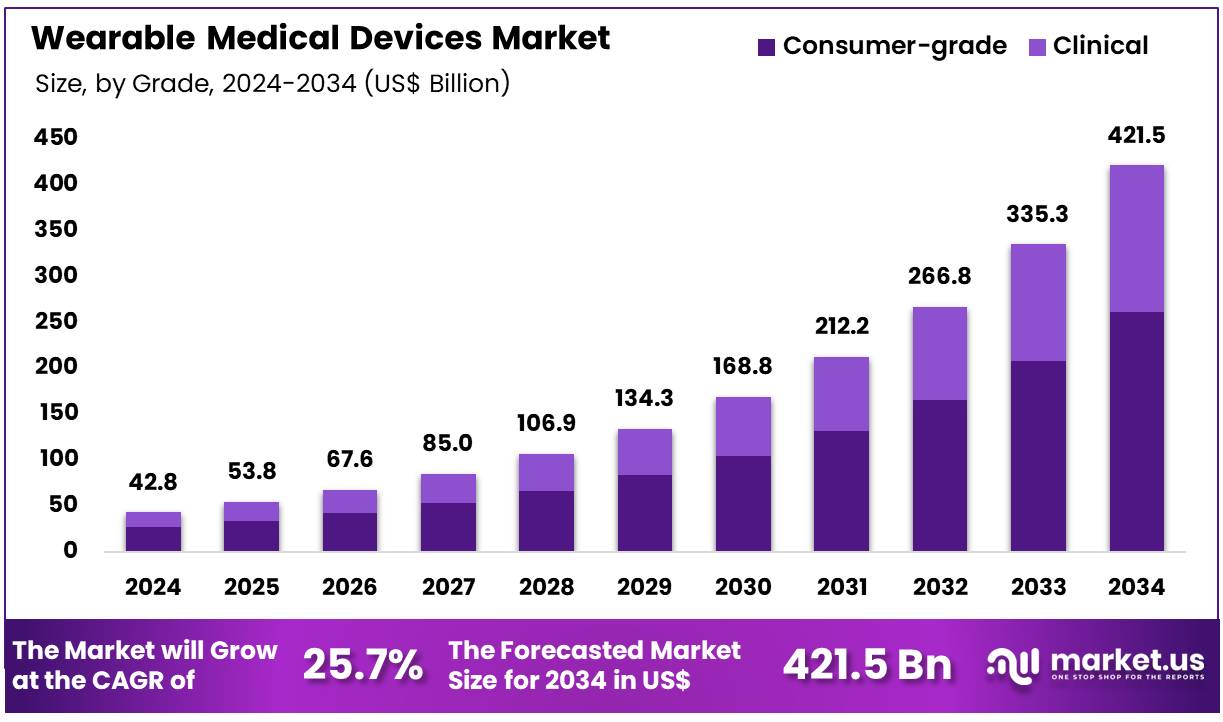
New York, NY – Dec 16, 2025 – Global Wearable Medical Devices Market size is expected to be worth around US$ 421.5 Billion by 2034 from US$ 42.8 Billion in 2024, growing at a CAGR of 25.7% during the forecast period 2025 to 2034. In 2024, North America led the market, achieving over 46.5% share with a revenue of US$ 19.9 Billion.
The global wearable medical devices market is experiencing consistent growth, supported by rising demand for continuous health monitoring, increasing prevalence of chronic diseases, and expanding adoption of digital healthcare solutions. Wearable medical devices are designed to monitor, diagnose, and manage health conditions in real time, offering improved patient outcomes and enhanced clinical efficiency.
These devices include smartwatches, fitness trackers, biosensors, wearable ECG monitors, insulin pumps, and remote patient monitoring systems. Their integration with mobile applications and cloud-based platforms has enabled seamless data collection, analysis, and transmission, supporting informed clinical decision-making. The growth of telemedicine and home-based healthcare services has further strengthened market demand.
Technological advancements such as artificial intelligence, miniaturized sensors, and wireless connectivity are enhancing device accuracy and usability. In addition, rising awareness of preventive healthcare and increasing healthcare expenditure are contributing to broader market penetration. Regulatory support for digital health technologies in developed and emerging economies has also played a key role in market expansion.
North America continues to lead the wearable medical devices market due to strong healthcare infrastructure, high adoption of connected health technologies, and presence of major industry players. Meanwhile, Asia-Pacific is expected to register significant growth, driven by expanding healthcare access, large patient populations, and rapid digital transformation.
Overall, the wearable medical devices market is positioned for sustained growth, as healthcare systems increasingly focus on personalized care, early diagnosis, and remote patient management solutions.
Key Takeaways
- In 2024, the wearable medical devices market recorded revenue of US$ 42.8 billion and is projected to expand at a CAGR of 25.7%, reaching approximately US$ 421.5 billion by 2034.
- By product type, the market is categorized into diagnostic devices and therapeutic devices, with diagnostic devices leading the segment and accounting for 57.6% of total market share in 2024.
- Based on grade, the market is segmented into consumer-grade and clinical devices. The consumer-grade segment dominated the market, capturing a substantial 62.1% share.
- In terms of application, the market is divided into sports and fitness, remote patient monitoring, and home healthcare. Among these, home healthcare emerged as the largest contributor, holding 49.9% of total revenue.
- By distribution channel, the market includes pharmacies, online channels, and hypermarkets. The pharmacies segment maintained market leadership with a 36.5% revenue share.
- North America remained the leading regional market in 2024, accounting for 46.5% of the global market share.
Regional Analysis
In 2024, North America accounted for 46.5% of the global wearable medical devices market, driven by the widespread adoption of continuous glucose monitoring systems and ECG-enabled smartwatches within chronic disease management frameworks for diabetes and atrial fibrillation. Healthcare providers increasingly integrated these ambulatory devices into routine care pathways, enabling real-time transmission of patient data to clinician dashboards. This shift supported timely therapeutic adjustments, including insulin titration and anticoagulation management, while reducing the frequency of in-person clinical visits.
The post-pandemic expansion of hybrid care models further accelerated demand for wearables featuring fall detection and activity monitoring, particularly among aging populations with mobility constraints. Regulatory support, including accelerated 510(k) clearance processes, facilitated innovation in low-power, high-precision sensors, enhancing device longevity and reliability.
In parallel, expanded reimbursement coverage by private insurers for FDA-approved wearables encouraged adoption within preventive cardiology and chronic care programs. Community-based pilot initiatives demonstrated measurable benefits in early hypertension detection, contributing to reduced emergency department utilization. Between 2022 and 2024, the FDA approved 17 AI- and machine-learning-enabled wearable medical devices, primarily focused on cardiovascular and anesthesiology monitoring applications.
The Asia Pacific region is projected to register the fastest CAGR during the forecast period, supported by targeted public investments in ambulatory monitoring technologies to address the rising burden of metabolic and cardiovascular disorders. Regulatory bodies in countries such as India and South Korea have prioritized subsidized ECG monitoring solutions, enabling large-scale arrhythmia screening across working populations.
Regional innovation ecosystems are advancing next-generation biosensors, rehabilitation-focused wearables, and network-enabled diagnostic tools to extend healthcare access across remote and underserved areas. Government-backed funding for AI-driven health analytics continues to reinforce the region’s long-term growth potential.
Emerging Trends in Wearable Medical Devices
- Rising Adoption Among Seniors: Health-related wearable device usage among Americans aged 65 and above has exceeded 20%, reflecting a 104% increase over the past five years. This growth is primarily driven by increasing health awareness and the need for continuous monitoring.
- Expansion of Fitness Tracker Ownership: Nearly one-third of U.S. adults now own fitness trackers or smartwatches. Adoption levels remain significantly higher in higher-income households, indicating income-based disparities in device accessibility.
- Acceleration in Remote Patient Monitoring (RPM): Remote patient monitoring solutions, including wearable devices, have recorded a 60% surge in adoption following the COVID-19 pandemic, driven by the expansion of virtual care models.
- Growing Demand for Sleep Monitoring Solutions: Consumer interest in sleep tracking has increased by approximately 50%, as sleep health gains recognition as a critical component of overall wellness.
- Growth in Chronic Disease Management Applications: Wearable devices used for chronic disease management, such as continuous glucose monitoring systems, have experienced a growth rate of nearly 40%, supported by rising diabetes prevalence and preventive care initiatives.
- Integration With Telehealth Platforms: More than 35% of telehealth service providers now utilize wearable-generated data to support personalized treatment plans and clinical decision-making.
- Advancements in Wearable ECG Technologies: Annual sales of wearable ECG monitoring devices have increased by approximately 30% since 2016, driven by heightened awareness of cardiovascular health risks.
- Increasing Focus on Mental Health Monitoring: Wearables equipped with stress, anxiety, and mood-tracking capabilities have shown a 25% year-on-year rise in adoption, reflecting broader attention to mental well-being.
- Sustained Growth in Wearable Fitness Device Usage: Since the onset of the pandemic, wearable fitness device usage has increased by 27%, with continued upward momentum observed in the post-pandemic period.
Use Cases and Consumer Adoption Patterns
- Income-Based Usage Patterns: Approximately 30% of households with annual incomes exceeding $75,000 use fitness trackers or smartwatches, compared to only 12% among households earning below $30,000.
- Gender-Based Adoption Trends: Women account for approximately 25% of users of wearable healthcare devices, highlighting gender-specific engagement patterns in digital health monitoring.
- Ethnic Usage Distribution: Around 26% of Hispanic adults regularly use wearable health technologies, including fitness trackers and smartwatches.
- Overall Population Engagement: An estimated 30–31% of adults actively use wearable healthcare devices, representing approximately 1,266 users out of a surveyed population of 4,551 individuals.
- Frequency of Device Interaction: Nearly 47.33% of wearable device users report daily engagement, indicating strong user dependency and habitual usage.
- Willingness to Share Health Data: More than 82% of users express willingness to share wearable-generated health data with healthcare professionals, supporting clinical integration.
- Market Valuation and Growth Outlook: The wearable healthcare device market was valued at several billion dollars in 2018 and is projected to reach approximately $139.35 billion by 2026, expanding at a compound annual growth rate (CAGR) of 24.7%.
- Shift Toward Preventive and Personalized Healthcare: Wearable technologies are increasingly utilized for continuous health, fitness, and wellness monitoring, supporting preventive care and early diagnosis.
- Healthcare System Integration: Wearable devices are being progressively embedded into telehealth ecosystems and remote patient monitoring frameworks.
- Technological Advancements: Ongoing innovations in sensor accuracy, battery efficiency, and advanced data analytics continue to enhance wearable device functionality and reliability.
- Market Diversification: Wearable medical devices are expanding beyond fitness tracking into elderly care, mental health monitoring, and chronic disease management, addressing a wider range of healthcare needs.
Frequently Asked Questions on Wearable Medical Devices
- How do wearable medical devices support patient care?
Wearable medical devices support patient care by enabling continuous monitoring, early detection of health abnormalities, remote patient management, and improved treatment adherence, which collectively enhance clinical decision-making and reduce the need for frequent hospital visits. - What types of wearable medical devices are commonly used?
Common wearable medical devices include fitness trackers, smartwatches with medical-grade sensors, continuous glucose monitors, wearable ECG monitors, blood pressure monitors, and wearable respiratory monitoring devices used across preventive and chronic care settings. - Are wearable medical devices clinically reliable?
The clinical reliability of wearable medical devices has improved significantly due to regulatory approvals, sensor accuracy advancements, and clinical validation studies, although performance may vary depending on device quality, intended use, and patient compliance. - What factors are driving the wearable medical devices market growth?
The growth of the wearable medical devices market is driven by rising chronic disease prevalence, increasing demand for remote patient monitoring, technological advancements in sensors, and growing adoption of digital health solutions across healthcare systems. - Which end users dominate the wearable medical devices market?
Hospitals, home healthcare settings, and individual consumers dominate the wearable medical devices market, with home-based users showing strong growth due to increased emphasis on preventive healthcare and remote monitoring solutions. - How does regulation impact the wearable medical devices market?
Regulatory frameworks significantly influence the wearable medical devices market by ensuring product safety, data accuracy, and patient privacy, while regulatory approvals also increase device credibility and adoption among healthcare professionals and institutions. - What is the future outlook of the wearable medical devices market?
The wearable medical devices market is expected to experience sustained growth, supported by integration of artificial intelligence, expansion of telehealth services, and increasing investments in personalized and data-driven healthcare technologies.
Conclusion
The global wearable medical devices market is undergoing sustained expansion, driven by the rising need for continuous health monitoring, growth in chronic disease prevalence, and accelerating adoption of digital and remote healthcare models. Advancements in sensor technology, artificial intelligence, and cloud connectivity have improved clinical reliability and expanded use across preventive, diagnostic, and therapeutic applications.
Strong adoption in North America and rapid growth across Asia-Pacific highlight widening global penetration. As healthcare systems increasingly prioritize personalized care, early diagnosis, and home-based monitoring, wearable medical devices are expected to remain a core component of modern, data-driven healthcare delivery.
Discuss your needs with our analyst
Please share your requirements with more details so our analyst can check if they can solve your problem(s)




