


Table of Contents
Overview
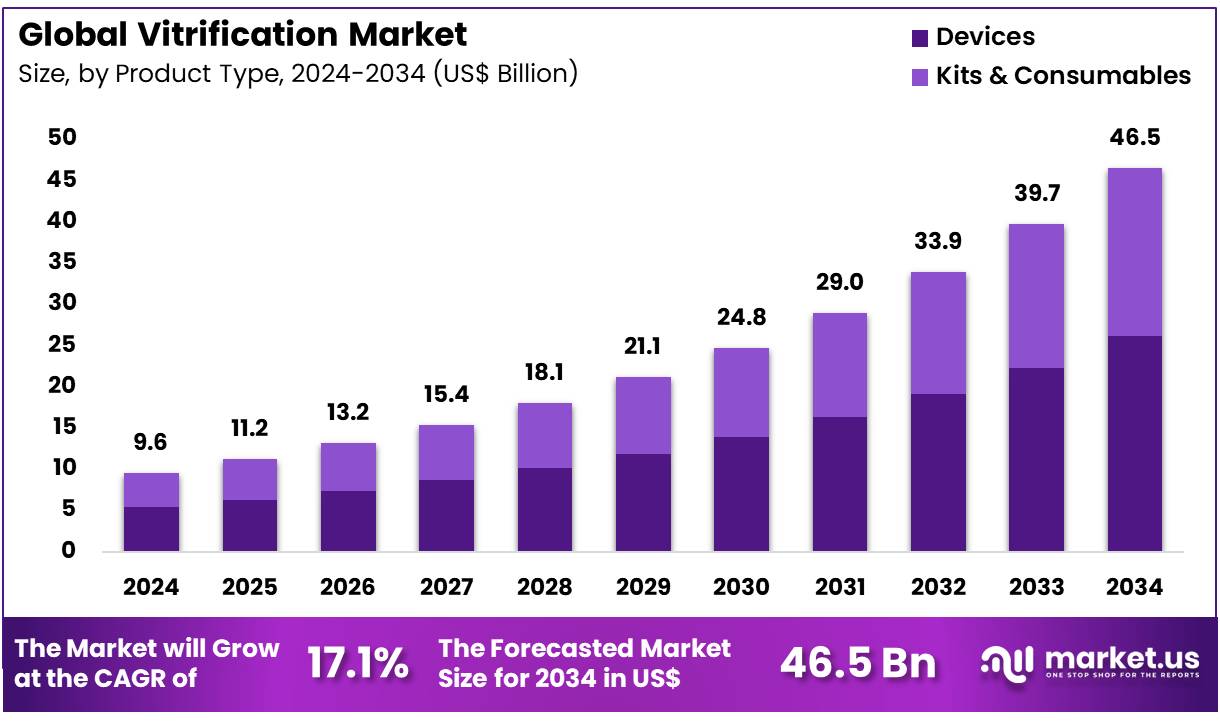
New York, NY – Dec 17, 2025 – Global Vitrification Market size is expected to be worth around US$ 46.5 Billion by 2034 from US$ 9.6 Billion in 2024, growing at a CAGR of 17.1% during the forecast period 2025 to 2034. In 2024, North America led the market, achieving over 42.6% share with a revenue of US$ 4.1 Billion.
Vitrification is a scientific process through which materials are transformed into a glass-like, non-crystalline solid by exposure to high temperatures followed by controlled cooling. This process is widely applied across industries such as construction, waste management, ceramics, metallurgy, and medical preservation due to its ability to enhance material stability and durability.
The basic formation of vitrification begins with the heating of raw materials commonly silica-based compounds to temperatures sufficient to break down their crystalline structure. As the temperature increases, the material enters a molten state in which atoms are randomly arranged. Rapid or regulated cooling then prevents the reformation of crystalline bonds, resulting in an amorphous, glass-like structure. This non-crystalline formation is characterized by high chemical resistance, mechanical strength, and long-term structural integrity.
In industrial applications, vitrification is valued for its ability to immobilize hazardous substances. During the vitrification process, toxic elements are encapsulated within the glass matrix, significantly reducing environmental risk and enhancing safety in waste disposal. In construction and ceramics, vitrified materials are preferred for their low porosity, high hardness, and resistance to wear and corrosion.
The growing focus on sustainable manufacturing and advanced material performance has increased interest in vitrification-based technologies. Continued research and development are expected to improve energy efficiency and expand the range of applications. As a result, vitrification remains a critical process supporting innovation, safety, and long-term material performance across multiple sectors.
Key Takeaways
- In 2024, the vitrification market recorded revenue of US$ 9.6 billion and is projected to expand at a CAGR of 17.1%, reaching US$ 46.5 billion by 2034.
- By product type, the market is categorized into devices and kits & consumables, with devices leading the segment, accounting for 56.2% of total market share in 2024.
- Based on specimen type, the market is segmented into oocytes, embryos, and sperm, where oocytes emerged as the leading segment, capturing a 42.3% share.
- In terms of end users, the vitrification market is divided into IVF clinics and biobanks, with IVF clinics dominating the segment, holding a 63.5% revenue share.
- Regionally, North America maintained market leadership, securing a 42.6% share of the global vitrification market in 2024.
Regional Analysis
The vitrification market in North America accounted for a substantial 42.6% share in 2024 and demonstrated strong growth momentum. This expansion was largely driven by rising demand for fertility preservation services, particularly egg and embryo cryopreservation. Societal shifts such as delayed parenthood, increased female workforce participation, and higher awareness of reproductive health options have significantly contributed to market growth.
Data from the Society for Assisted Reproductive Technology (SART) indicated that IVF cycles in the United States increased from 389,993 in 2022 to 432,641 in 2023, highlighting the growing dependence on assisted reproductive technologies that rely heavily on vitrification.
Elective fertility preservation also gained traction, with egg-freezing cycles rising from 24,560 in 2021 to 29,803 in 2022. Continuous improvements in vitrification protocols, resulting in higher post-thaw survival rates and better clinical outcomes, have further strengthened confidence among patients and clinicians. Market leaders have benefited from this trend, as evidenced by CooperCompanies, whose CooperSurgical fertility segment reported a 15% revenue growth in constant currency during Q4 FY2024 in North America.
Meanwhile, Asia Pacific is projected to register the highest CAGR during the forecast period. Growth in the region is supported by increasing infertility prevalence, broader adoption of assisted reproductive technologies, and expanding healthcare investments. Government-backed fertility reimbursement programs in countries such as Australia and Japan are expected to further accelerate demand for vitrification-based solutions.
Emerging Trends
- Automation in Vitrification Devices: Automation in vitrification devices is increasing across fertility laboratories. Advanced systems reduce human error, improve consistency, and enhance cell survival rates. Automated workflows improve efficiency, support higher sample volumes, and allow technicians to focus on monitoring, quality assurance, and patient safety.
- Improved Cryoprotectants: Improved cryoprotectants are enhancing cell protection during freezing and thawing. These formulations reduce cellular damage, increase survival rates, and improve treatment outcomes. Advances allow longer storage periods and cell-specific optimization, strengthening confidence in fertility preservation and assisted reproductive procedures.
- Growing Fertility Preservation Awareness: Global awareness of fertility preservation is rising due to delayed parenthood and cancer treatments. Educational initiatives and social acceptance are driving demand for egg, sperm, and embryo freezing. This shift is expanding clinic services and accelerating adoption of vitrification technologies worldwide.
- Integration with Assisted Reproductive Technologies (ART): Vitrification is increasingly integrated with ART procedures such as IVF. This enables flexible treatment planning, improved implantation outcomes, and personalized care. High-quality cell preservation supports optimized timing and enhances overall success rates, making reproductive treatments more adaptable and patient-centric.
- Miniaturized and Portable Devices: Miniaturized vitrification devices are improving accessibility for smaller clinics. Compact and portable systems require less infrastructure while maintaining precision and safety. These innovations reduce training complexity, encourage broader adoption, and support scalability of advanced fertility preservation technologies across diverse healthcare settings.
- Research-Driven Customization: Research-driven customization is expanding vitrification beyond reproductive cells to stem cells and tissues. Tailored protocols improve survival and functionality for specialized applications. This trend supports regenerative medicine, clinical research, and therapeutic development, increasing the technology’s versatility and market scope.
Use Cases
- Egg Freezing for Fertility Preservation: Egg freezing using vitrification enables women to preserve fertility while delaying pregnancy. The method maintains egg quality during long-term storage, offering reproductive flexibility. Growing awareness and career-related choices are driving adoption, making egg freezing a mainstream fertility planning option.
- Embryo Freezing in IVF Treatment: Embryo vitrification is widely used in IVF to improve treatment flexibility and success rates. High-quality embryos can be stored for future cycles, reducing repeated hormone treatments. This approach lowers patient costs and stress while increasing long-term pregnancy opportunities.
- Sperm Storage: Sperm vitrification supports long-term fertility preservation for medical and personal reasons. It is commonly used before cancer treatments or delayed fatherhood. The process maintains sperm quality, is minimally invasive, and ensures future reproductive options remain available.
- Cancer Patients Preserving Reproductive Cells: Vitrification allows cancer patients to preserve eggs, sperm, or embryos before fertility-damaging treatments. This approach safeguards future family-building options while patients focus on recovery. Fertility preservation is increasingly integrated into oncology care planning worldwide.
- Stem Cell and Tissue Research: Vitrification is widely used to preserve stem cells and tissues for biomedical research. It ensures high cell viability and functionality after thawing. The technique supports drug development, regenerative medicine, and long-term sample storage, accelerating scientific innovation.
- Animal Breeding and Conservation: Vitrification supports animal breeding and conservation by preserving embryos with high survival rates. It helps maintain genetic diversity, particularly in endangered species. The method enables strategic breeding programs and protects valuable genetic material for future agricultural and conservation efforts.
Frequently Asked Questions on Vitrification
- How does vitrification work?
The vitrification process works by heating materials to extremely high temperatures until they melt and then cooling them rapidly, preventing crystal formation and producing a stable glass matrix that traps contaminants securely. - Where is vitrification commonly used?
Vitrification is widely used in waste management, nuclear waste treatment, soil remediation, and cryopreservation applications, as it provides long-term stability, reduces environmental risks, and prevents the release of harmful substances. - What are the advantages of vitrification?
Key advantages of vitrification include high chemical durability, resistance to leaching, volume reduction of waste, and long-term containment of hazardous materials, making it a preferred solution for complex and toxic waste streams. - What are the limitations of vitrification?
The vitrification process is capital-intensive and energy-intensive, requiring advanced infrastructure and high operational costs, which can limit adoption, particularly in developing regions or for low-value waste treatment applications. - What factors are driving the vitrification market growth?
Market growth is driven by stringent environmental regulations, increasing nuclear waste volumes, rising focus on sustainable waste management, and growing investments in long-term hazardous waste treatment technologies by governments and utilities. - Which industries are the major end users of vitrification technologies?
Major end users include nuclear power plants, government waste management agencies, environmental remediation firms, and research institutions, where vitrification is applied for safe disposal and stabilization of hazardous and radioactive materials. - What regions dominate the vitrification market?
North America and Europe dominate the vitrification market due to established nuclear infrastructure, strong regulatory frameworks, and continuous government funding, while Asia-Pacific is emerging with increasing nuclear energy and waste treatment projects. - What is the future outlook of the vitrification market?
The vitrification market is expected to witness steady growth, supported by long-term nuclear decommissioning projects, advancements in vitrification technologies, and sustained emphasis on environmental safety and regulatory compliance worldwide.
Conclusion
Vitrification has emerged as a critical technology across both industrial material processing and biomedical cryopreservation, driven by its ability to deliver long-term stability, safety, and performance. Strong market growth is supported by rising adoption in assisted reproductive technologies, increasing fertility preservation awareness, and continuous technological advancements such as automation and improved cryoprotectants.
North America currently leads due to advanced healthcare infrastructure, while Asia Pacific shows the fastest growth potential. Despite high capital and energy requirements, ongoing research, supportive regulations, and expanding applications are expected to sustain market momentum and reinforce vitrification’s role in future scientific and healthcare innovations.
Discuss your needs with our analyst
Please share your requirements with more details so our analyst can check if they can solve your problem(s)




