


Table of Contents
Overview
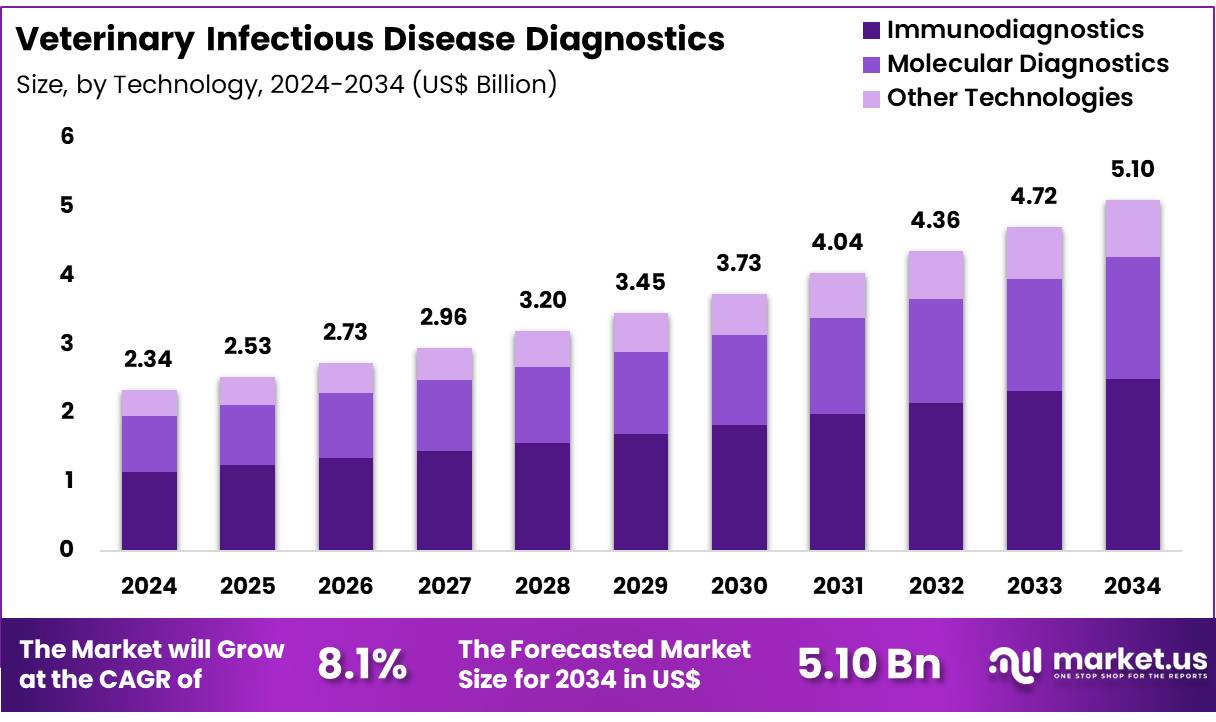
New York, NY – Dec 17, 2025 – Global Veterinary Infectious Disease Diagnostics Market size is expected to be worth around US$ 5.10 Billion by 2034 from US$ 2.34 Billion in 2024, growing at a CAGR of 8.1% during the forecast period 2025 to 2034. In 2024, North America led the market, achieving over 39.6% share with a revenue of US$ 926.6 Billion.
The global veterinary infectious disease diagnostics market is experiencing steady expansion, supported by increasing awareness of animal health, rising prevalence of infectious diseases among companion and livestock animals, and growing demand for early and accurate disease detection.
Veterinary infectious disease diagnostics refers to a range of laboratory tests and technologies used to identify bacterial, viral, parasitic, and fungal infections in animals. These diagnostics play a critical role in disease surveillance, treatment planning, and prevention of zoonotic disease transmission. Common diagnostic methods include immunodiagnostics, molecular diagnostics, clinical chemistry, and hematology testing.
Market growth is primarily attributed to the increasing adoption of pets worldwide, expansion of livestock production, and rising investments in veterinary healthcare infrastructure. Additionally, the growing focus on food safety and animal-derived product quality has strengthened the demand for routine disease screening in farm animals. Technological advancements, such as polymerase chain reaction (PCR)-based testing and rapid point-of-care diagnostics, have further enhanced testing accuracy and turnaround time.
North America currently holds a significant share of the market, driven by well-established veterinary healthcare systems and high pet ownership rates. Meanwhile, emerging economies in Asia-Pacific are expected to witness accelerated growth due to improving veterinary services and increasing awareness of animal disease management.
Overall, the veterinary infectious disease diagnostics market is expected to continue its positive trajectory, supported by innovation, regulatory initiatives, and the growing importance of preventive animal healthcare.
Key Takeaways
- In 2024, the Veterinary Infectious Disease Diagnostics market generated revenue of US$ 2.34 billion and is projected to expand at a CAGR of 8.1%, reaching US$ 5.10 billion by 2034.
- Based on technology, the market is segmented into Immunodiagnostics (including Lateral Flow Assays, ELISA tests, and others), Molecular Diagnostics, and Other Technologies. Immunodiagnostics dominated the market in 2024, accounting for 49.1% of the total market share.
- By animal type, the market is categorized into Companion Animals and Livestock. The Companion Animals segment held a leading position, capturing 57.5% of the market share in 2024.
- In terms of infection type, the market is divided into Bacterial, Viral, Parasitic, and Other infections. Bacterial infections emerged as the largest segment, contributing 39.8% of the overall market revenue.
- On the basis of end users, the market is classified into Reference Laboratories, Veterinary Hospitals & Clinics, and Point-of-Care/In-House Testing. Reference Laboratories led this segment in 2024 with a market share of 46.8%.
- Regionally, North America dominated the Veterinary Infectious Disease Diagnostics market, securing a 39.6% share in 2024.
Regional Analysis
The North America veterinary infectious disease diagnostics market is positioned for strong growth, accounting for a 39.6% share of the global market. This leadership is primarily supported by high pet ownership levels, with more than 67% of U.S. households owning at least one pet, which has significantly increased the demand for veterinary care and advanced diagnostic services.
The region benefits from a well-established and technologically advanced veterinary healthcare infrastructure. The widespread presence of modern veterinary clinics and specialized diagnostic laboratories has enabled the rapid adoption of innovative diagnostic technologies, improving disease detection and management. In addition, government- and industry-led initiatives focused on controlling zoonotic diseases and strengthening animal health monitoring systems continue to support market expansion.
Product innovation and strategic collaborations further contribute to regional growth. For instance, in November 2022, VolitionRx Limited, a multinational epigenetics company, announced the commercial launch of its Nu.Q Vet Cancer Screening Test in the United States, with plans for subsequent expansion into European markets. The launch is being supported through Heska Corporation, a leading global provider of advanced veterinary diagnostics, utilizing Heska’s established network of veterinary diagnostic laboratories.
Collectively, these factors are expected to sustain North America’s dominant position in the veterinary infectious disease diagnostics market over the forecast period.
Emerging Trend
- Growing Demand for Rapid and On-Site Testing: The adoption of rapid, on-site veterinary diagnostic kits is increasing, as they deliver results within minutes. These tools enable immediate treatment, reduce dependence on laboratories, lower costs, and help contain contagious diseases more efficiently across clinics and farms.
- Shift Toward Molecular Diagnostics: Molecular diagnostics, particularly PCR-based testing, are gaining strong adoption due to their high accuracy and early disease detection capability. These technologies support precise pathogen identification, enable targeted treatment decisions, and are increasingly integrated into routine veterinary diagnostic workflows as costs decline.
- Integration of AI and Digital Platforms: Artificial intelligence and cloud-based platforms are improving veterinary diagnostic efficiency by enabling faster data analysis, reduced human error, and seamless data sharing. These technologies support remote collaboration, quicker clinical decisions, and improved disease detection accuracy across both urban and rural veterinary practices.
- Increased Awareness of Zoonotic Diseases: Rising awareness of zoonotic diseases is driving demand for early animal disease detection. Governments, veterinarians, and animal owners increasingly prioritize diagnostics to prevent transmission to humans, particularly in livestock and companion animals living in close contact with human populations.
- Rising Use of Point-of-Care Devices for Field Testing: Portable point-of-care diagnostic devices are gaining traction in farms and remote areas where laboratory access is limited. These tools enable on-site testing, faster treatment decisions, reduced operational delays, and improved disease control, particularly in large-scale livestock and rural veterinary settings.
- Focus on Preventive Healthcare: Preventive veterinary healthcare is becoming increasingly important, with routine screenings used to detect infections before symptoms appear. This approach reduces treatment costs, limits disease spread, improves recovery outcomes, and supports long-term herd and companion animal health management strategies.
Use Cases
- Companion Animal Clinics: Veterinary clinics rely on rapid diagnostic tests to identify infectious diseases in pets such as dogs and cats. Early detection supports timely treatment, limits disease transmission, improves survival rates, and provides faster reassurance to pet owners through accurate diagnostic confirmation.
- Livestock Health Management: Livestock producers use diagnostic testing to identify infectious diseases early and prevent herd-wide outbreaks. Timely detection protects animal welfare, ensures food safety, reduces economic losses, and supports regulatory compliance across cattle, poultry, and swine farming operations.
- Wildlife Disease Surveillance: Veterinary diagnostics are used in wildlife surveillance to monitor diseases affecting endangered species and prevent cross-species transmission. Portable testing solutions enable early detection in remote areas, supporting biodiversity protection, ecosystem stability, and prevention of spillover into livestock or humans.
- Animal Shelters and Rescue Centers: Animal shelters use diagnostic screening to detect contagious diseases in incoming animals. Early testing enables isolation and treatment, prevents outbreaks, optimizes resource use, and accelerates adoption timelines by ensuring animals are healthy and safe for public placement.
- Equine Health Checks: Regular diagnostic testing in horses helps detect infectious diseases that can impact performance and breeding outcomes. Early identification supports treatment planning, protects competition standards, reduces disease transmission, and safeguards high-value investments within the equine industry.
- Export and Trade Compliance: Veterinary diagnostics play a critical role in meeting international animal health regulations for export and trade. Accurate testing confirms disease-free status, prevents border delays, reduces global disease spread risks, and supports market access for farmers and breeders.
Frequently Asked Questions on Veterinary Infectious Disease Diagnostics
- Which diagnostic methods are commonly used in veterinary infectious diseases?
Common diagnostic methods include immunoassays, polymerase chain reaction (PCR), ELISA tests, rapid lateral flow assays, and culture techniques, each selected based on disease type, required accuracy, testing speed, and available laboratory infrastructure. - Why is early diagnosis important in veterinary infectious diseases?
Early diagnosis allows prompt therapeutic intervention, reduces disease transmission among animal populations, minimizes mortality rates, and supports biosecurity measures, thereby protecting livestock productivity, companion animal health, and public health from zoonotic risks. - What animals are typically tested using infectious disease diagnostics?
These diagnostics are widely used for companion animals, livestock, poultry, and aquatic animals, supporting disease surveillance, herd health management, trade compliance, and prevention of economically significant infectious outbreaks across veterinary sectors. - What factors are driving growth in the veterinary infectious disease diagnostics market?
Market growth is driven by rising animal disease prevalence, increasing pet ownership, expanding livestock production, heightened awareness of zoonotic diseases, and continuous advancements in molecular diagnostics and rapid testing technologies. - Which diagnostic technologies hold the largest market share?
Immunodiagnostics and molecular diagnostics hold significant market shares due to their high sensitivity, specificity, faster turnaround times, and growing adoption in both reference laboratories and point-of-care veterinary settings. - How does companion animal care influence market demand?
The increasing focus on preventive healthcare, routine screening, and advanced diagnostic services for companion animals significantly boosts demand, as pet owners and veterinarians prioritize early disease detection and improved treatment outcomes. - What is the market outlook for veterinary infectious disease diagnostics?
The market outlook remains cautiously optimistic, supported by technological innovation, expanding veterinary infrastructure in emerging economies, and sustained investments in animal health, while regulatory compliance and cost constraints continue to influence adoption rates.
Conclusion
The global veterinary infectious disease diagnostics market is set for sustained growth, driven by rising animal disease prevalence, increased pet ownership, and expanding livestock production. Strong demand for early and accurate detection, supported by advances in immunodiagnostics, molecular testing, and point-of-care technologies, continues to shape market expansion.
North America maintains a leading position due to robust veterinary infrastructure, while Asia-Pacific shows high growth potential. Increasing focus on preventive healthcare, zoonotic disease control, and food safety further reinforces demand. Overall, continued innovation and investment are expected to support long-term market development and stability.
Discuss your needs with our analyst
Please share your requirements with more details so our analyst can check if they can solve your problem(s)




