


Table of Contents
Overview
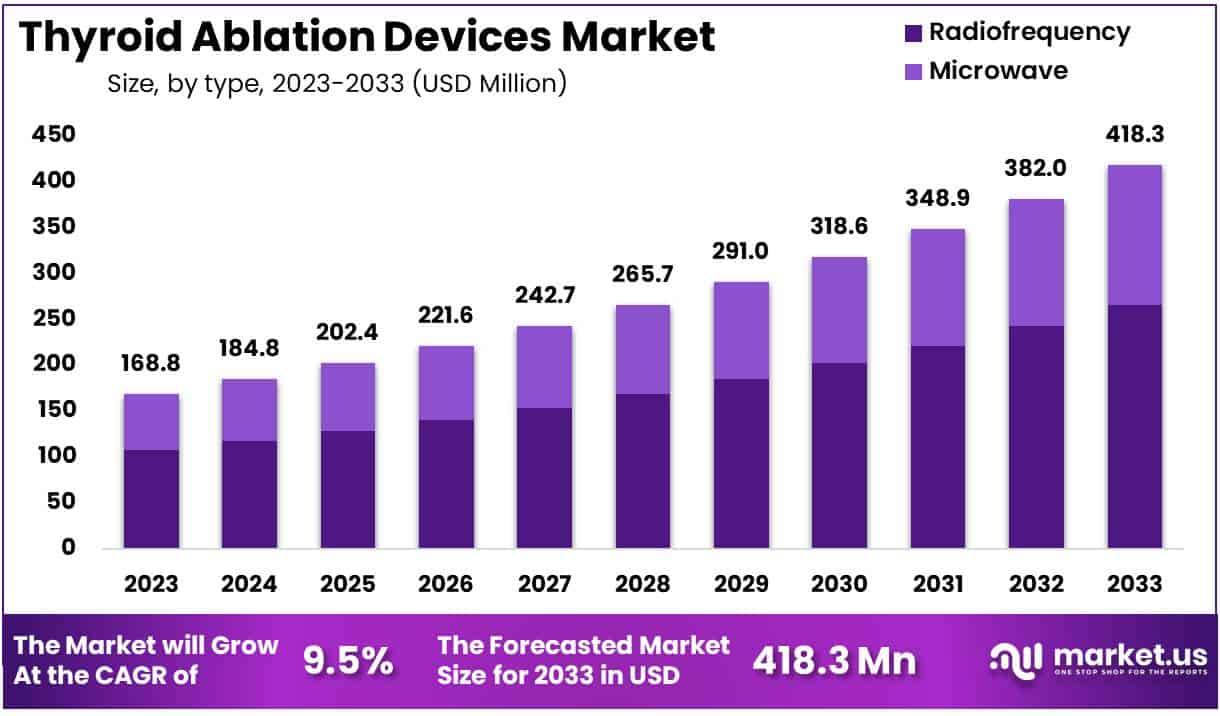
New York, NY – Jan 08, 2026 – Global Thyroid Ablation Devices Market size is expected to be worth around US$ 418.3 Million by 2033 from US$ 168.8 Million in 2023, growing at a CAGR of 9.5% during the forecast period 2024 to 2033.
The global thyroid ablation devices market is witnessing consistent growth, supported by the rising prevalence of thyroid nodules and increasing demand for minimally invasive treatment options. Thyroid ablation devices are used to destroy abnormal thyroid tissue using thermal or chemical energy, offering an effective alternative to conventional surgical procedures.
The growth of the market can be attributed to the increasing incidence of benign thyroid nodules, growing awareness of non-surgical treatment methods, and advancements in image-guided ablation technologies. Procedures such as radiofrequency ablation, microwave ablation, and laser ablation are being widely adopted due to their clinical effectiveness, reduced complication rates, and shorter recovery times. These benefits have led to higher patient preference and improved physician acceptance across healthcare settings.
Hospitals and specialty clinics remain the primary end users, driven by the availability of skilled professionals and advanced diagnostic infrastructure. Additionally, the expansion of outpatient treatment facilities is supporting market penetration, particularly in developed regions. Favorable reimbursement policies for minimally invasive procedures in selected countries are further strengthening market growth.
From a regional perspective, North America holds a significant market share due to early technology adoption and a strong healthcare system. Meanwhile, Asia Pacific is expected to witness notable growth, supported by a large patient pool, improving healthcare access, and rising healthcare expenditure.
Overall, the thyroid ablation devices market is expected to maintain a positive growth trajectory. Continuous technological innovation, combined with increasing focus on patient-centric and cost-effective treatment approaches, is anticipated to support long-term market development.
Key Takeaways
- In 2023, the thyroid ablation devices market recorded a revenue of US$ 8 million and is projected to expand at a CAGR of 9.5%, reaching US$ 418.3 million by 2033.
- Based on product type, the market is categorized into microwave and radiofrequency devices, with radiofrequency dominating the segment in 2023, accounting for 63.5% of the total market share.
- By technology, the market is segmented into thermal and non-thermal approaches. The thermal segment held a substantial share of 71.2%, reflecting its widespread clinical adoption.
- In terms of application, the market is divided into cancer and nodules, with the cancer segment emerging as the leading contributor, capturing 58.9% of overall market revenue.
- The end-use landscape includes hospitals, cancer specialty centers, ambulatory surgical centers, and others, where hospitals maintained market leadership with a 52.4% revenue share.
- Regionally, North America dominated the global thyroid ablation devices market in 2023, securing a market share of 41.2%.
Regional Analysis
North America Leads the Thyroid Ablation Devices Market
North America accounted for the largest share of the thyroid ablation devices market in 2023, capturing 41.2% of total revenue. This leadership is primarily driven by the rising incidence of thyroid cancer and the growing preference for minimally invasive treatment approaches.
According to estimates from the American Cancer Society, approximately 44,020 new thyroid cancer cases are expected to be diagnosed in the United States in 2024, along with nearly 2,170 related deaths. The increasing disease burden has accelerated demand for effective, non-surgical alternatives such as radiofrequency and microwave ablation devices.
Technological advancements have enhanced treatment precision, safety, and clinical outcomes, supporting broader adoption across hospitals and specialty clinics. In addition, strong healthcare infrastructure, growing outpatient care trends, and higher awareness of early thyroid intervention continue to reinforce market growth in the region.
Asia Pacific Expected to Register the Fastest Growth
The Asia Pacific thyroid ablation devices market is projected to witness the highest CAGR during the forecast period, supported by regulatory progress and rising awareness of non-surgical therapies.
In July 2023, Baird Medical received approval from China’s National Medical Products Administration for a Class III microwave ablation needle for thyroid nodules. Increasing thyroid disorder diagnoses, expanding healthcare infrastructure in China and India, and rising healthcare expenditure are expected to further drive regional market expansion.
Emerging Trends
- Adoption of Minimally Invasive Approaches: Thermal ablation techniques, including radiofrequency ablation (RFA), are increasingly being adopted for the management of benign thyroid nodules. These methods enable precise destruction of nodular tissue while preserving surrounding healthy thyroid structures. Procedures are generally performed in an outpatient setting, resulting in shorter hospital stays and faster patient recovery.
- Expansion to Low-Risk Thyroid Malignancies: Growing clinical evidence has supported the use of thermal ablation in selected cases of low-risk papillary thyroid microcarcinomas (PTMCs). This strategy provides a less invasive alternative for patients unsuitable for surgery and reflects a broader movement toward treatment de-escalation in oncology.
- Incorporation into Clinical Practice Guidelines: As data demonstrating the safety and effectiveness of thyroid ablation continues to accumulate, leading professional societies are progressively integrating these techniques into clinical guidelines. This development supports wider clinical adoption and promotes greater standardization of treatment practices.
Key Use Cases
- Management of Benign Thyroid Nodules: Thyroid ablation has been shown to effectively reduce the volume of benign nodules associated with compressive symptoms or cosmetic issues. Clinical studies indicate substantial nodule shrinkage, contributing to improved patient comfort and quality of life.
- Treatment of Autonomously Functioning Thyroid Nodules: In patients with hyperfunctioning nodules causing excess thyroid hormone production, ablation offers a targeted therapeutic option. This approach can restore hormonal balance while reducing reliance on long-term pharmacological therapy.
- Non-Surgical Option for Low-Risk Thyroid Cancer: For carefully selected patients with low-risk thyroid cancers, particularly PTMCs, ablation serves as an alternative to conventional surgery. This modality reduces the risk of procedure-related complications such as vocal cord injury and postoperative hypothyroidism, while maintaining effective disease control.
Frequently Asked Questions on Thyroid Ablation Devices
- What are thyroid ablation devices?
Thyroid ablation devices are minimally invasive medical systems designed to destroy abnormal thyroid tissue using thermal or chemical energy, reducing nodule size while preserving surrounding structures and avoiding open surgical procedures. - What technologies are commonly used in thyroid ablation devices?
Common technologies include radiofrequency ablation, microwave ablation, laser ablation, and ethanol ablation. These methods deliver controlled energy to targeted thyroid nodules, ensuring precision, reduced complications, and shorter recovery periods. - Which patients are suitable for thyroid ablation procedures?
Thyroid ablation is typically recommended for patients with benign thyroid nodules causing symptoms or cosmetic concerns, and for selected low-risk thyroid cancers, particularly when surgery is contraindicated or declined. - What are the clinical advantages of thyroid ablation devices?
The advantages include minimal scarring, lower complication rates, reduced hospital stays, preservation of thyroid function, and faster patient recovery, making these devices a preferred alternative to conventional thyroid surgery. - What factors are driving the thyroid ablation devices market growth?
Market growth is driven by rising thyroid disorder prevalence, increasing demand for minimally invasive treatments, technological advancements, and growing physician and patient preference for non-surgical therapeutic options with lower procedural risks. - How is the market segmented by technology?
The market is segmented into radiofrequency ablation, microwave ablation, laser ablation, and ethanol ablation. Among these, radiofrequency ablation holds a significant share due to strong clinical evidence and widespread adoption. - Which regions dominate the thyroid ablation devices market?
North America and Asia-Pacific dominate the market due to advanced healthcare infrastructure, high disease awareness, favorable reimbursement policies, and increasing adoption of minimally invasive thyroid treatment techniques across hospitals and specialty clinics.
Conclusion
The global thyroid ablation devices market is positioned for sustained growth, driven by the rising prevalence of thyroid disorders and increasing preference for minimally invasive treatment approaches. Advancements in radiofrequency and microwave ablation technologies have enhanced clinical safety, precision, and patient outcomes, supporting broader adoption across hospitals and specialty centers.
Strong growth in North America reflects early technology uptake and robust healthcare infrastructure, while Asia Pacific is emerging as a high-growth region due to expanding access and regulatory support. Overall, continued innovation, favorable clinical evidence, and patient-centric care models are expected to support long-term market expansion.
Discuss your needs with our analyst
Please share your requirements with more details so our analyst can check if they can solve your problem(s)




