


Table of Contents
Overview
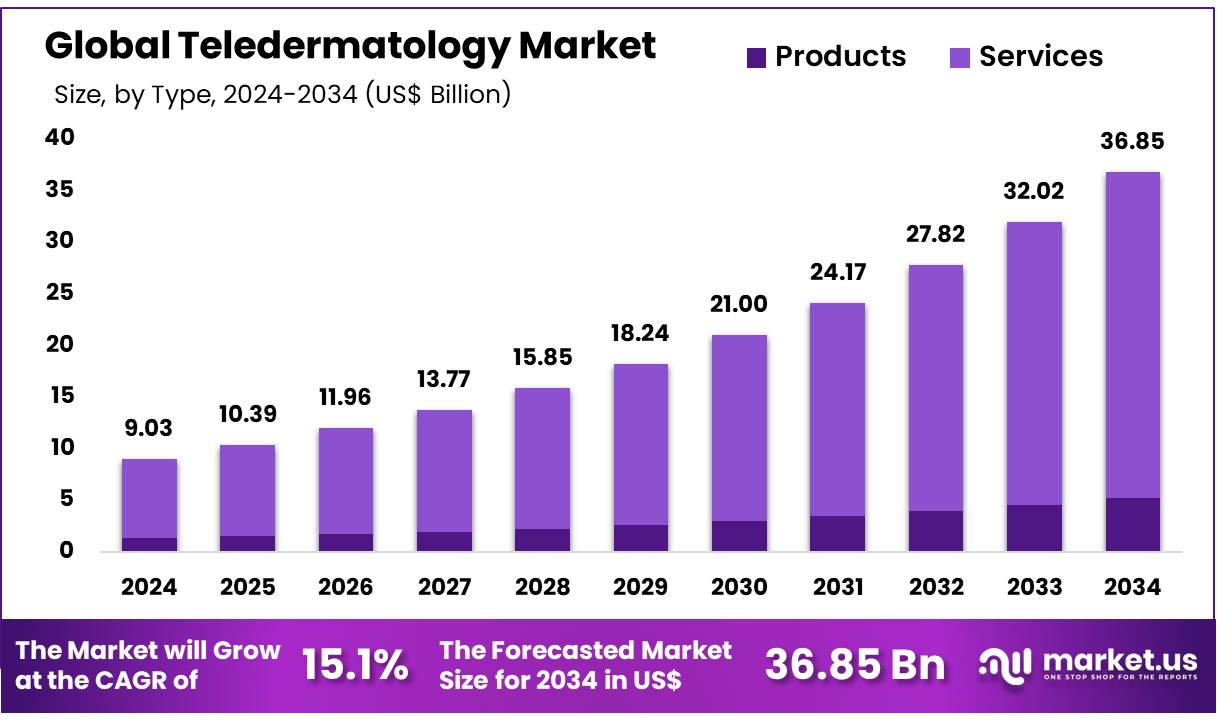
New York, NY – Dec 11, 2025 – Global Teledermatology Market size is expected to be worth around US$ 36.85 Billion by 2034 from US$ 9.03 Billion in 2024, growing at a CAGR of 15.1% during the forecast period 2025 to 2034. In 2024, North America led the market, achieving over 38.7% share with a revenue of US$ 3.49 Billion.
The global teledermatology market has been witnessing steady expansion as digital health adoption continues to accelerate worldwide. Growth in the market has been supported by rising dermatological disorder incidence, increasing demand for remote consultations, and the integration of advanced telemedicine platforms across healthcare systems. The adoption of teledermatology solutions has been further encouraged by the need for timely specialist access, particularly in regions with limited dermatology infrastructure.
Significant progress has been observed in store-and-forward services, real-time video consultations, and mobile-based diagnostic platforms. These modalities have facilitated improved clinical workflow efficiency and reduced patient waiting times. The growth of the market has also been attributed to the increasing penetration of smartphones, enhanced internet connectivity, and the expansion of cloud-based healthcare solutions.
Healthcare providers and insurers have been increasingly recognizing teledermatology as a cost-effective care delivery model, resulting in wider reimbursement support in multiple regions. The market has also been influenced by continuous technological advancements such as artificial intelligence–based diagnostic support tools, high-resolution imaging systems, and automated triage applications, which have strengthened clinical accuracy and patient engagement.
North America has maintained a dominant position due to advanced digital health infrastructure, while strong growth potential has been identified across Asia-Pacific as healthcare digitalization accelerates. Key industry participants have been focusing on platform innovation, strategic partnerships, and service delivery expansion to strengthen their competitive presence. Overall, sustained demand for remote dermatology services and rising awareness of digital healthcare benefits are expected to support the long-term growth trajectory of the teledermatology market.
Key Takeaways
- In 2024, the teledermatology market generated revenue of US$ 9.03 billion and has been projected to grow at a CAGR of 15.1%, reaching US$ 36.85 billion by 2034.
- The Type segment has been categorized into Products and Services, with Services leading the market in 2023 by accounting for 85.8% of the total share.
- Within Service Type, the market has been divided into Teleconsultation, Telemonitoring, Tele-education, and Others, where Teleconsultation emerged as the dominant category with 37.9% of the market share.
- In terms of Modality, the market has been segmented into Store-and-Forward, Real-Time, and Hybrid, with Store-and-Forward representing the largest share at 63.7%.
- Based on End-User, the market has been classified into Healthcare Facilities and Homecare, and Healthcare Facilities accounted for the leading share at 65.8%.
- North America remained the leading regional market in 2024, securing 38.7% of the global share.
Regional Analysis
North America has maintained its position as the leading region in the global teledermatology market, supported by a well-established healthcare infrastructure, extensive internet accessibility, and rising demand for convenient dermatological services. Market expansion has been reinforced by the increasing incidence of skin disorders, including acne, eczema, and skin cancer, alongside a documented shortage of dermatologists. These factors have positioned teledermatology as an essential approach for ensuring timely and efficient patient care.
Prominent participants in the United States include MDLIVE, DermatologistsOnCall, and First Derm, all of which provide teleconsultation platforms designed to reduce the gap between patients and specialists. First Derm, for example, enables users to submit images of skin concerns through a mobile application and obtain assessments from board-certified dermatologists without requiring an in-person consultation.
In April 2023, MedX Health Corp., a recognized global provider of teledermatology solutions, formalized a Memorandum of Understanding to introduce a new commercialization pilot initiative in collaboration with PharmaChoice Canada. PharmaChoice represents one of Canada’s rapidly expanding pharmacy networks, encompassing more than 1,000 independent pharmacy owners and operators under the PharmaChoice and RxHealthMed brands.
Emerging Trends
- Growing Adoption of Mobile Apps: Mobile-based teledermatology is expanding as patients capture and share skin images through dedicated apps. This convenience removes barriers such as travel and scheduling, increases engagement, and broadens access, allowing dermatology services to reach larger populations with improved responsiveness.
- Integration of Artificial Intelligence (AI): AI-driven image analysis is strengthening diagnostic efficiency in teledermatology. Automated assessments support clinicians by accelerating evaluation, enhancing accuracy, and enabling early detection. These tools reduce patient wait times, streamline workflows, and help manage increasing consultation volumes, improving overall service reliability and performance.
- Focus on Remote and Rural Areas: Teledermatology adoption is rising in underserved regions where specialist access remains limited. Virtual consultations eliminate long-distance travel, ensure timely dermatologic advice, and promote equitable healthcare delivery. This expansion strengthens early intervention, reduces patient burden, and enhances skin care availability in remote communities.
- Expansion of Services Beyond Diagnosis: Teledermatology platforms now include ongoing treatment management, follow-up consultations, and chronic disease monitoring. Educational resources strengthen patient understanding and adherence. This comprehensive model delivers continuous, accessible care that supports long-term skin health, improves treatment outcomes, and reduces dependence on frequent in-person visits.
- Rising Awareness and Acceptance: Patients and clinicians increasingly recognize the convenience and cost efficiency of teledermatology. Growing familiarity and trust are accelerating adoption, enabling broader reach and streamlined care delivery. This acceptance supports significant future market expansion as virtual dermatology becomes an integrated component of routine healthcare.
Use Cases
- Remote Diagnosis of Skin Conditions: Patients submit images of rashes or lesions for professional review, enabling dermatologists to provide timely diagnoses without physical visits. This approach reduces travel, shortens wait times, and improves accessibility, particularly for individuals in distant locations, ensuring faster attention to emerging or minor conditions.
- Follow-up for Chronic Conditions: Regular virtual check-ins support the management of long-term issues such as eczema or psoriasis. Patients share progress updates from home, allowing clinicians to adjust treatments promptly. This approach reduces hospital visits, supports continuity of care, and enhances long-term management effectiveness.
- Triage for Urgent Skin Problems: Teledermatology enables rapid assessment of potentially urgent conditions. Dermatologists review submitted images to determine severity, preventing unnecessary emergency visits and guiding patients appropriately. This triage system optimizes healthcare resources, reduces hospital congestion, and ensures timely direction to urgent care when required.
- Skin Cancer Screening: Suspicious moles or lesions can be reviewed remotely, facilitating early identification of potential skin cancers. Dermatologists recommend further in-person evaluation when necessary. This accessible first-line screening encourages earlier patient action, reduces diagnostic delays, and supports improved treatment outcomes through prompt detection.
- Education and Awareness: Teledermatology platforms deliver educational materials that help patients understand skin conditions, treatment adherence, and preventive care. Increased knowledge strengthens self-management, encourages proactive behavior, and improves decision-making. These resources establish a supportive environment that enhances patient engagement and promotes healthier long-term dermatologic outcomes.
Frequently Asked Questions on Teledermatology
- How does teledermatology work?
Teledermatology operates through store-and-forward image sharing or real-time video consultations. Dermatologists assess submitted images, provide diagnoses, and recommend treatments. This process has improved accessibility, particularly in regions with limited specialist availability. - What conditions can be diagnosed through teledermatology?
Teledermatology is used for acne, eczema, psoriasis, infections, pigmentation issues, and suspected malignancies. The accuracy of remote evaluation has been shown to be comparable to in-person visits for many conditions when high-quality images are provided. - What are the benefits of teledermatology?
The benefits include reduced wait times, improved access in underserved locations, and lower healthcare costs. Teledermatology also supports early detection of critical conditions and enhances continuity of care through quicker follow-up consultations. - Is teledermatology accurate?
Teledermatology demonstrates high diagnostic accuracy when supported by clear images and structured clinical information. Studies have reported agreement rates comparable to traditional consultations, reinforcing confidence in remote dermatological assessments. - Which regions are leading the teledermatology market?
North America and Europe currently lead due to advanced healthcare systems, higher digital adoption, and supportive telehealth regulations. Asia-Pacific is experiencing rapid growth driven by expanding digital health initiatives and increasing patient awareness. - What technologies support teledermatology market growth?
Key technologies include artificial intelligence, high-resolution imaging, cloud-based platforms, and integrated electronic health records. These innovations enable faster diagnostics, improve workflow efficiency, and enhance the reliability of remote dermatology services. - What is the future outlook for the teledermatology market?
The market outlook remains positive due to rising consumer acceptance, increasing investment in telehealth infrastructure, and integration of AI-based diagnostic tools. These developments are expected to support sustained growth over the forecast period.
Conclusion
The teledermatology market is expected to maintain a strong growth trajectory, supported by rising skin disorder prevalence, expanding digital health ecosystems, and increasing acceptance of remote care. Service-based models, particularly teleconsultations and store-and-forward modalities, will continue to dominate due to their efficiency and accessibility.
Advancements in artificial intelligence, mobile applications, and cloud-based platforms are anticipated to enhance diagnostic accuracy and operational performance. With North America leading and Asia-Pacific demonstrating accelerating adoption, global penetration is set to deepen. Overall, sustained demand for timely specialist access and improved healthcare convenience will reinforce teledermatology’s long-term market expansion.
Discuss your needs with our analyst
Please share your requirements with more details so our analyst can check if they can solve your problem(s)




