


Table of Contents
Overview
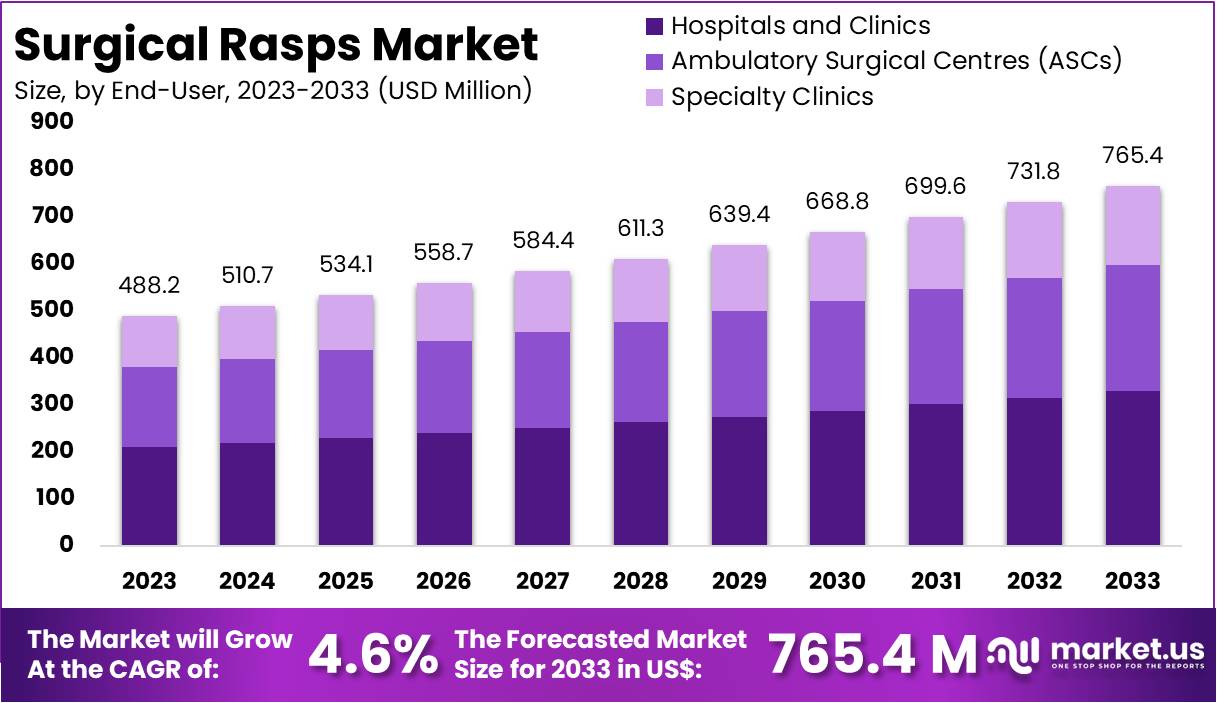
New York, NY – Feb 17, 2026 – The Global Surgical Rasps Market size is expected to be worth around US$ 765.4 Million by 2033, from US$ 488.2 Million in 2023, growing at a CAGR of 4.6% during the forecast period from 2024 to 2033. North America led the Market, capturing a 39% market share with a valuation of US$ 190.3 million.
The global surgical rasps market is witnessing steady expansion, driven by the increasing volume of orthopedic, dental, and reconstructive surgical procedures worldwide. Surgical rasps are specialized medical instruments used for shaping, smoothing, and contouring bone surfaces during surgical interventions. Their application is critical in procedures such as joint reconstruction, fracture repair, and maxillofacial surgeries, where precision and surface finishing are essential for optimal clinical outcomes.
Market growth can be attributed to the rising prevalence of musculoskeletal disorders, an aging global population, and the growing adoption of minimally invasive surgical techniques. According to healthcare statistics, orthopedic procedures have increased consistently over the past decade, particularly hip and knee replacement surgeries, which directly support demand for high-quality surgical rasps. Technological advancements, including the development of ergonomic designs, enhanced grip control, and improved stainless-steel and titanium materials, have further strengthened product efficiency and durability.
Hospitals and specialized surgical centers represent the primary end-user segment, supported by expanding healthcare infrastructure in emerging economies. North America and Europe continue to dominate market revenue due to advanced healthcare systems, while Asia-Pacific is expected to register significant growth driven by rising healthcare investments and patient awareness.
Overall, sustained innovation, growing surgical volumes, and improved healthcare access are expected to support stable long-term growth in the surgical rasps market.
Key Takeaways
- The global Surgical Rasps Market is anticipated to expand from US$ 488.2 million in 2023 to US$ 765.4 million by 2033, registering a compound annual growth rate (CAGR) of 4.6% during the forecast period.
- In 2023, double-ended rasps accounted for the largest share within the product type segment, contributing more than 73% of total market revenue.
- Hospitals and clinics represented the leading end-user segment in 2023, holding over 43% of the overall market share.
- North America dominated the regional landscape in 2023, securing a 39% share of the global market, with a total valuation of US$ 190.3 million.
Regional Analysis
In 2023, North America accounted for more than 39% of the global Surgical Rasps Market, with a total valuation of US$ 190.3 million. Market dominance was supported by a well-established healthcare infrastructure that enables the rapid adoption of advanced surgical technologies. High healthcare spending, particularly in the United States, has strengthened demand for precision-based surgical instruments designed to improve clinical efficiency and patient outcomes.
The presence of major surgical instrument manufacturers in the region has further accelerated product innovation and ensured strong distribution networks. Emphasis on ergonomic design and high-performance materials has aligned product development with surgeon requirements. In addition, the increasing volume of orthopedic procedures, influenced by an aging population and rising incidence of sports-related injuries, has contributed significantly to market expansion.
A structured regulatory environment in the U.S. and Canada has reinforced product quality and safety standards. Continuous investment in research and development has also supported technological advancements, sustaining regional market leadership.
Emerging Trends
- Integration of Computer-Assisted Navigation: The adoption of computer-assisted navigation systems is enhancing the precision of rasp placement during orthopedic procedures. Advanced preoperative planning software and navigation templates are being utilized to improve alignment accuracy, minimize intraoperative errors, and optimize postoperative patient outcomes across joint replacement surgeries.
- Adoption of Patient-Specific Instrumentation (PSI): Three-dimensional planning and patient-specific instrumentation are increasingly being implemented to align rasp orientation with individual anatomical structures. Clinical evidence indicates that customized guides and laser-assisted systems significantly reduce implant positioning deviation, thereby improving surgical accuracy and long-term implant stability.
- Advancement in Curved and Ergonomic Rasp Designs: The development of curved shaft rasps and ergonomically optimized handles is reducing the incidence of implant malalignment. Improved instrument geometry enhances intraoperative control, minimizes surgeon fatigue, and supports better femoral canal preparation compared to traditional straight rasp configurations.
- Virtual Reality–Based Surgical Training: Virtual reality–based simulation platforms are being integrated into surgical education programs to strengthen rasp handling skills. Immersive training modules allow residents to practice procedural steps in controlled environments, thereby improving technical proficiency and reducing learning-curve–related complications in live surgeries.
- Strengthened Regulatory and Safety Compliance: Although surgical rasps are generally categorized as low-risk medical devices, manufacturers are increasingly focusing on regulatory registration, quality management systems, and post-market surveillance. Enhanced traceability measures and safety monitoring protocols are being implemented to ensure product reliability and compliance with global standards.
Use Cases
- Total Hip Arthroplasty (THA): In total hip arthroplasty, rasps are used to prepare and shape the femoral canal prior to stem implantation. Rising hip replacement volumes, driven by aging populations and degenerative joint conditions, continue to support consistent demand for precision-engineered rasp systems.
- Total Knee Arthroplasty (TKA): During total knee arthroplasty, tibial and femoral rasps are utilized to contour bone surfaces for optimal implant positioning. High procedural volumes globally reinforce the essential role of rasps in achieving accurate bone preparation and stable prosthetic fixation.
- Unicompartmental Knee Replacement: In partial knee replacement procedures, specialized rasps are employed to reshape a single compartment of the joint. This approach supports tissue preservation, promotes faster recovery timelines, and ensures precise implant alignment within the targeted compartment.
- Spinal Fusion and Graft Bed Preparation: Rasps are applied in spinal fusion surgeries to remove cortical bone and prepare graft beds for autograft or allograft placement. The introduction of advanced and 3D-fabricated rasp systems has expanded their role in complex spinal reconstruction procedures.
- Plastic and Reconstructive Surgery: In craniofacial and reconstructive procedures, manual rasps are used to smooth bone edges following osteotomies. Their precision enables controlled bone contouring in delicate anatomical regions, contributing to both functional restoration and aesthetic refinement.
- Shoulder Arthroplasty: In shoulder joint replacement surgeries, humeral rasps are utilized to shape the proximal humerus for prosthetic insertion. Growing adoption of short-stem and stemless implant designs has driven the need for compact and anatomically precise rasp configurations.
Frequently Asked Questions on Surgical Rasps
- What materials are commonly used in manufacturing surgical rasps?
Surgical rasps are primarily manufactured using medical-grade stainless steel to ensure durability, corrosion resistance, and sterilization compatibility. In some advanced applications, titanium alloys are also utilized due to their lightweight properties and high strength-to-weight ratio. - What are the key applications of surgical rasps?
Surgical rasps are widely applied in orthopedic surgeries, including joint reconstruction and fracture repair, as well as in dental and maxillofacial procedures. They are also utilized in plastic and reconstructive surgeries to refine bone structures for functional and aesthetic outcomes. - What factors are driving the growth of the surgical rasps market?
The growth of the surgical rasps market is driven by the increasing prevalence of orthopedic disorders, rising geriatric population, and higher incidence of trauma cases globally. Additionally, advancements in surgical techniques and healthcare infrastructure expansion support consistent market demand. - How is the surgical rasps market segmented?
The surgical rasps market is segmented based on product type, application, end user, and geography. Product segmentation includes flat, half-round, and curved rasps, while end users primarily comprise hospitals, specialty clinics, and ambulatory surgical centers. - Which regions hold significant market share in the surgical rasps market?
North America holds a substantial share of the surgical rasps market due to advanced healthcare systems and high surgical volumes. Europe follows closely, while Asia-Pacific is expected to witness accelerated growth supported by improving medical infrastructure and rising healthcare investments. - Who are the major end users of surgical rasps?
Major end users of surgical rasps include hospitals, orthopedic specialty centers, dental clinics, and ambulatory surgical centers. Hospitals account for the largest share due to higher surgical case volumes and broader access to specialized surgical equipment. - What technological advancements are influencing the surgical rasps market?
Technological advancements such as ergonomic instrument designs, improved surface texturing, and enhanced sterilization compatibility are influencing product development. Integration with minimally invasive surgical techniques has also increased the demand for precision-engineered rasps across various specialties.
Conclusion
The global surgical rasps market is positioned for stable and sustained growth, supported by increasing orthopedic and reconstructive surgical volumes, demographic aging, and continuous technological innovation. Strong demand from hospitals and specialty centers, combined with ergonomic advancements and precision-focused designs, has enhanced product adoption across major regions.
North America maintains leadership due to advanced infrastructure and high healthcare expenditure, while Asia-Pacific presents notable expansion potential. The integration of digital planning tools, patient-specific instrumentation, and enhanced regulatory compliance frameworks is further strengthening market maturity. Overall, consistent procedural demand and innovation are expected to ensure long-term market expansion.
Discuss your needs with our analyst
Please share your requirements with more details so our analyst can check if they can solve your problem(s)




