


Table of Contents
Overview
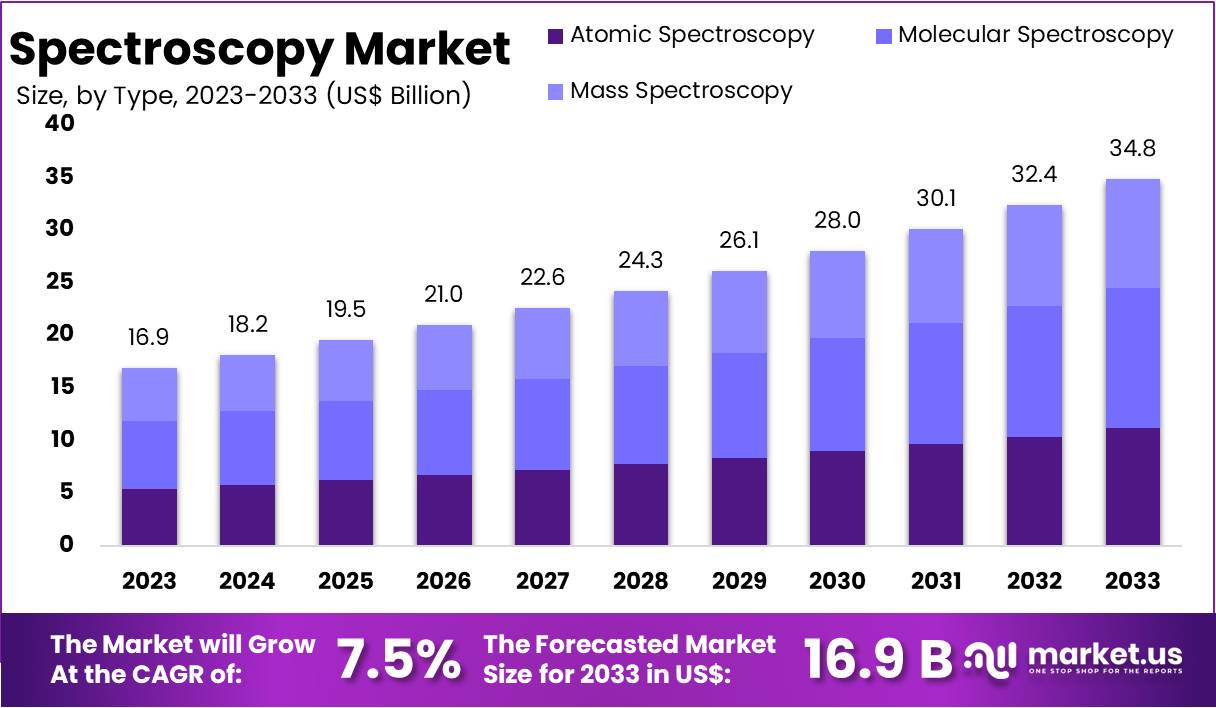
New York, NY – Feb 13, 2026 – The Global Spectroscopy Market size is expected to be worth around US$ 34.8 Billion by 2033, from US$ 16.9 Billion in 2023, growing at a CAGR of 7.5% during the forecast period from 2024 to 2033.
Spectroscopy is a fundamental analytical technique used to study the interaction between electromagnetic radiation and matter. It enables the identification and quantification of chemical compounds by analyzing absorption, emission, or scattering patterns across specific wavelengths. This scientific approach has become essential in laboratories and industrial facilities due to its high precision and reliability.
The technology is widely applied across pharmaceuticals, biotechnology, environmental monitoring, food safety, petrochemicals, and academic research. In pharmaceutical manufacturing, spectroscopy supports drug formulation validation and quality assurance. Environmental agencies rely on spectroscopic methods to detect pollutants and ensure regulatory compliance. Food and beverage producers utilize the technique to maintain product integrity and safety standards.
Modern spectroscopy systems are designed with advanced automation, digital integration, and enhanced sensitivity. These improvements have strengthened analytical performance while reducing testing time and operational costs. Continuous innovation in portable and miniaturized devices has expanded field-based applications, increasing accessibility across emerging markets.
The growing emphasis on research and development, coupled with stringent regulatory frameworks, has reinforced the strategic importance of spectroscopy. As industries prioritize accuracy, safety, and efficiency, spectroscopy remains a critical technology supporting scientific advancement and industrial progress worldwide.
Key Takeaways
- The global spectroscopy market is expected to attain a valuation of approximately US$ 34.8 billion by 2033, increasing from US$ 16.9 billion in 2023, registering a CAGR of 7.5% during the forecast period.
- The Molecular Spectroscopy segment emerged as the leading type category in 2023, accounting for more than 38.4% of the overall market share.
- The Pharmaceutical and Biopharmaceutical application segment held the dominant position in 2023, contributing over 31.5% to the total market revenue.
- North America remained the largest regional market in 2023, representing over 45.2% of the global share, with a market value estimated at US$ 7.6 billion.
Regional Analysis
In 2023, North America accounted for over 45.2% of the global spectroscopy market, reaching a valuation of US$ 7.6 billion. Market leadership was supported by strong technological capabilities and consistent investment in advanced analytical solutions. Significant expenditure on research and development by leading regional companies has accelerated the introduction of innovative spectroscopic techniques, improving precision, sensitivity, and operational efficiency.
The region’s well-established industrial infrastructure has further strengthened demand. Sectors such as pharmaceuticals, chemicals, and food and beverage extensively utilize spectroscopy for quality assurance and regulatory compliance. Strict regulatory frameworks, particularly those enforced by the U.S. Food and Drug Administration (FDA), have reinforced the adoption of reliable analytical technologies.
Public institutions and private enterprises continue to prioritize technological advancement, enhancing product innovation and laboratory capabilities. While North America maintains its leading position, Asia Pacific is projected to register the fastest growth, driven by industrial expansion and research funding. Europe also demonstrates steady progress, supported by pharmaceutical and environmental research activities.
Emerging Trends in Spectroscopy
Miniaturized and Portable Instrumentation
The advancement of compact and handheld spectroscopy systems has significantly expanded the scope of field-based analysis. Near-infrared (NIR) spectroscopy has experienced notable progress, with the introduction of miniaturized sensors designed for point-of-need applications. These instruments enable rapid, on-site testing in areas such as agricultural product evaluation and bedside biomedical diagnostics. Portability, broad sample compatibility, and minimal sample preparation requirements—particularly for moist or irregularly shaped materials have enhanced operational flexibility beyond conventional laboratory environments.
Integration of Advanced Computational Methods and Artificial Intelligence
The implementation of chemometric models and machine learning algorithms has become increasingly standardized for processing complex spectral datasets. Multivariate analytical techniques, including principal component analysis (PCA) and support vector machines (SVM), are widely utilized to identify patterns, automate classification, and strengthen quantitative precision. This analytical evolution has improved reproducibility, reduced interpretation variability, and accelerated decision-making processes across quality control, environmental monitoring, and clinical diagnostics applications.
Calibration-Independent and High-Resolution Spectroscopic Approaches
Recent innovations in laser-based absorption spectroscopy have reduced reliance on conventional calibration standards. High-resolution laser absorption methods allow for the direct quantification of absolute gas concentrations through first-principles modeling, including application of the Beer–Lambert law and Voigt profile analysis. Such methodologies have demonstrated accurate detection of trace gases, including elemental mercury in ambient air, while lowering operational costs and shortening analytical timelines relative to traditional mass spectrometry-based calibration techniques.
Multi-Modal Spectroscopy Combined with Imaging Technologies
The convergence of vibrational spectroscopy with advanced imaging systems has gained momentum in both clinical and materials research. Spectroscopy imaging platforms enable rapid acquisition of molecular-level information without the need for dyes or labeling agents. In clinical environments, this approach supports real-time, non-invasive tissue characterization, including intraoperative margin assessment. In materials science, it facilitates spatial mapping of chemical composition across complex surfaces, improving structural and compositional analysis efficiency.
Key Use Cases of Spectroscopy
Intraoperative Cancer Detection: High-wavenumber Raman spectroscopy has been implemented during surgical interventions to differentiate malignant from healthy tissue in real time. Using a 671 nm excitation source and acquisition times of approximately 0.5 seconds, dense tumor regions containing more than 60% cancer cells were identified with 80% sensitivity and 90% specificity. These performance metrics indicate strong potential for supporting rapid intraoperative decision-making and improving surgical precision.
Gastric Tissue Diagnostics: Raman spectroscopy has demonstrated high diagnostic accuracy in distinguishing normal gastric tissue from dysplastic lesions. Reported sensitivity reached 94.4%, while specificity achieved 96.3%. These outcomes highlight its applicability as a minimally invasive diagnostic adjunct within gastroenterology, contributing to early-stage detection and improved clinical assessment.
Lung Cancer Screening Across Multiple Biological Samples: A meta-analysis encompassing 12 independent studies assessed the diagnostic performance of Raman spectroscopy in lung cancer detection. The pooled sensitivity was reported at 0.90 (95% confidence interval: 0.87–0.92), and pooled specificity at 0.76 (95% confidence interval: 0.72–0.79). Subgroup analyses revealed variation based on sample type:
- Lung tissue samples: Sensitivity of 0.89 and specificity of 0.68
- Blood samples: Sensitivity of 0.88 and specificity of 0.87
- Saliva samples: Sensitivity of 0.92 and specificity of 0.94
These findings indicate strong diagnostic capability across diverse biological matrices, with particularly high performance observed in saliva-based screening, supporting continued development of non-invasive diagnostic protocols.
Frequently Asked Questions on Spectroscopy
- How does spectroscopy work?
Spectroscopy works by analyzing how materials absorb, emit, or scatter light at specific wavelengths. Each substance produces a unique spectral signature, enabling precise identification and quantification. This method supports accurate analysis in laboratories, manufacturing units, and research institutions worldwide. - What are the main types of spectroscopy?
Major types include ultraviolet-visible (UV-Vis), infrared (IR), nuclear magnetic resonance (NMR), Raman, and mass spectroscopy. Each method is designed for specific analytical needs, ranging from structural analysis and molecular identification to trace element detection and pharmaceutical validation processes. - What are the applications of spectroscopy?
Spectroscopy is extensively used in pharmaceuticals, biotechnology, food safety, environmental monitoring, petrochemicals, and forensic science. It enables quality assurance, contamination detection, and regulatory compliance. Increasing demand for accurate and rapid analysis has strengthened its importance across multiple industries. - What are the advantages of spectroscopy techniques?
Spectroscopy provides high sensitivity, rapid analysis, minimal sample preparation, and non-destructive testing capabilities. These advantages improve laboratory efficiency and analytical precision. Advanced spectroscopic instruments also support automation, enhancing productivity and reducing operational costs in industrial and research settings. - What factors are driving the growth of the spectroscopy market?
Market growth is driven by rising pharmaceutical research, increasing environmental regulations, food safety requirements, and advancements in analytical technologies. Growing demand for precise diagnostic tools and industrial automation has significantly contributed to the expansion of spectroscopy-based solutions globally. - Which industries are the major end users in the spectroscopy market?
Key end users include pharmaceutical and biotechnology companies, chemical manufacturers, academic research institutes, healthcare laboratories, food and beverage producers, and environmental agencies. These sectors rely heavily on spectroscopy for quality control, compliance monitoring, and product innovation initiatives. - What are the regional trends in the spectroscopy market?
North America and Europe maintain strong market shares due to established research infrastructure and regulatory standards. Meanwhile, Asia-Pacific is witnessing rapid growth driven by expanding pharmaceutical manufacturing, increased R&D investments, and rising industrialization in emerging economies.
Conclusion
The spectroscopy market demonstrates strong and sustained growth, supported by expanding pharmaceutical research, stringent regulatory requirements, and increasing demand for precise analytical solutions. With global revenue projected to reach US$ 34.8 billion by 2033 at a CAGR of 7.5%, the industry is positioned for stable expansion.
Molecular spectroscopy and pharmaceutical applications continue to dominate revenue contribution, while North America maintains regional leadership. Advancements in portable systems, artificial intelligence integration, and high-resolution methodologies are enhancing analytical efficiency and accessibility. As industries prioritize accuracy, compliance, and operational optimization, spectroscopy will remain a foundational technology driving scientific innovation and industrial advancement globally.
Discuss your needs with our analyst
Please share your requirements with more details so our analyst can check if they can solve your problem(s)




