


Table of Contents
Overview
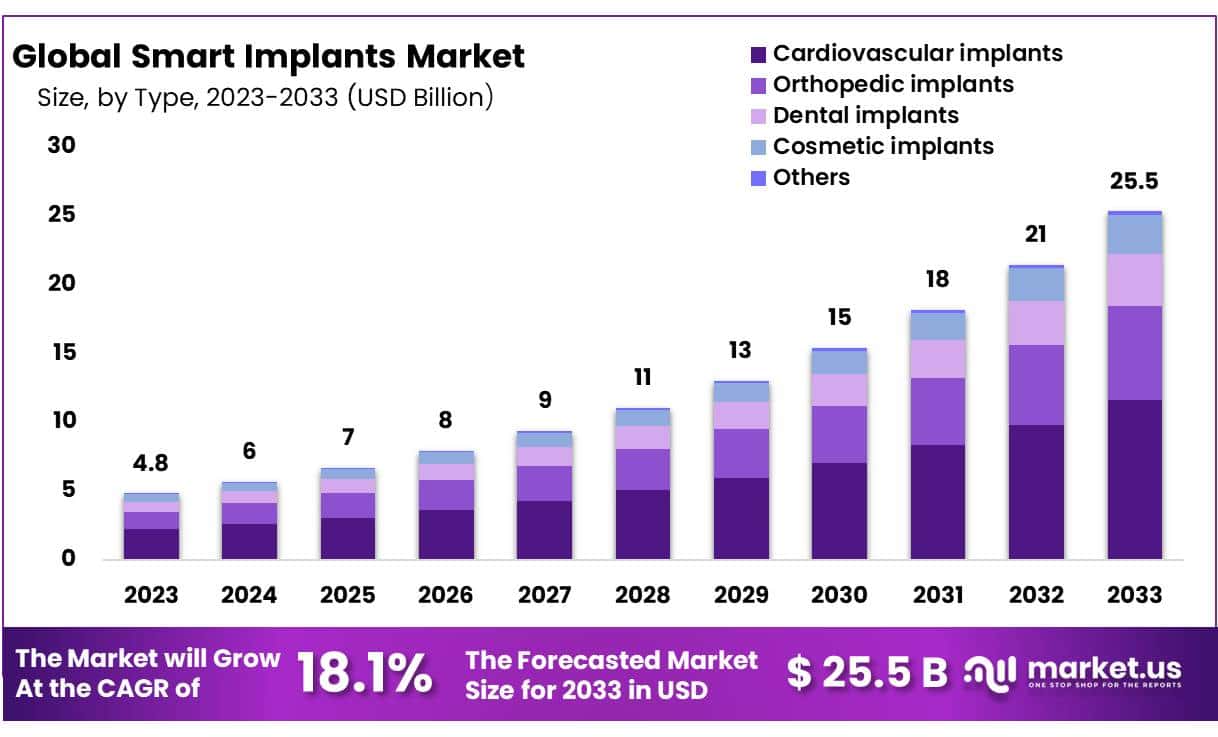
New York, NY – Feb 03, 2026 – The Global Smart Implants Market size is expected to be worth around USD 25.5 Billion by 2033 from USD 4.8 Billion in 2023, growing at a CAGR of 18.1% during the forecast period from 2024 to 2033.
Smart implants represent an advanced category of implantable medical devices designed to monitor, respond to, and communicate physiological data in real time. These implants are formed by combining traditional biomedical materials with embedded sensors, microprocessors, power sources, and wireless communication technologies. The basic formation process focuses on achieving long-term biocompatibility, functional reliability, and secure data transmission within the human body.
The core structure of a smart implant typically includes a medical-grade outer casing made from titanium, polymers, or ceramics to ensure durability and compatibility with biological tissues. Inside the casing, miniaturized electronic components are integrated to collect and process health-related data such as pressure, temperature, motion, or biochemical signals. Power is commonly supplied through long-life batteries or energy-harvesting mechanisms, reducing the need for frequent surgical replacement.
Connectivity is a defining feature of smart implants. Wireless interfaces enable continuous data transfer to external monitoring systems, allowing healthcare providers to track patient conditions remotely and make timely clinical decisions. In some designs, smart implants are also capable of delivering targeted therapy or adjusting their function based on real-time feedback.
The formation of smart implants is supported by advances in microelectronics, materials science, and digital health platforms. As healthcare systems increasingly emphasize precision medicine and remote patient monitoring, smart implants are expected to play a critical role in improving treatment outcomes, reducing hospital visits, and enhancing overall patient care efficiency.
Key Takeaways
- The global smart implants market size is projected to reach approximately USD 25.5 billion by 2033, increasing from USD 4.8 billion in 2023.
- The market is expected to expand at a strong compound annual growth rate (CAGR) of 18.1% during the forecast period from 2024 to 2033.
- By type, the orthopedic implants segment accounted for the largest revenue share, representing 45.8% of the total market in 2023.
- In terms of application, the pacing devices segment held a significant market share of 43.2%, supported by the growing prevalence of cardiovascular diseases.
- Based on end use, hospitals emerged as the leading segment, capturing a notable revenue share of 56.8% in the global smart implants market in 2023.
- Regionally, North America led the global smart implants market, accounting for the highest revenue share of 41.8% in 2023.
Market Segmentation Analysis
- By Type Analysis: The orthopedic implants segment led the global smart implants market in 2023 with a 45.8% revenue share. Growth is supported by rising knee, hip, spine, and fracture procedures, alongside sensor-enabled implants that reduce complications and improve post-surgical outcomes.
- By Surgery Analysis: Open surgery represented 64.3% of the smart implants market in 2023, driven by its established clinical reliability. It remains critical for complex procedures such as spinal surgeries, ensuring precise implant placement, with more than 300 million open surgeries performed globally each year.
- By Application Analysis: The pacing devices segment accounted for 43.2% of market revenue in 2023, supported by advancements in remote monitoring technologies. Increasing cardiovascular disease prevalence, aging populations, and demand for personalized cardiac care continue to strengthen adoption of smart pacing solutions.
- By End-User Analysis: Hospitals dominated the smart implants market with a 56.8% share in 2023, due to advanced infrastructure and specialized expertise. Their ability to perform complex implant procedures, supported by reimbursement frameworks and multidisciplinary care, positions hospitals as the primary treatment setting.
Regional Analysis
North America emerged as the leading region in the global smart implants market, accounting for a substantial revenue share of 41.8% in 2023. The region continues to be a preferred market due to the widespread availability of advanced medical technologies and a high level of awareness regarding implant-based surgical procedures among patients and healthcare professionals.
A well-established and technologically advanced healthcare infrastructure further supports market expansion. In addition, the strong presence and continuous growth of pharmaceutical and biotechnology companies contribute to innovation and faster adoption of smart implant solutions.
The increasing use of smart implants in the United States, driven by the demand for faster, more precise, and efficient clinical outcomes, has been a key factor supporting regional market growth in recent years.
Emerging Trend
- Integration of Wireless Connectivity: Smart implants are increasingly equipped with wireless communication technologies that enable real-time data transmission to healthcare systems. This trend supports continuous patient monitoring, faster clinical response, and improved post-implantation care through timely and data-driven interventions.
- Energy Harvesting Technologies: Advancements in energy harvesting allow smart implants to generate power from body heat or movement. This reduces dependence on conventional batteries, extends device lifespan, and lowers the need for replacement surgeries, improving overall patient safety and convenience.
- Neural Implants: Rising research investment is driving the development of neural implants that interface directly with the nervous system. These devices offer promising solutions for neurological disorders, sensory restoration, and brain–computer interactions, supporting improved functional recovery and quality of life.
- Use of Nanomaterials: The adoption of nanomaterials in smart implants enhances biocompatibility, durability, and functional performance. Improved tissue integration and reduced immune response contribute to safer implantation and more reliable long-term outcomes across various clinical applications.
- Additive Manufacturing (3D Printing): The use of additive manufacturing enables patient-specific smart implants tailored to individual anatomy. This customization improves surgical precision, implant fit, and clinical outcomes, while also supporting faster production cycles and greater flexibility in implant design.
Frequently Asked Questions on Smart Implants
- How do smart implants work?
Smart implants operate by collecting biological or mechanical data through integrated sensors. The data is processed internally and transmitted wirelessly to external systems, allowing continuous monitoring, early detection of complications, and timely medical intervention. - What medical applications use smart implants?
Smart implants are widely used in orthopedics, cardiology, neurology, and dental applications. They assist in monitoring bone healing, cardiac rhythms, neural activity, and implant stability, improving treatment outcomes and reducing post-surgical complications. - What are the key benefits of smart implants?
The adoption of smart implants improves patient outcomes through real-time monitoring, reduced hospital visits, and early complication detection. These devices also support data-driven healthcare, enhancing treatment precision and long-term implant performance. - Are smart implants safe for long-term use?
Smart implants are designed to meet strict regulatory and safety standards. Long-term safety is ensured through biocompatible materials, secure data transmission, and rigorous clinical testing to minimize risks such as infection, device failure, or data breaches. - What factors are driving smart implants market growth?
Market growth is primarily driven by aging populations, increasing orthopedic and cardiovascular disorders, and advancements in IoT-enabled healthcare devices. Additionally, the shift toward value-based care has increased demand for continuous monitoring and outcome-based treatments. - Which regions dominate the smart implants market?
North America holds a significant market share due to advanced healthcare infrastructure, high adoption of innovative medical technologies, and strong R&D investment. Europe follows closely, while Asia-Pacific is expected to register the fastest growth during the forecast period. - What is the future outlook of the smart implants market?
The smart implants market is expected to experience sustained growth driven by AI integration, miniaturization of sensors, and expanding clinical applications. Continuous innovation and supportive regulatory frameworks are likely to enhance adoption across multiple medical specialties.
Conclusion
Smart implants represent a transformative advancement in implantable medical technology, combining biocompatible materials with sensors, connectivity, and data intelligence. Market growth is being driven by rising chronic disease prevalence, aging populations, and the healthcare shift toward continuous monitoring and precision medicine.
Strong adoption in orthopedics and cardiology, supported by hospital-based infrastructure, reinforces market expansion. Technological progress in wireless connectivity, energy harvesting, and personalized manufacturing continues to enhance device performance and patient outcomes. With sustained innovation, favorable reimbursement, and growing acceptance among clinicians, smart implants are expected to play an increasingly critical role in efficient, data-driven, and outcome-focused healthcare delivery globally.
Discuss your needs with our analyst
Please share your requirements with more details so our analyst can check if they can solve your problem(s)




