


Table of Contents
Overview
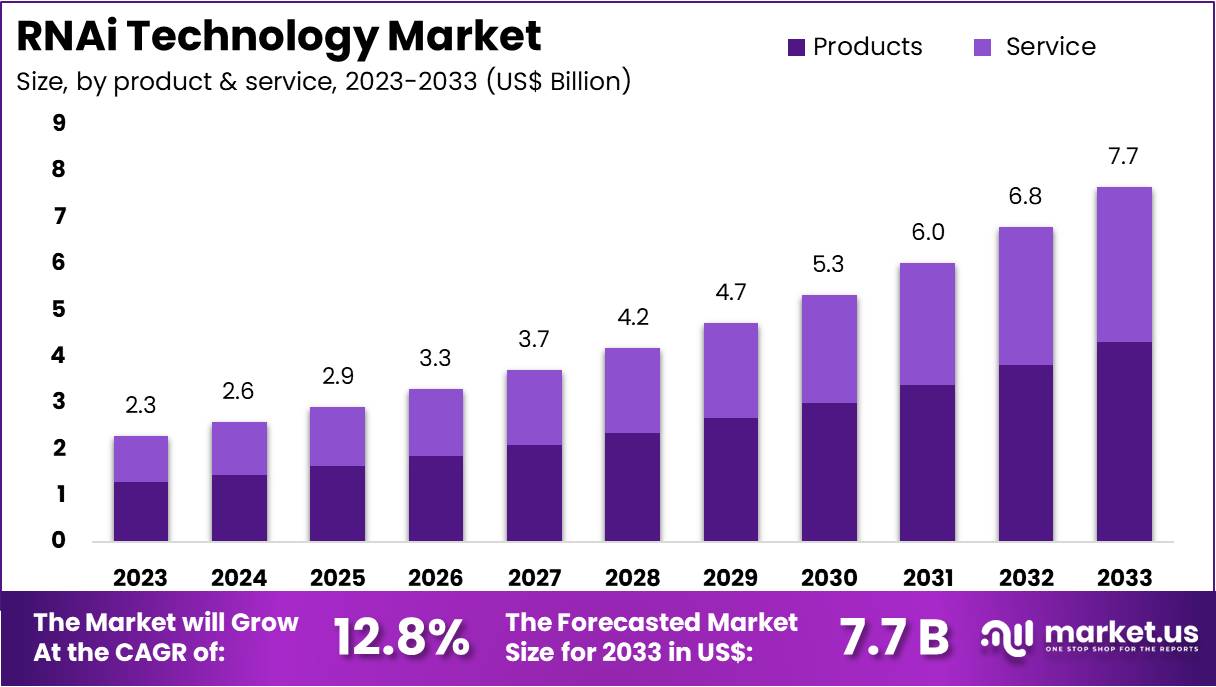
New York, NY – Feb 12, 2026 – The Global RNAi Technology Market size is expected to be worth around US$ 7.7 Billion by 2033, from US$ 2.3 Billion in 2023, growing at a CAGR of 12.8% during the forecast period from 2024 to 2033. North America dominated the RNAi Technology Market, accounting for over 35.82% of the market share and achieving a valuation of US$ 0.8 billion in the year.
RNA interference (RNAi) technology represents a transformative advancement in molecular biology and therapeutic development. RNAi is a naturally occurring biological process in which small RNA molecules regulate gene expression by degrading or inhibiting specific messenger RNA (mRNA) sequences. This mechanism effectively “silences” targeted genes, preventing the production of disease-associated proteins.
The basic formation of RNAi begins with the introduction or generation of double-stranded RNA (dsRNA) within a cell. This dsRNA is processed by an enzyme known as Dicer into small interfering RNA (siRNA) molecules, typically 20–25 nucleotides in length. The siRNA is then incorporated into the RNA-induced silencing complex (RISC). Guided by the siRNA strand, RISC identifies and binds to complementary mRNA sequences. Once bound, the target mRNA is cleaved and degraded, thereby blocking protein synthesis.
RNAi technology has been widely adopted in research and drug development due to its high specificity and targeted mechanism of action. It enables selective gene silencing without altering the underlying DNA sequence, offering a reversible and precise therapeutic approach. Applications have expanded across oncology, rare genetic disorders, infectious diseases, and agricultural biotechnology.
Ongoing advancements in delivery systems and molecular design have enhanced stability, reduced off-target effects, and improved clinical efficacy. As a result, RNAi technology is increasingly recognized as a cornerstone platform in next-generation therapeutics and precision medicine initiatives worldwide.
Key Takeaways
- The RNAi technology market is expected to expand from US$ 2.3 billion in 2023 to approximately US$ 7.7 billion by 2033, reflecting a compound annual growth rate (CAGR) of 12.8% during the forecast period.
- Within the product and service segmentation, the products category accounted for the largest share in 2023, contributing more than 56.41% of total market revenue.
- In terms of application, drug discovery and development emerged as the leading segment in 2023, representing 38.46% of the overall market share.
- Pharmaceutical and biotechnology companies constituted the primary end-user group in 2023, securing over 49.57% of the total market share.
- North America held the dominant regional position in 2023, capturing 35.82% of the global market and generating a market value of approximately US$ 0.8 billion.
Regional Analysis
In 2023, North America accounted for over 35.82% of the global RNAi technology market, generating approximately US$ 0.8 billion in revenue. Regional dominance has been supported by a well-established biomedical research ecosystem, high biotechnology investments, and favorable regulatory policies that promote innovation in genetic research and pharmaceutical development.
The United States represented the largest contributor within the region, supported by advanced healthcare infrastructure and the strong presence of leading biotechnology and pharmaceutical companies actively developing RNAi-based therapeutics. Continuous public and private sector funding has significantly strengthened research and development activities, accelerating the commercialization of RNAi solutions, particularly for oncology and chronic disease treatment.
Canada and Mexico contributed moderately to regional growth, supported by gradual improvements in research capacity and healthcare infrastructure. Sustained technological advancements, structured regulatory pathways, and rising demand for precision-based molecular therapies are expected to maintain North America’s leading position over the forecast period.
Emerging Trends in RNAi Technology
- Increasing Regulatory Approvals of RNAi Therapeutics: The expansion of RNAi technology has been supported by a consistent rise in regulatory approvals from the U.S. Food and Drug Administration. More than ten siRNA-based therapies have obtained approval, reflecting the transition of RNAi from experimental research to validated clinical applications across rare and common diseases.
- Progress in Targeted Delivery Platforms: Significant progress has been achieved through the adoption of N-acetylgalactosamine (GalNAc) conjugation, enabling precise liver-targeted delivery of siRNA molecules. Early clinical evaluations demonstrated favorable tolerability in over 40 healthy individuals, supporting reduced dosing frequency and enhanced therapeutic safety profiles.
- Broadening of the Clinical Development Pipeline: A substantial number of RNAi candidates are currently being evaluated across global clinical programs. According to ClinicalTrials.gov, hundreds of active trials spanning Phase I to Phase III are underway, covering genetic, cardiovascular, metabolic, and neurological indications, indicating strong platform validation.
- Expansion into Agricultural Biotechnology: RNAi applications have extended into crop protection and pest management. Government-supported research initiatives have shown that RNAi-based spray formulations can silence essential pest genes, achieving mortality rates exceeding 70%, while offering biodegradable and environmentally sustainable alternatives to conventional chemical pesticides.
Use Cases of RNAi Technology
- Hereditary Transthyretin-Mediated Amyloidosis (hATTR): Onpattro (patisiran) received regulatory approval in 2018 for adults with hATTR amyloidosis. Clinical studies demonstrated up to 87% reduction in transthyretin protein levels, alongside a favorable safety and tolerability profile in pivotal patient populations.
- Primary Hyperoxaluria Type 1 (PH1): Lumasiran was approved for the treatment of PH1 following positive Phase III outcomes. Trial data indicated a mean urinary oxalate reduction of approximately 65% among pediatric and adult patients, highlighting therapeutic effectiveness in rare metabolic disorders.
- Atherosclerotic Cardiovascular Disease: Olpasiran (AMG 890) demonstrated encouraging Phase II results in patients with elevated lipoprotein(a). In a randomized study of 480 participants, reductions of up to 50% in Lp(a) levels were observed at 24 weeks, supporting cardiovascular risk management potential.
- Alcohol Use Disorder: DCR-AUD is currently being evaluated in a 24-week Phase I/II clinical study involving adults with alcohol use disorder. This program represents one of the early applications of RNAi therapeutics in behavioral and neuropsychiatric conditions.
- Crop Pest Management Applications: Field-based agricultural trials funded by national agencies have demonstrated that topical RNAi formulations can achieve more than 70% mortality in targeted insect populations across multiple crops. This approach offers precision targeting with reduced environmental persistence compared to synthetic insecticides.
Frequently Asked Questions on RNAi Technology
- How does RNAi technology work?
RNAi technology operates through small RNA molecules such as small interfering RNA (siRNA) and microRNA (miRNA). These molecules bind to complementary messenger RNA sequences, leading to their degradation or translational suppression, thereby inhibiting protein synthesis at the post-transcriptional level. - What are the primary applications of RNAi technology?
RNAi technology is widely applied in therapeutic development, functional genomics, drug discovery, and agricultural biotechnology. It enables targeted gene silencing to treat genetic disorders, viral infections, and cancer, while also supporting crop improvement and pest resistance strategies. - What are the advantages of RNAi-based therapeutics?
RNAi-based therapeutics provide high target specificity, reduced off-target effects, and the ability to address previously undruggable genes. This precision enhances treatment efficacy and safety profiles, supporting the development of innovative therapies for rare and chronic diseases. - What role does RNAi play in drug discovery?
RNAi technology accelerates drug discovery by enabling rapid identification and validation of gene targets. By selectively silencing genes, researchers can determine their functional roles in disease pathways, thereby supporting the development of more precise and effective therapeutic candidates. - Which regions dominate the RNAi technology market?
North America leads the market due to strong research infrastructure, high healthcare expenditure, and presence of major biotechnology companies. Europe follows closely, while Asia-Pacific is witnessing rapid growth supported by expanding biopharmaceutical manufacturing capabilities and government funding initiatives. - What are the key segments within the RNAi technology market?
The market is segmented by molecule type, application, delivery method, end user, and geography. Therapeutics represent the dominant segment, followed by research and agricultural applications, while lipid nanoparticles and viral vectors remain prominent delivery platforms. - Who are the major players in the RNAi technology market?
Leading companies include Alnylam Pharmaceuticals, Arrowhead Pharmaceuticals, Silence Therapeutics, and Dicerna Pharmaceuticals. These organizations focus on pipeline expansion, strategic partnerships, and advanced delivery platforms to strengthen competitive positioning.
Conclusion
RNA interference technology has evolved into a validated and commercially viable platform within modern molecular medicine and biotechnology. Strong regulatory momentum, expanding clinical pipelines, and measurable therapeutic outcomes have reinforced its scientific and economic relevance.
The market is projected to grow from US$ 2.3 billion in 2023 to approximately US$ 7.7 billion by 2033, reflecting sustained innovation and rising demand for targeted therapies. North America continues to lead due to advanced research infrastructure and investment intensity. With ongoing improvements in delivery systems and broader application scope, RNAi is positioned as a foundational technology in precision therapeutics and sustainable agricultural solutions.
Discuss your needs with our analyst
Please share your requirements with more details so our analyst can check if they can solve your problem(s)




