


Table of Contents
Overview
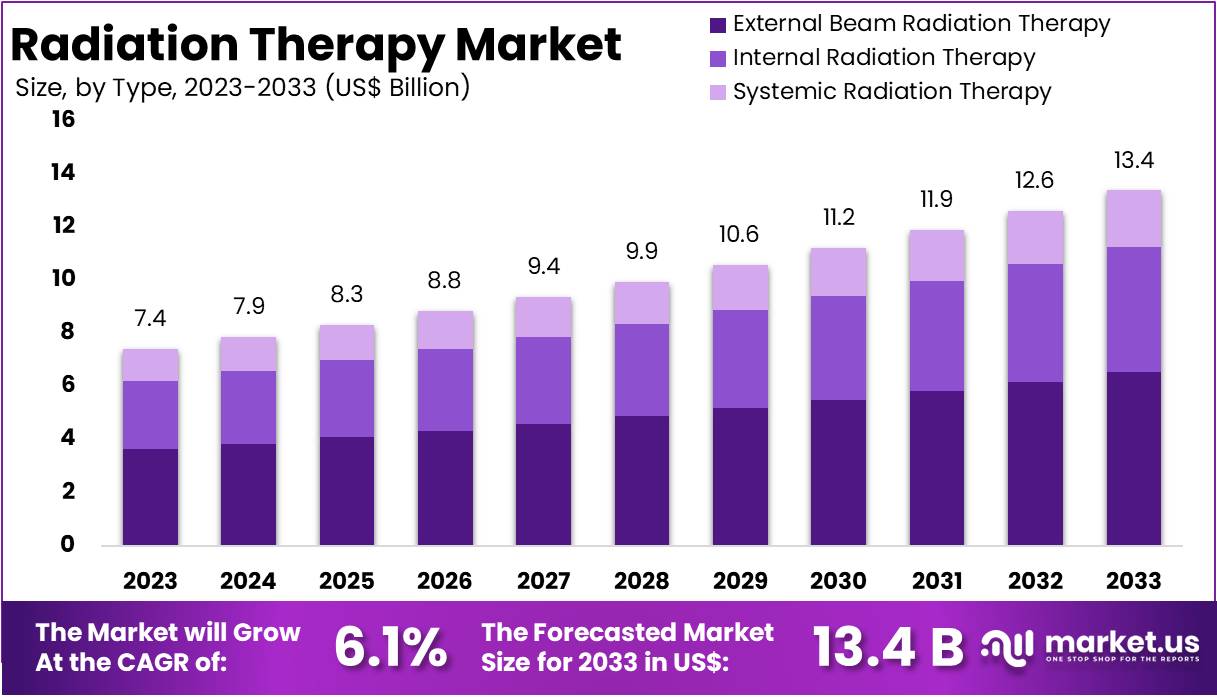
New York, NY – Feb 19, 2026 – The Global Radiation Therapy Market size is expected to be worth around US$ 13.4 Billion by 2033, from US$ 7.4 Billion in 2023, growing at a CAGR of 6.1% during the forecast period from 2024 to 2033.
Radiation therapy is a core treatment modality in modern oncology and is widely utilized in the management of various cancers. It involves the controlled use of high-energy radiation to destroy malignant cells, shrink tumors, and reduce the risk of recurrence. The therapy works by damaging the DNA of cancer cells, thereby inhibiting their ability to grow and divide. Healthy surrounding tissues are preserved through advanced targeting technologies and precise dose planning.
Radiation therapy may be delivered externally through linear accelerators or internally via brachytherapy, where radioactive sources are placed inside or near the tumor site. Technological advancements such as intensity-modulated radiation therapy (IMRT), image-guided radiation therapy (IGRT), and proton therapy have significantly improved treatment accuracy and minimized side effects. These innovations have enhanced clinical outcomes and patient safety.
The increasing global burden of cancer has strengthened the demand for effective and accessible treatment solutions. According to international health agencies, cancer incidence continues to rise due to aging populations, lifestyle factors, and improved diagnostic capabilities. As a result, radiation therapy remains an essential component of comprehensive cancer care, often used alone or in combination with surgery and chemotherapy.
Ongoing research and investment in radiation technologies are expected to further improve precision, reduce toxicity, and expand therapeutic applications, supporting continued advancements in oncology treatment worldwide.
Key Takeaways
- The global Radiation Therapy Market is expected to increase from US$ 7.4 billion in 2023 to approximately US$ 13.4 billion by 2033, reflecting a compound annual growth rate (CAGR) of 6.1% during the forecast period.
- In 2023, External Beam Radiation Therapy emerged as the dominant type segment, accounting for more than 49% of the total market share.
- Breast cancer represented the largest application segment in 2023, contributing over 28% to the overall Radiation Therapy Market revenue.
- Within the drug class category, the opioids segment held the leading position in 2023, capturing more than 28% of the market share.
- North America maintained its leading regional position in 2023, representing 44% of the global market and generating revenue of approximately US$ 3.2 billion.
Regional Analysis
In 2023, North America secured a leading share in the radiation therapy market, accounting for more than 44% of global revenue and reaching an estimated value of US$ 3.2 billion. This leadership position has been supported by a well-established healthcare system and continuous investments in advanced medical technologies. The adoption of innovative solutions, including image-guided radiation therapy (IGRT) and proton therapy, has strengthened treatment accuracy and improved clinical outcomes, thereby driving higher utilization rates across healthcare facilities.
Robust healthcare expenditure across the United States and Canada has facilitated broad access to advanced oncology treatments. Strong research and development capabilities within the region have accelerated technological innovation, improving the safety, efficiency, and effectiveness of radiation therapy procedures. In addition, favorable reimbursement frameworks, supportive regulatory pathways, and active private sector participation have encouraged the integration of next-generation radiation systems and infrastructure modernization.
A high incidence of cancer across North America has sustained consistent demand for effective therapeutic interventions, with radiation therapy remaining a central component of multidisciplinary cancer management. Accelerated regulatory approvals have enabled faster commercialization of advanced solutions, while increasing public awareness and early diagnosis programs have contributed to earlier treatment initiation. Collectively, these factors have reinforced North America’s prominent position in the global radiation therapy market.
Emerging Trends
- Shorter Treatment Schedules: Radiation therapy is increasingly adopting hypofractionation, where higher doses are delivered in fewer sessions. This approach reduces hospital visits, improves patient convenience, lowers operational burden, and enhances treatment efficiency, particularly for breast and prostate cancer management.
- Artificial Intelligence Integration: Artificial intelligence is streamlining radiation planning by automating tumor contouring and protecting healthy tissues. Treatment preparation time is significantly reduced, precision is improved, clinical errors are minimized, and overall workflow efficiency within oncology centers is strengthened.
- Expanded Access to Proton Therapy: Advancements in compact proton systems are improving affordability and accessibility. Proton therapy enables precise dose delivery with minimal damage to surrounding tissues, benefiting patients with tumors near critical organs and expanding availability beyond major academic institutions.
- Growth of Theranostics: Theranostics combines diagnostic imaging and targeted radiation within a single therapeutic agent. This approach enables accurate tumor identification, real-time monitoring, and personalized treatment delivery, supporting improved clinical outcomes in prostate and neuroendocrine cancer care.
Use Cases
- Post-Surgical Cancer Management: Radiation therapy is frequently administered after surgery to eliminate residual cancer cells. This approach reduces recurrence risk, particularly in breast and rectal cancers, and strengthens long-term treatment outcomes while minimizing the need for additional invasive procedures.
- Primary Treatment Alternative to Surgery: Radiation therapy serves as a primary treatment when surgery is not feasible. It effectively controls tumor growth in lung, head, neck, and prostate cancers, offering a non-invasive solution for patients with medical or age-related limitations.
- Management of Brain Tumors and Metastases: Radiation therapy is widely applied in treating brain tumors and metastatic lesions. Techniques such as stereotactic radiosurgery provide targeted, high-dose treatment, preserving cognitive function while reducing tumor size and controlling disease progression.
- Pediatric Brain and Spine Tumors: Radiation therapy plays a critical role in managing pediatric brain and spinal tumors. Advanced precision techniques, including proton therapy, are utilized to minimize long-term side effects while maintaining effective tumor control in developing patients.
Frequently Asked Questions on Radiation Therapy
- How does Radiation Therapy work?
Radiation therapy works by delivering controlled doses of radiation that disrupt the DNA structure of cancer cells, preventing them from multiplying. Over time, damaged cells die, and tumors shrink. Advanced imaging technologies are used to enhance targeting accuracy. - What are the main types of Radiation Therapy?
The primary types include external beam radiation therapy, brachytherapy, and proton therapy. External beam therapy directs radiation from outside the body, while brachytherapy places radioactive material near tumors. Proton therapy enables highly precise dose distribution with reduced tissue damage. - What are the common side effects of Radiation Therapy?
Common side effects include fatigue, skin irritation, and localized discomfort at the treatment site. Effects vary depending on dosage and cancer type. Most side effects are temporary and manageable through supportive care and medical supervision. - What is driving growth in the Radiation Therapy Market?
Market growth is primarily driven by rising global cancer incidence, aging populations, and increasing demand for advanced oncology treatments. Continuous technological advancements and improved healthcare infrastructure further contribute to expanded adoption across developed and emerging economies. - Which region leads the Radiation Therapy Market?
North America leads the radiation therapy market due to strong healthcare spending, advanced treatment facilities, and rapid adoption of innovative technologies. High cancer prevalence and favorable reimbursement frameworks further support the region’s dominant market position. - What technological advancements are shaping the market?
Innovations such as intensity-modulated radiation therapy (IMRT), image-guided radiation therapy (IGRT), and proton therapy are transforming treatment precision. These advancements enhance clinical outcomes, reduce side effects, and improve patient safety, strengthening overall market development.
Conclusion
Radiation therapy remains a fundamental pillar of modern oncology, supported by continuous technological innovation and expanding clinical applications. Market growth is projected to remain steady, driven by rising cancer prevalence, improved diagnostic rates, and increasing adoption of advanced treatment modalities. Strong regional leadership, particularly in North America, reflects robust healthcare infrastructure and sustained investment in research and development.
Emerging trends such as hypofractionation, artificial intelligence integration, proton therapy expansion, and theranostics are enhancing precision and efficiency. Collectively, these factors are expected to strengthen treatment outcomes, improve patient access, and support long-term expansion of the global radiation therapy market.
Discuss your needs with our analyst
Please share your requirements with more details so our analyst can check if they can solve your problem(s)




