


Table of Contents
Overview
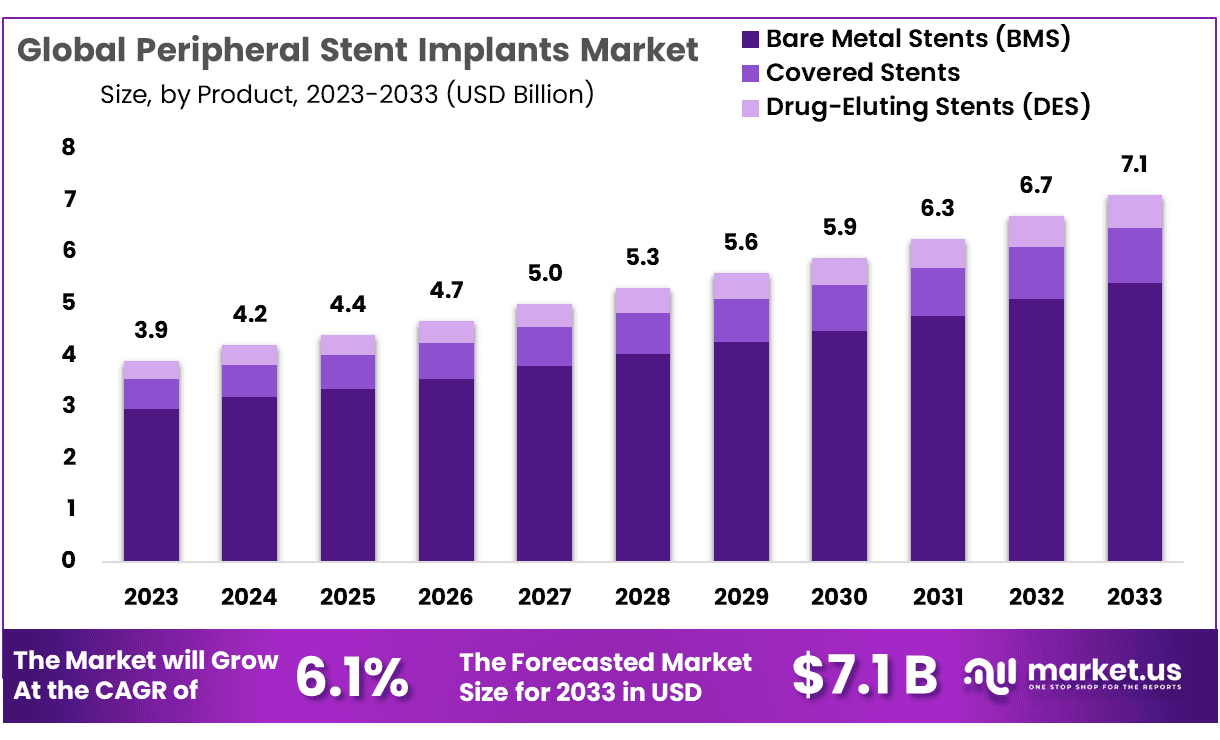
New York, NY – Jan 23, 2026 – The Global Peripheral Stent Implants Market size is expected to be worth around USD 7.1 Billion by 2033 from USD 3.9 Billion in 2023, growing at a CAGR of 6.1% during the forecast period from 2024 to 2033.
Peripheral stent implants are increasingly being adopted as a standard interventional solution for the treatment of peripheral artery disease (PAD). These devices are designed to restore and maintain blood flow in narrowed or blocked peripheral arteries, particularly in the lower extremities, where reduced circulation can lead to pain, mobility limitations, and severe clinical complications.
Peripheral stents are small, expandable metal or polymer-based structures that are implanted into affected arteries using minimally invasive catheter-based procedures. Once deployed, the stent supports the arterial wall, prevents vessel collapse, and improves long-term patency. Advances in materials science and engineering have enabled the development of self-expanding and drug-eluting peripheral stents, which are associated with improved flexibility, durability, and reduced rates of restenosis.
The growing prevalence of cardiovascular disorders, diabetes, and an aging population is contributing to the rising demand for peripheral stent implants worldwide. According to clinical observations, early diagnosis and timely intervention using stent-based therapies can significantly reduce disease progression and improve patient quality of life. Hospitals and specialty clinics remain the primary end users, supported by increasing investments in interventional cardiology and vascular surgery infrastructure.
Ongoing research and development activities are focused on enhancing stent performance, optimizing delivery systems, and expanding indications for use. Regulatory approvals and favorable reimbursement frameworks in key healthcare markets are further supporting market adoption.
Overall, peripheral stent implants continue to play a critical role in modern vascular care, offering a safe, effective, and minimally invasive treatment option for patients with peripheral arterial conditions.
Key Takeaways
- Market Size: The Peripheral Stent Implants market is projected to reach approximately USD 7.1 billion by 2033, rising from an estimated USD 3.9 billion in 2023.
- Market Growth: Market expansion is expected to occur at a compound annual growth rate (CAGR) of 6.1% over the forecast period from 2024 to 2033.
- Product Analysis: Bare Metal Stents (BMS) dominated the market in 2023, accounting for a substantial 76.0% share of total revenue.
- Artery Type Analysis: Among artery types, iliac stents emerged as the leading segment, capturing 47.6% of the overall market share.
- End-Use Analysis: Hospitals represented the largest end-use segment in 2023, contributing 58.1% of total market demand.
- Regional Analysis: The United States accounted for an estimated 42.8% market share, generating approximately USD 1.6 billion in revenue.
- Technological Advancements: Leading manufacturers, including Medtronic and Abbott Laboratories, are actively advancing peripheral stent implant technologies through innovations in design, materials, and drug-eluting features to enhance clinical outcomes.
Regional Analysis
In 2023, the United States accounted for an estimated 42.8% share of the global peripheral artery disease (PAD) market, generating approximately USD 1.6 billion in revenue. This dominant position can be attributed to the rising incidence of PAD within the country. The increase has been driven by multiple interrelated factors, including higher smoking prevalence, sedentary lifestyles, and poor dietary habits, which collectively contribute to the growing burden of cardiovascular and cerebrovascular diseases, diabetes, and an expanding ageing population.
According to data from the Centers for Disease Control and Prevention (CDC), by 2022, an estimated 6.5 million adults aged 40 years and older in the United States had been diagnosed with PAD. It should be noted that PAD presents with symptoms that frequently overlap with other vascular and non-vascular conditions, and atherosclerosis alone does not explain all PAD cases, highlighting the complexity of diagnosis and disease progression.
Emerging Trends
- Advancement of Drug-Eluting Stents (DES): Building on the proven efficacy of paclitaxel in reducing restenosis, next-generation drug-eluting stents are engineered to deliver therapeutic agents gradually over extended durations, often up to 12 months, ensuring sustained vessel patency and lowering repeat intervention rates.
- Introduction of Bioresorbable Stents: Innovations such as Abbott’s Esprit BTK System have introduced bioresorbable stents that dissolve after providing structural support and drug delivery. These devices promote natural vessel healing and represent a major advancement in managing chronic limb-threatening ischemia.
- Integration of Advanced Imaging Technologies: The adoption of intravascular ultrasound (IVUS) and optical coherence tomography (OCT) has improved procedural precision by enabling accurate stent placement and real-time assessment, thereby enhancing clinical outcomes, procedural success, and overall patient safety.
- Shift Toward Minimally Invasive Interventions: Endovascular procedures, including angioplasty with stent placement, are increasingly favored over open surgeries. These minimally invasive approaches offer shorter hospital stays, faster recovery, and reduced complication risks, supporting broader adoption across healthcare systems.
Use Cases
- Management of Peripheral Artery Disease (PAD): Peripheral stent implantation is widely used in PAD treatment, a condition affecting more than 200 million people globally. Stents restore blood flow in narrowed limb arteries, reducing pain, improving mobility, and lowering the risk of limb-threatening complications.
- Treatment of Iliac Artery Occlusions: Stents are frequently deployed in iliac artery interventions, with combined angioplasty and stenting demonstrating technical success rates of nearly 96% in aorto-iliac occlusive disease, making it a preferred approach for restoring pelvic and lower-limb circulation.
- Treatment of Femoral-Popliteal Artery Lesions: Stenting of the femoral and popliteal arteries addresses arterial blockages in the thigh and knee regions. This application significantly improves blood flow, walking ability, and overall quality of life in patients with advanced peripheral vascular disease.
- Repair of Arterial Aneurysms and Traumatic Injuries: Covered stents are utilized to treat arterial aneurysms, ruptures, and traumatic injuries by sealing damaged vessels. This minimally invasive option reduces surgical risk and recovery time compared with conventional open vascular repair techniques.
- Stroke Risk Reduction in Carotid Artery Disease: Carotid artery stenting is employed to treat significant arterial narrowing in the neck. By restoring adequate blood flow to the brain, this procedure effectively reduces stroke risk in patients unsuitable for or at high risk from open surgery.
Frequently Asked Questions on Peripheral Stent Implants
- How do peripheral stents work in treating PAD?
Peripheral stents function by mechanically supporting weakened or narrowed arterial walls after angioplasty. Once expanded, the stent maintains vessel patency, improves circulation, and reduces symptoms such as pain, cramping, and mobility limitations. - What materials are used in peripheral stent implants?
Peripheral stents are typically manufactured from nitinol or stainless steel due to their flexibility, durability, and biocompatibility. Drug-eluting coatings may also be applied to reduce restenosis by inhibiting abnormal tissue growth within the artery. - Who is eligible for peripheral stent implantation?
Patients diagnosed with moderate to severe peripheral artery disease who do not respond adequately to lifestyle changes or medication are generally considered eligible. Clinical suitability depends on lesion location, artery size, and overall patient health. - What are the risks associated with peripheral stent implants?
Although generally safe, peripheral stent implantation carries risks such as restenosis, stent fracture, infection, or thrombosis. Proper patient selection and advancements in stent design have significantly reduced complication rates over time. - What factors are driving the peripheral stent implants market growth?
Market growth is driven by rising PAD prevalence, ageing populations, increasing adoption of minimally invasive procedures, and continuous technological advancements in stent materials and drug-eluting technologies across developed and emerging healthcare markets. - Which regions dominate the peripheral stent implants market?
North America holds a leading market position due to high disease awareness, strong healthcare infrastructure, and early adoption of advanced vascular devices. Europe and Asia Pacific are also experiencing steady growth driven by expanding patient pools. - What role does technology play in market expansion?
Technological innovation plays a critical role by improving stent flexibility, durability, and clinical outcomes. Advancements such as bioresorbable stents and drug-coated platforms are enhancing treatment efficacy and supporting long-term market expansion. - How does reimbursement impact the peripheral stent implants market?
Favorable reimbursement policies in developed healthcare systems support higher adoption of peripheral stent procedures. However, limited reimbursement coverage in developing regions can restrict market penetration despite growing clinical demand.
Conclusion
In conclusion, peripheral stent implants have emerged as a cornerstone in the management of peripheral arterial diseases, driven by rising disease prevalence, technological innovation, and growing adoption of minimally invasive therapies. Continuous advancements in drug-eluting and bioresorbable stent technologies, supported by improved imaging and delivery systems, are enhancing clinical outcomes and long-term vessel patency.
Favorable reimbursement policies, expanding hospital infrastructure, and increasing awareness further support market growth. Overall, the market is expected to witness steady expansion, underpinned by unmet clinical needs, an ageing global population, and sustained investment in vascular intervention technologies.
Discuss your needs with our analyst
Please share your requirements with more details so our analyst can check if they can solve your problem(s)




