


Table of Contents
Overview
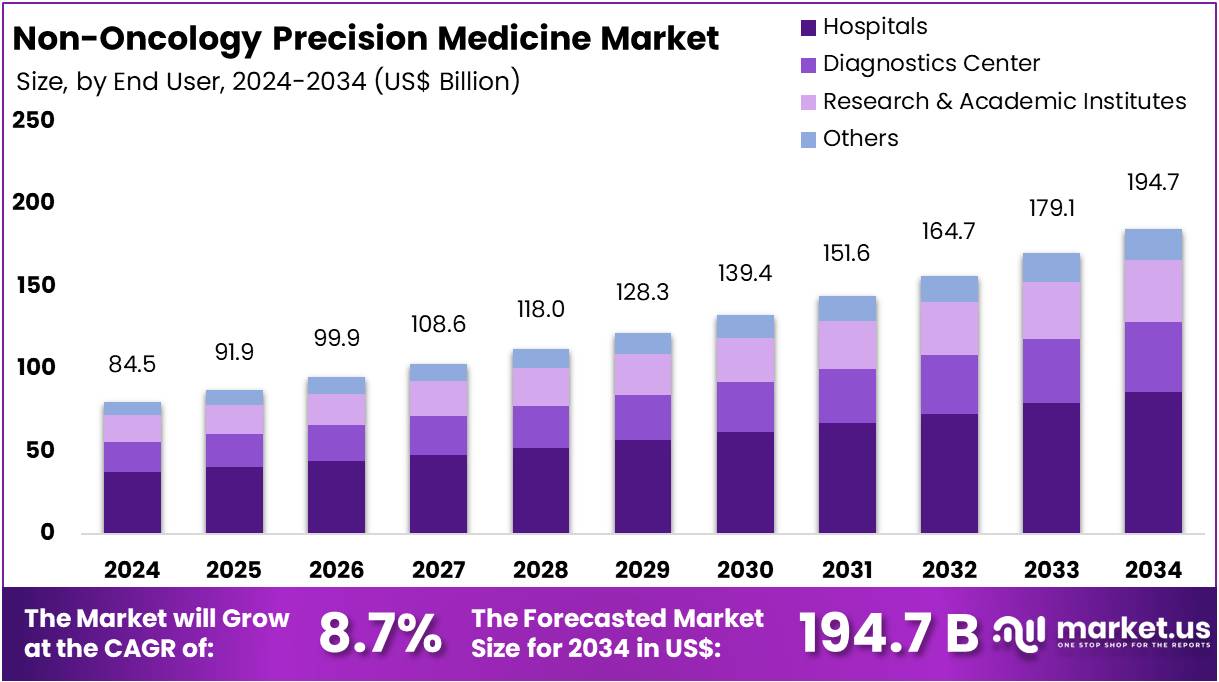
New York, NY – Dec 12, 2025 – The Global Non-Oncology Precision Medicine Market size is expected to be worth around US$ 194.7 Billion by 2034, from US$ 84.5 Billion in 2024, growing at a CAGR of 8.7% during the forecast period from 2025 to 2034. North America held a dominant market position, capturing more than a 44.2% share and holds US$ 37.3 Billion market value for the year.
Non-oncology precision medicine represents a transformative approach to disease prevention, diagnosis, and treatment by tailoring medical care to individual patient characteristics. This approach integrates genetic, molecular, environmental, and lifestyle data to support more accurate clinical decision-making across a wide range of non-cancer conditions.
The foundation of non-oncology precision medicine lies in the understanding that diseases such as cardiovascular disorders, neurological conditions, autoimmune diseases, rare genetic disorders, and metabolic syndromes show significant variability among patients. Traditional “one-size-fits-all” treatment models often result in variable outcomes. Precision medicine addresses this challenge by identifying patient subgroups most likely to benefit from specific therapies, thereby improving treatment efficacy and safety.
Key components of non-oncology precision medicine include genomics, proteomics, biomarker analysis, and advanced diagnostics. Genomic testing enables the identification of inherited or acquired genetic variations that influence disease risk and drug response. Biomarkers are used to support early diagnosis, monitor disease progression, and guide therapy selection. Digital health technologies and real-world data further enhance patient stratification and longitudinal disease management.
The adoption of non-oncology precision medicine is supported by advances in sequencing technologies, declining testing costs, and increasing clinical validation of biomarkers. Healthcare systems are gradually integrating these tools into routine practice, supported by regulatory frameworks and growing physician awareness.
Overall, non-oncology precision medicine is positioned as a critical pillar of modern healthcare. It supports improved clinical outcomes, optimized resource utilization, and a shift toward preventive and personalized care models. Continued investment in research, data infrastructure, and clinical implementation is expected to accelerate its impact across global healthcare systems.
Key Takeaways
- The global non-oncology precision medicine market was valued at US$ 84.5 billion in 2024 and is projected to reach approximately US$ 194.7 billion by 2034.
- Market expansion is expected to occur at a compound annual growth rate (CAGR) of 8.7% from 2025 to 2034, primarily supported by the rising adoption of personalized therapeutic approaches.
- In 2024, therapeutic products emerged as the leading product category, accounting for more than 74.6% of the overall non-oncology precision medicine market share.
- The central nervous system (CNS) segment represented the largest application area in 2024, capturing over 31.2% of the total application-based market share.
- Hospitals remained the dominant end-user segment in 2024, holding more than 31.2% of the global non-oncology precision medicine market share.
- North America maintained its leading regional position in 2024, accounting for over 44.2% of the global market and generating a market value of US$ 37.3 billion.
Regional Analysis
In 2024, North America maintained a leading position in the non-oncology precision medicine market, accounting for more than 44.2% of the global share and achieving a market value of US$ 37.3 billion. This dominance was supported by the region’s well-developed healthcare infrastructure and the widespread adoption of genomic and molecular technologies. A large number of hospitals and research institutions in the United States have incorporated precision medicine into standard clinical practice. The availability of advanced diagnostic platforms and strong clinical capabilities has enabled the effective use of personalized therapies across multiple non-oncology disease areas.
Government support has been a key factor in accelerating market growth. Initiatives such as the U.S. Precision Medicine Initiative have strengthened research funding and promoted technological innovation. Public health organizations have encouraged the integration of biomarkers and genomic data into routine medical care. In parallel, educational programs have enhanced awareness among healthcare professionals and patients, supporting earlier diagnosis and more effective treatment strategies for conditions including cardiovascular and neurological disorders.
The high prevalence of chronic diseases in North America has further reinforced demand for personalized treatment approaches. Data from the Centers for Disease Control and Prevention indicate that a significant proportion of the adult population is affected by long-term conditions. Targeted therapies have demonstrated improved disease management outcomes for this expanding patient base. Sustained healthcare expenditure and access to skilled professionals are expected to support continued investment in precision medicine, allowing North America to retain its dominant market position over the forecast period.
Emerging Trends
- Expansion into Chronic Disease Management: Precision medicine is being increasingly adopted for the management of chronic diseases, including cardiovascular disorders, diabetes, and neurodegenerative conditions. Through the analysis of genetic and molecular profiles, individualized treatment strategies can be developed, enabling therapies to be better aligned with patient-specific disease characteristics.
- Integration of Artificial Intelligence (AI): Artificial intelligence is strengthening precision medicine capabilities by supporting the analysis of large and complex datasets, such as genomic, proteomic, and clinical data. This integration is facilitating earlier disease detection, improved risk stratification, and the development of more targeted therapeutic approaches.
- Advancements in Genomic Technologies: Technological progress in next-generation sequencing (NGS) and gene-editing platforms, including CRISPR, has significantly advanced precision medicine. These tools support comprehensive genetic profiling and offer the potential to modify disease-causing genetic variants, contributing to improved treatment effectiveness.
- Growing Focus on Preventive Care: Predictive genomics is enabling the early identification of individuals with a higher risk of developing specific diseases. This preventive approach supports timely interventions, lifestyle adjustments, and ongoing monitoring, thereby reducing the likelihood of disease progression.
- Development of Non-Invasive Diagnostic Solutions: Non-invasive diagnostic technologies, such as liquid biopsies, are gaining prominence. By detecting biomarkers in bodily fluids, these tools provide safer and more patient-friendly alternatives to conventional tissue biopsies while supporting continuous disease monitoring.
Key Use Cases
- Cardiovascular Disease Management: Pharmacogenomic testing is used to assess patient-specific drug metabolism for therapies such as clopidogrel and warfarin. This enables optimized dosing strategies, minimizes adverse reactions, and improves clinical outcomes.
- Diabetes Prevention and Treatment: Genetic screening is applied to identify individuals at elevated risk of developing type 2 diabetes, allowing for early lifestyle interventions. Personalized treatment regimens based on genetic insights further support improved glycemic control and reduced complication rates.
- Neurological Disorders: In neurological conditions, including Alzheimer’s and Parkinson’s diseases, precision medicine approaches help identify genetic risk factors. Tailored interventions are being explored to slow disease progression and enhance patient quality of life.
- Autoimmune Disease Management: Precision medicine is increasingly utilized in autoimmune disorders such as rheumatoid arthritis and lupus. Genetic and molecular analyses are used to predict disease activity and therapeutic response, enabling more effective and targeted disease management.
- Infectious Disease Management: AI-enabled precision medicine approaches are being applied in infectious disease management by integrating genomic, proteomic, and clinical data. This supports rapid pathogen identification and the customization of treatment strategies.
Frequently Asked Questions on Non-Oncology Precision Medicine
- Which diseases are commonly addressed through non-oncology precision medicine?
Non-oncology precision medicine is widely applied in cardiovascular diseases, diabetes, autoimmune disorders, neurological conditions, infectious diseases, and rare inherited disorders, where patient-specific variability significantly influences disease progression and treatment response. - What technologies support non-oncology precision medicine?
Key technologies include genomics, proteomics, transcriptomics, biomarker analysis, companion diagnostics, artificial intelligence, and advanced bioinformatics platforms, which collectively enable precise disease stratification, risk assessment, and personalized therapeutic decision-making. - How does precision medicine improve patient outcomes in non-oncology fields?
Patient outcomes are improved through early disease detection, optimized drug selection, reduced adverse reactions, and enhanced treatment efficacy, as therapies are aligned with individual biological profiles rather than generalized population-based treatment approaches. - What role do biomarkers play in non-oncology precision medicine?
Biomarkers are used to predict disease susceptibility, monitor disease progression, assess treatment response, and guide therapy selection, thereby supporting evidence-based clinical decisions and improving overall healthcare efficiency and effectiveness. - What factors are driving the growth of the non-oncology precision medicine market?
Market growth is driven by rising prevalence of chronic diseases, increasing adoption of genomic technologies, expanding biomarker research, advancements in data analytics, and growing demand for personalized healthcare solutions across global healthcare systems. - How large is the commercial potential of the non-oncology precision medicine market?
The market demonstrates strong commercial potential due to broad disease applicability, expanding clinical use cases, increasing healthcare investments, and continuous technological innovation, positioning it as a high-growth segment within the broader precision medicine industry. - How is the market expected to evolve over the next decade?
The market is expected to evolve through increased integration of artificial intelligence, expanded multi-omics applications, improved regulatory clarity, and wider clinical adoption, supporting sustained growth and deeper penetration across non-oncology therapeutic areas.
Conclusion
Non-oncology precision medicine is reshaping modern healthcare by enabling more accurate, individualized, and preventive care across a broad range of chronic and complex diseases. By integrating genomics, biomarkers, advanced diagnostics, and data-driven technologies, this approach addresses the limitations of traditional treatment models and improves clinical outcomes.
Strong market growth is supported by technological innovation, expanding clinical validation, and rising demand for personalized therapies. With continued investment in research, digital infrastructure, and clinical adoption, non-oncology precision medicine is expected to play a central role in improving healthcare efficiency, patient outcomes, and long-term disease management globally.
Discuss your needs with our analyst
Please share your requirements with more details so our analyst can check if they can solve your problem(s)




