


Table of Contents
Overview
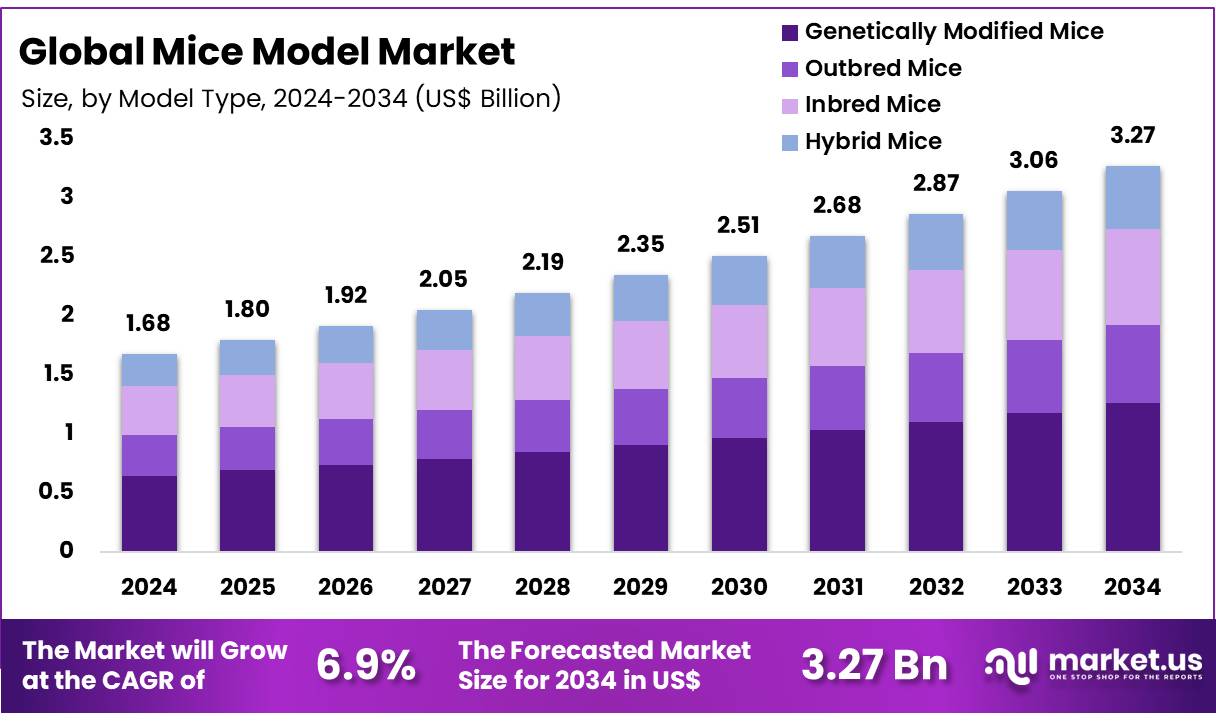
New York, NY – Dec 17, 2025 – Global Mice Model Market size is expected to be worth around US$ 3.27 Billion by 2034 from US$ 1.68 Billion in 2024, growing at a CAGR of 6.9% during the forecast period 2025 to 2034. In 2024, North America led the market, achieving over 39.4% share with a revenue of US$ 661.9 Million.
Mice models are widely recognized as a fundamental tool in biomedical and life science research. Their basic formation involves the use of laboratory mice that are genetically, biologically, and behaviorally similar to humans, allowing researchers to study disease mechanisms and evaluate therapeutic approaches under controlled conditions.
The formation of a mice model typically begins with the selection of a specific mouse strain based on the research objective. These strains may be inbred, outbred, or genetically engineered to express or suppress particular genes. Genetic modification is commonly achieved through techniques such as transgenesis, gene knockout, or gene knock-in, enabling precise replication of human disease conditions. Once developed, the mice are bred and maintained in standardized laboratory environments to ensure consistency, reproducibility, and reliability of results.
Mice models are extensively used in areas such as oncology, immunology, neuroscience, and metabolic disorders. Their short life cycle, well-mapped genome, and cost-effective maintenance contribute to their widespread adoption across academic, pharmaceutical, and biotechnology research settings. Additionally, mice models play a critical role in preclinical testing, where the safety, efficacy, and pharmacokinetics of new drug candidates are evaluated before human clinical trials.
Overall, the structured formation of mice models supports high-quality scientific research and accelerates the development of innovative treatments. Continued advancements in genetic engineering technologies are expected to further enhance the relevance and precision of mice models in translational and clinical research.
Key Takeaways
- In 2024, the mice model market generated revenue of US$ 1.68 billion and is projected to expand at a CAGR of 6.9%, reaching US$ 3.27 billion by 2034.
- By model type, the market is categorized into genetically modified mice, outbred mice, inbred mice, and hybrid mice. Genetically modified mice accounted for the largest share in 2024, representing 38.5% of total revenue.
- Based on service, the market is segmented into breeding services, cryopreservation, rederivation services, quarantine services, and other services. Breeding services dominated the segment with a 47.2% market share in 2024.
- In terms of technology, the market includes CRISPR/Cas9, embryonic stem cell injection, nuclear transfer, microinjection, physiological monitoring, and others. CRISPR/Cas9 emerged as the leading technology, capturing 46.9% of the revenue share.
- By application, the market is classified into oncology, neurology, cardiovascular diseases, immunology, metabolic diseases, toxicology studies, infectious diseases, and others. Oncology led the market in 2024 with a 32.5% share.
- On the basis of end user, the market is divided into pharmaceutical & biotechnology companies, research laboratories, contract research organizations (CROs), and hospitals & clinics. Pharmaceutical & biotechnology companies held the dominant position, accounting for 41.6% of the market share in 2024.
- North America led the global mice model market in 2024, securing a 39.4% share of total revenue.
Regional Analysis
North American mice model market is poised for continued growth which dominated the global market with 39.4% market share, driven by ongoing advancements in genetic engineering, a strong research ecosystem, and increasing demand for personalized medicine. The region’s leadership in biomedical research and development positions it as a key player in the global mice model market.
In February 2025, a research team led by Professor Jiyue Zhu from the WSU College of Pharmacy and Pharmaceutical Sciences has developed mice with human-like short telomeres, allowing for the study of cellular aging in a way that closely mimics human biology and organ systems. Typically, mice have telomeres that are up to 10 times longer than those of humans. Professor Zhu received US$5 million in grants to further develop this mouse model, which simulates human replicative aging, as well as to explore the potential implications for cancer research.
Emerging Trend
- Rise of Genetically Engineered Mice: The adoption of genetically engineered mice is increasing across research laboratories. These models replicate human diseases such as cancer and diabetes, enabling accurate disease studies. Their use improves preclinical testing quality, accelerates drug development, and lowers late-stage clinical trial failure risks.
- Shift Toward Humanized Mice: Humanized mice, containing human cells or immune systems, are gaining strong adoption. They enable precise evaluation of human-specific diseases, particularly in immuno-oncology and infectious research. These models support improved vaccine development, immune-response analysis, and targeted therapy validation.
- Growth in Personalized Medicine Research: Mouse models are increasingly applied in personalized medicine research. Genetically tailored mice reflect specific patient populations, enabling evaluation of individualized drug responses. This approach enhances treatment precision, improves safety profiling, and supports faster development of customized therapeutic strategies.
- Integration of CRISPR Gene-Editing Technology: CRISPR gene-editing has significantly improved the speed and accuracy of mouse model development. It enables precise genetic modifications, supports rare disease research, and reduces model creation timelines. This technology enhances mutation-specific studies and accelerates targeted drug discovery processes.
- Increase in Preclinical Drug Testing: Mouse models remain essential in preclinical drug evaluation. They provide early insights into safety, efficacy, and biological response, reducing development risks. Growing pharmaceutical pipelines continue to drive demand, as regulatory compliance requires robust animal-based safety validation.
Use Cases
- Cancer Research: Mouse models are widely used to replicate human tumor behavior. They enable evaluation of drug effectiveness, immune response, and cancer progression. These studies improve therapy selection accuracy, reduce clinical risk, and support development of innovative oncology treatments.
- Neurological Disorder Studies: Genetically modified mice model neurological conditions such as Alzheimer’s and Parkinson’s disease. They support analysis of disease progression, brain function changes, and therapeutic impact. These models are critical for identifying effective treatments while minimizing risks associated with human testing.
- Infectious Disease Research: Mouse models are essential for studying viral and bacterial infections. They enable immune response evaluation, vaccine testing, and treatment validation. These models played a vital role in flu and COVID-19 research, supporting safer and faster public health solutions.
- Diabetes and Metabolic Disorder Testing: Genetically altered mice are used to study diabetes and metabolic disorders. They allow long-term observation of disease progression, organ impact, and treatment outcomes. These models support safer drug testing and faster development of effective metabolic therapies.
- Toxicology and Safety Testing: Mice are extensively used in toxicology studies to assess safety, dosage limits, and side effects of new substances. These tests support regulatory approval, identify long-term risks, and ensure public safety before advancing compounds to human clinical trials.
Frequently Asked Questions on Mice Model
- What is a mice model in biomedical research?
A mice model refers to laboratory mice used to study human diseases, biological processes, and drug responses. These models are genetically, chemically, or surgically modified to replicate specific human disease conditions accurately. - Why are mice models widely used in scientific research?
Mice models are widely used due to their genetic similarity to humans, short reproductive cycles, and ease of genetic manipulation. These factors allow efficient disease modeling, faster experimentation, and cost-effective preclinical research outcomes. - What are the main types of mice models?
The main types of mice models include inbred mice, transgenic mice, knockout mice, humanized mice, and disease-induced models. Each type is designed to address specific research objectives and experimental requirements. - How are genetically modified mice models developed?
Genetically modified mice models are developed using techniques such as CRISPR-Cas9, microinjection, or embryonic stem cell manipulation. These methods enable precise gene insertion, deletion, or modification to study gene function. - What diseases are commonly studied using mice models?
Mice models are commonly used to study cancer, cardiovascular diseases, neurological disorders, autoimmune conditions, metabolic diseases, and infectious diseases. Their adaptability makes them essential for understanding disease mechanisms and therapeutic responses. - What factors are driving the growth of the mice model market?
Market growth is driven by increasing biomedical research activities, rising demand for personalized medicine, expanding pharmaceutical pipelines, and advancements in genetic engineering technologies. Government and private funding for life sciences also support expansion. - Which end-users dominate the mice model market?
Pharmaceutical and biotechnology companies dominate the mice model market, followed by academic and research institutes. Contract research organizations are also gaining importance due to outsourcing trends in preclinical drug development activities. - Which regions lead the mice model market?
North America leads the mice model market due to strong research infrastructure, high R&D investment, and presence of major industry players. Europe and Asia-Pacific follow, supported by growing biotechnology sectors and government research initiatives.
Conclusion
The mice model market remains a cornerstone of biomedical and life science research, supporting robust disease modeling, preclinical testing, and therapeutic innovation. Strong adoption of genetically engineered and humanized mice, combined with rapid integration of CRISPR/Cas9 technology, has significantly improved model precision and research efficiency.
Growth is being sustained by expanding pharmaceutical pipelines, rising personalized medicine research, and increased funding for life sciences. North America continues to lead due to advanced research infrastructure and innovation capacity. Overall, mice models are expected to play an increasingly critical role in accelerating translational research and improving clinical outcomes worldwide.
Discuss your needs with our analyst
Please share your requirements with more details so our analyst can check if they can solve your problem(s)




