


Table of Contents
Overview
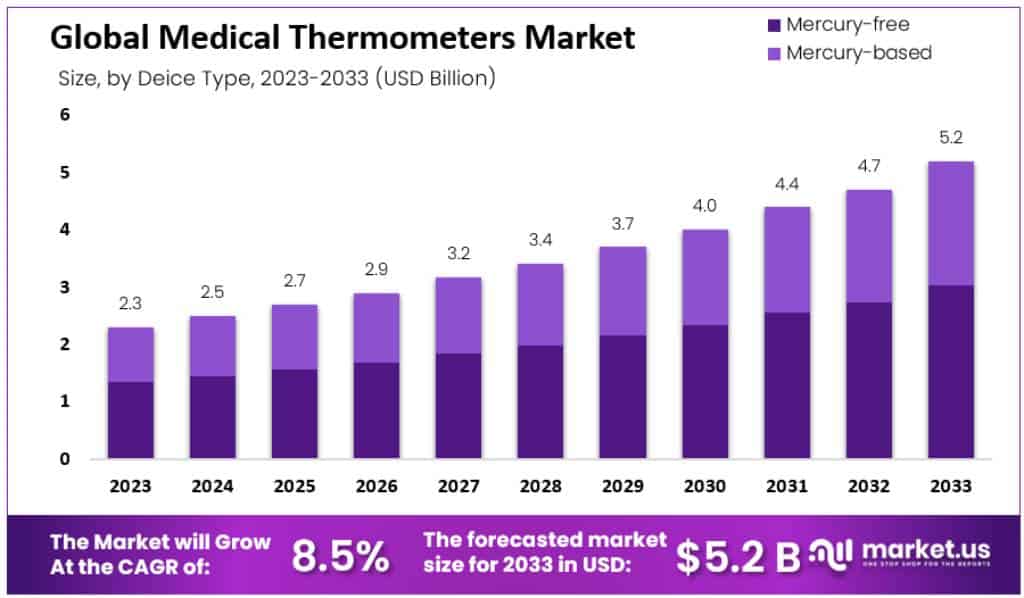
New York, NY – Jan 21, 2026 – The Global Medical Thermometer Market size is expected to be worth around USD 5.2 Billion by 2033, from USD 2.3 Billion in 2023, growing at a CAGR of 8.5% during the forecast period from 2024 to 2033.
The medical thermometer is a critical diagnostic device used to measure body temperature accurately and efficiently. It plays an essential role in clinical settings, hospitals, diagnostic centers, and home healthcare environments. The growing focus on early disease detection and routine health monitoring has increased the importance of reliable temperature measurement devices worldwide.
Medical thermometers are designed using advanced sensing technologies to ensure precision, safety, and ease of use. Traditional mercury-based thermometers have largely been replaced by digital, infrared, and smart thermometers due to safety concerns and regulatory restrictions. Digital thermometers are widely adopted for their affordability and accuracy, while infrared thermometers are preferred in clinical and public settings because they allow non-contact measurement and reduce the risk of cross-contamination.
The rising prevalence of infectious diseases, along with increased awareness of personal health monitoring, has supported the steady demand for medical thermometers. The expansion of home healthcare services and remote patient monitoring has further strengthened market adoption. In addition, technological advancements such as Bluetooth-enabled thermometers and mobile application integration have enhanced user convenience and data tracking capabilities.
From a manufacturing perspective, product development is focused on improving response time, accuracy, and user comfort. Compliance with international quality and safety standards remains a key priority across the industry.
In conclusion, the medical thermometer continues to be a fundamental medical device with stable demand across healthcare systems. Ongoing innovation and growing preventive healthcare practices are expected to support its sustained relevance in both professional and consumer healthcare segments.
Key Takeaways
- Market Size: The global medical thermometer market is expected to expand from USD 2.3 billion in 2023 to nearly USD 5.2 billion by 2033.
- Market Growth: Growth is projected at a compound annual growth rate (CAGR) of 8.5% over the forecast period from 2024 to 2033.
- Device Type Analysis: In 2023, mercury-free medical thermometers represented more than 58.2% of total market revenue, supported by increasing adoption of safer and environmentally compliant products.
- Patient Demographic Analysis: Adults accounted for the largest share of the medical thermometer market, contributing over 67.2% of total demand in 2023.
- Point of Measurement Analysis: Adult-use thermometers maintained a leading position, capturing more than 67.2% of the market share in 2023.
- Regional Analysis: North America dominated the global market with a 37.5% share, generating approximately USD 0.862 billion in revenue in 2023.
Regional Analysis
North America dominated the medical thermometer market in 2023, accounting for a 37.5% share valued at USD 0.862 billion, and is expected to retain its leading position throughout the forecast period. Market growth in the region is supported by the strong presence of key industry players, high incidence of infectious diseases, continuous technological innovation, and increasing adoption of self-healthcare practices.
The United States plays a central role, driven by robust healthcare policies, a large patient population, and advanced healthcare infrastructure. High rates of infectious conditions, including influenza and parasitic diseases, have significantly increased physician visits, thereby strengthening demand for medical thermometers.
Product innovation further supports regional growth, with the introduction of wearable and continuous monitoring thermometers incorporating advanced sensors and artificial intelligence. Such developments are enhancing accuracy and user convenience, accelerating market adoption across clinical and homecare settings.
The Asia-Pacific market is projected to experience substantial growth during the forecast period, supported by a large population base, rising disposable incomes, and a high burden of infectious diseases such as COVID-19, influenza, and tuberculosis. Improvements in healthcare infrastructure and clinical development in countries including India, China, and Japan are expected to further drive demand.
Europe is anticipated to hold a significant market share, driven by increasing healthcare expenditure, widespread adoption of digital and non-contact thermometers, expanding telemedicine services, and the strong presence of established market participants across major economies such as Germany, the UK, and France.
Emerging Trends in Medical Thermometers
- Shift toward mercury-free digital thermometers: A clear transition is being observed from traditional mercury-based thermometers to mercury-free digital alternatives. This shift is driven by improved safety, elimination of mercury-related health risks, and faster measurement times. Digital thermometers also offer consistent accuracy, making them suitable for both clinical and household applications.
- Rising adoption of non-contact infrared technology: Non-contact infrared thermometers have gained widespread acceptance, particularly during global health emergencies such as the COVID-19 pandemic. These devices enable temperature measurement without physical contact, significantly reducing the risk of cross-contamination. Regulatory bodies, including the U.S. Food and Drug Administration (FDA), recognize their effectiveness in infection control practices.
- Growth of smart thermometers with connectivity features: Technological advancements have supported the development of smart thermometers with wireless connectivity. These devices can synchronize with smartphones and digital platforms, allowing continuous temperature tracking, data storage, and health insights. Market players such as Kinsa have demonstrated the value of app-enabled thermometers in personal health management.
- Improvement in accuracy through machine learning applications: Machine learning techniques are increasingly being explored to enhance the precision of temperature measurement, particularly in infrared thermography. By analyzing large datasets and identifying measurement patterns, these algorithms aim to reduce errors and improve fever detection reliability, supporting early diagnosis and intervention.
- Integration with comprehensive health monitoring ecosystems: Medical thermometers are progressively being integrated into broader health monitoring systems. Innovations such as smart health mirrors and connected wellness platforms combine temperature data with other physiological indicators, offering a more holistic assessment of individual health status.
Key Use Cases of Medical Thermometers
- Clinical and hospital settings: Medical thermometers play a critical role in hospitals and clinics for continuous patient monitoring. Accurate body temperature measurement is essential for diagnosing infections, assessing disease progression, and guiding treatment decisions. During infectious disease outbreaks, routine temperature screening has become a standard clinical protocol.
- Home healthcare and personal use: In home environments, thermometers are widely used for monitoring fever and managing common illnesses. Digital thermometers are preferred due to their simplicity, rapid results, and reliable accuracy, making them suitable for self-care and family use.
- Occupational health and workplace safety: Various industries, including manufacturing and food services, utilize thermometers to monitor employee health and prevent workplace transmission of illnesses. Non-contact infrared thermometers are particularly effective for rapid screening in high-traffic work environments.
- Educational institutions: Schools, colleges, and daycare centers regularly conduct temperature checks to minimize the spread of infectious diseases. Early identification of fever among students supports timely medical attention and helps maintain a safe learning environment.
- Travel hubs and public venues: Transportation centers and large public venues have implemented temperature screening as a preventive health measure. Airports, railway stations, and event locations use thermometers to identify individuals with elevated body temperatures, supporting public health surveillance in crowded settings.
Frequently Asked Questions on Medical Thermometer
- What is a medical thermometer and how does it work?
A medical thermometer is a diagnostic device used to measure human body temperature. It works by detecting heat through sensors such as mercury, infrared, or digital probes, converting temperature variations into readable numerical values. - What are the main types of medical thermometers available?
Medical thermometers are available as digital thermometers, infrared thermometers, mercury-in-glass thermometers, and ear or forehead thermometers. Each type differs in measurement method, accuracy level, response time, and suitability for clinical or home use. - What factors are driving the growth of the medical thermometer market?
The growth of the medical thermometer market is driven by rising prevalence of infectious diseases, increased health awareness, expanding geriatric population, and growing demand for home-based healthcare monitoring and non-contact diagnostic devices globally. - How large is the medical thermometer market and what is its growth outlook?
The medical thermometer market is experiencing steady growth, supported by technological advancements and increasing healthcare expenditure. The market outlook remains positive due to continuous innovation, rising hospital admissions, and expanding use in preventive healthcare settings. - Which end users contribute most to medical thermometer demand?
Hospitals, clinics, diagnostic centers, and homecare settings are major end users of medical thermometers. Demand from homecare environments has increased significantly due to remote patient monitoring trends and growing preference for self-diagnosis tools. - How has technology impacted the medical thermometer market?
Technological advancements have improved accuracy, response time, and usability of medical thermometers. Innovations such as infrared sensing, Bluetooth connectivity, and smart digital displays have enhanced adoption across clinical and consumer healthcare segments worldwide.
Conclusion
The global medical thermometer market remains a vital component of modern healthcare, driven by its essential role in disease detection, patient monitoring, and preventive care. The transition toward mercury-free, digital, infrared, and smart thermometers has improved safety, accuracy, and ease of use across clinical and home settings.
Rising infectious disease prevalence, expanding home healthcare, and technological advancements continue to support market growth. With strong demand across regions, particularly North America and Asia-Pacific, and sustained innovation focused on precision and connectivity, the medical thermometer market is expected to maintain steady growth and long-term relevance through 2033.
Discuss your needs with our analyst
Please share your requirements with more details so our analyst can check if they can solve your problem(s)




