


Table of Contents
Overview
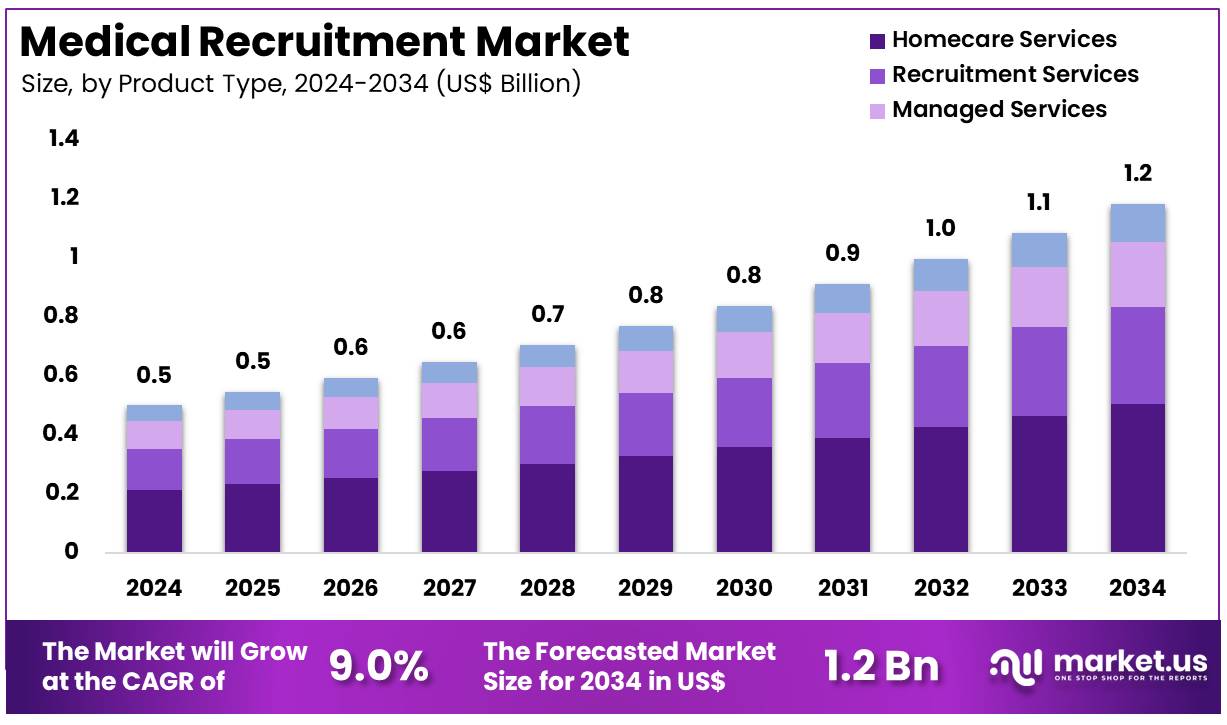
New York, NY – Dec 03, 2025 – Global Medical Recruitment Market size is expected to be worth around US$ 1.2 Billion by 2034 from US$ 0.5 Billion in 2024, growing at a CAGR of 9.0% during the forecast period 2025 to 2034. In 2023, North America’s market share exceeded 37.2%, translating into a revenue of US$ 0.2 Billion.
The medical recruitment market has been expanding steadily as healthcare systems worldwide experience rising demand for qualified professionals. The increasing prevalence of chronic diseases, the aging of the global population, and the continuous development of specialized medical services have created a sustained need for trained physicians, nurses, and allied health staff. The growth of the market has been reinforced by the widening skills gap in many regions, where healthcare institutions face persistent shortages in critical specialties.
Digitalization has played a central role in reshaping recruitment processes. The adoption of AI-enabled platforms, tele-interviewing tools, and automated screening systems has improved candidate matching accuracy and reduced hiring timelines. These technologies have supported staffing agencies in meeting the evolving expectations of hospitals and clinics that require faster and more reliable hiring solutions.
The expansion of private healthcare facilities, particularly in emerging markets, has contributed to increased recruitment activity. Government initiatives aimed at strengthening national healthcare infrastructures have further supported the market’s progression. Cross-border hiring has also become more significant, as countries with workforce deficits seek international talent to maintain service quality.
Demand continues to rise for temporary, locum, and contract-based placements, driven by the need for workforce flexibility and cost efficiency. The trend toward value-based care is creating additional emphasis on recruiting professionals with specialized training in diagnostics, patient management, and advanced treatment protocols.
Overall, the medical recruitment industry is positioned for continued growth as healthcare providers prioritize staffing stability, operational resilience, and improved patient outcomes.
Key Takeaways
- In 2024, the medical recruitment market recorded revenue of US$ 0.5 billion and exhibited a CAGR of 9.0%, with projections indicating an expansion to US$ 1.2 billion by 2034.
- By product type, the market is categorized into recruitment services, homecare services, managed services, and specialist care services. Homecare services emerged as the leading segment in 2024, accounting for 42.7% of the total share.
- Based on application, the market includes pharmaceuticals & biotechnology, nursing/healthcare, medical devices, and others. The pharmaceuticals & biotechnology segment held a dominant share of 47.5% in 2024.
- North America remained the leading regional market, representing 37.2% of the global share in 2024.
Regional Analysis
North America is Leading the Medical Recruitment Market
North America held the largest share of the medical recruitment market in 2024, accounting for 37.2% of global revenue. The region’s dominant position can be attributed to a sustained shortage of healthcare professionals across multiple specialties.
According to the Health Resources and Services Administration (HRSA), a shortage of registered nurses (RNs) is projected to continue through 2037, with data since 2022 showing a persistent imbalance between RN supply and demand. In addition, the Bureau of Labor Statistics indicates that healthcare occupations are expected to grow at a rate significantly higher than the average for all occupations, creating further pressure on recruitment activities to meet rising workforce requirements.
Asia Pacific to Register the Fastest CAGR During the Forecast Period
The Asia Pacific region is projected to exhibit the highest CAGR over the forecast period, supported by the increasing need for healthcare services driven by a growing and aging population. Many countries in the region are actively expanding their healthcare infrastructure, resulting in heightened demand for trained medical personnel.
Rising awareness of quality healthcare, increasing healthcare expenditure, and the rapid growth of the private healthcare sector are expected to reinforce recruitment efforts. As private healthcare providers expand their capabilities, competitive hiring of skilled professionals will further stimulate the medical recruitment market in Asia Pacific.
Emerging Trends
- Rapid Expansion of Healthcare Job Opportunities: The healthcare sector is expected to generate nearly 1.9 million job openings annually from 2023 to 2033, supported by employment growth and workforce replacement needs. During the same period, total U.S. employment is projected to rise by 6.7 million positions, with healthcare and social assistance contributing the largest share of overall national employment growth.
- Persistent Workforce Shortages Driving Aggressive Recruitment: A nationwide shortage of 207,980 full-time-equivalent registered nurses and 302,440 licensed practical nurses is anticipated by 2037, creating heightened competition for qualified talent. Primary care is expected to face a deficit of 87,150 physician FTEs, reinforcing the urgency for targeted recruitment strategies, particularly in underserved and high-need regions.
- Increased Government Investment in Workforce Expansion: In fiscal year 2024, HRSA allocated more than US$ 19 million to strengthen nursing education, practice, quality, and retention initiatives, with priority given to rural and underserved communities. These investments support nurse training, clinical rotation capacity, and retention programs, signaling a strategic policy focus on enhancing the recruitment pipeline through direct financial incentives.
- Adoption of Digital Recruitment Platforms: The Health Workforce Connector, administered by HRSA’s National Health Service Corps (NHSC), is being utilized for vacancy posting, candidate search, and talent matching. By the end of FY 2024, the platform supported 17,419 clinicians in high-need communities, illustrating the growing role of digital tools in streamlining recruitment and improving clinician placement efficiency.
Use Cases
- NHSC Health Workforce Connector for Rural Sites: NHSC-approved sites in federally designated Health Professional Shortage Areas rely on the Health Workforce Connector to advertise vacancies, review more than 17,000 clinician profiles, and manage applications. This tool has been vital in addressing primary care shortages affecting approximately 75 million residents living in underserved zones.
- Nurse Corps Loan Repayment Program Incentives: Through a two-year service commitment at NHSC-approved locations, 13,627 clinicians received loan repayment benefits in FY 2024. Healthcare facilities use this program to attract and retain nursing professionals, particularly in primary care and substance use disorder treatment, supporting workforce stability in high-demand specialties.
- State-Level Recruitment via HPSA Designations: State and territorial primary care offices identify Health Professional Shortage Areas and coordinate with HRSA to facilitate clinician recruitment. By 2024, about 75 million individuals lived in primary care HPSAs, and enhanced site approval processes and incentive eligibility have strengthened targeted recruitment activities in these critical shortage regions.
Frequently Asked Questions on Medical Recruitment
- What is medical recruitment?
Medical recruitment refers to the systematic process of identifying, screening, and hiring qualified healthcare professionals. The process is driven by talent shortages, workforce mobility, and increasing demand for skilled clinicians across hospitals, clinics, and specialized healthcare facilities globally. - Why is medical recruitment important for healthcare organizations?
Medical recruitment is essential because healthcare delivery depends on adequate staffing levels. The process ensures that qualified professionals are placed in roles that support patient care quality, regulatory compliance, operational continuity, and long-term institutional performance in dynamic healthcare environments. - What roles are typically filled through medical recruitment?
Medical recruitment commonly includes physicians, nurses, allied health professionals, laboratory technicians, therapists, and administrative medical staff. Demand for these roles is influenced by healthcare expansion, aging populations, and the increasing complexity of treatment protocols within care settings. - How is technology influencing medical recruitment?
Technology has enabled efficient candidate sourcing through digital platforms, AI-based screening, automated credential verification, and tele-interviews. These advancements support faster hiring cycles, improved accuracy, and stronger alignment between candidate competencies and workforce needs across healthcare organizations. - Which regions contribute significantly to market expansion?
North America and Europe dominate due to established healthcare systems, while Asia-Pacific is experiencing rapid growth. Expansion in these regions is driven by rising investments, workforce shortages, and increased adoption of recruitment outsourcing by healthcare providers. - Who are the key stakeholders in the medical recruitment market?
Stakeholders include recruitment agencies, healthcare organizations, staffing firms, training institutions, and regulatory bodies. Their activities influence talent pipelines, workforce planning strategies, and compliance frameworks that shape the structure and performance of the medical recruitment ecosystem.
Conclusion
The medical recruitment market is expected to maintain steady expansion as healthcare systems worldwide face persistent workforce shortages and rising service demands. Growth has been supported by digital recruitment technologies, government-backed workforce initiatives, and the rapid development of private healthcare infrastructure.
Strong hiring activity across pharmaceuticals, biotechnology, and homecare services continues to reinforce market performance. North America retains a leading position, while Asia Pacific is projected to grow most rapidly. Increasing job creation, escalating skills gaps, and greater reliance on flexible staffing models indicate that recruitment activities will remain central to sustaining healthcare delivery and improving patient outcomes over the coming decade.
Discuss your needs with our analyst
Please share your requirements with more details so our analyst can check if they can solve your problem(s)




