


Table of Contents
Overview
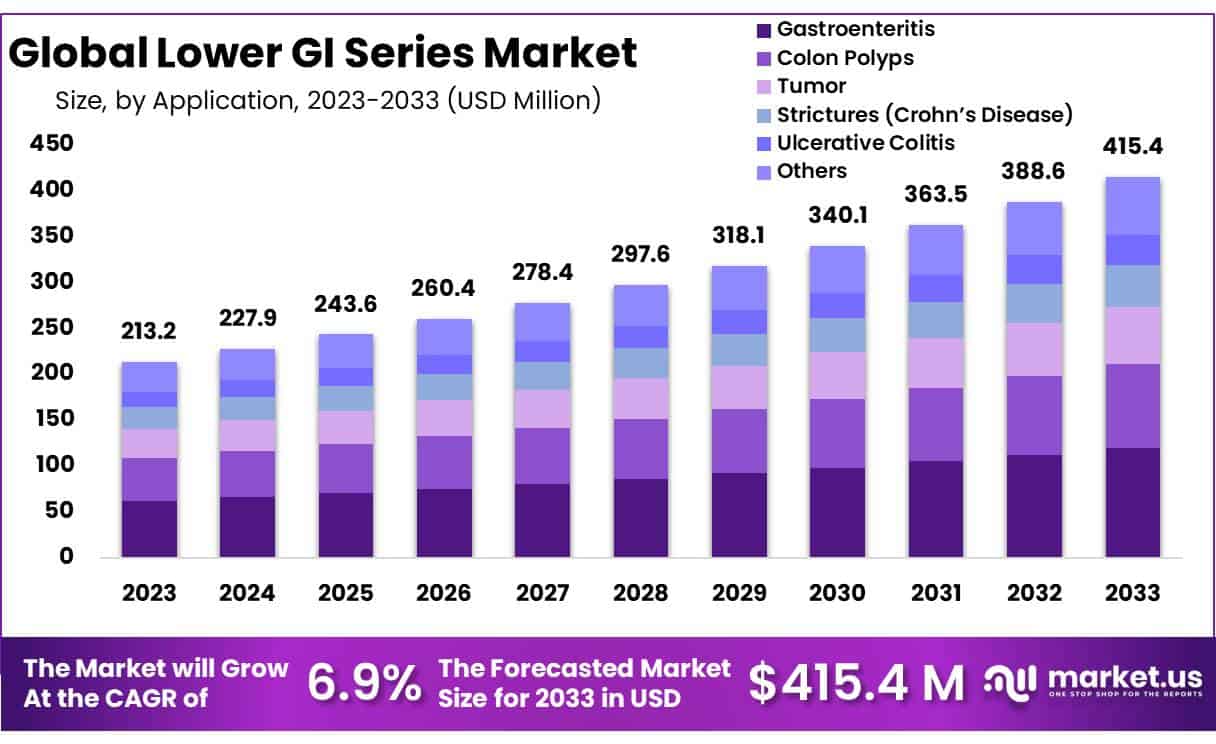
New York, NY – Jan 30, 2026 – The Global Lower GI Series Market size is expected to be worth around USD 415.4 Billion by 2033 from USD 213.2 Billion in 2023, growing at a CAGR of 6.9% during the forecast period from 2024 to 2033.
A Lower Gastrointestinal (GI) Series is a diagnostic imaging procedure widely used for the evaluation of the large intestine, including the colon and rectum. The procedure plays a significant role in identifying structural abnormalities, inflammatory conditions, and functional disorders affecting the lower digestive tract.
The Lower GI Series is performed using fluoroscopic X-ray technology in combination with a contrast agent, typically barium sulfate. The contrast material is introduced into the colon through the rectum, allowing clear visualization of the intestinal lining during real-time imaging. In some cases, air may also be introduced to enhance image clarity, a method commonly referred to as a double-contrast study.
This diagnostic examination is commonly recommended for patients presenting with symptoms such as persistent abdominal pain, chronic constipation, unexplained diarrhea, rectal bleeding, or changes in bowel habits. It is also used to detect conditions including colorectal polyps, diverticulosis, inflammatory bowel disease, intestinal obstruction, and suspected tumors.
The procedure is non-surgical and generally well tolerated. Proper bowel preparation prior to the examination is essential to ensure accurate results. Patients are typically advised to follow a clear liquid diet and use prescribed laxatives before the procedure.
The Lower GI Series continues to be valued for its ability to provide detailed anatomical information, particularly in settings where endoscopic procedures may not be suitable. Ongoing advancements in imaging technology are expected to further enhance diagnostic accuracy and patient comfort.
Overall, the Lower GI Series remains a reliable and effective diagnostic tool in gastrointestinal imaging, supporting timely diagnosis and informed clinical decision-making.
Key Takeaways
- Market Size: The Lower GI Series market is projected to reach approximately USD 415.4 billion by 2033, rising from USD 213.2 billion in 2023.
- Market Growth: Expansion of the market is anticipated at a compound annual growth rate (CAGR) of 6.9% over the forecast period from 2024 to 2033.
- Product Analysis: In 2023, gastroenteritis represented the largest product segment, accounting for 28.9% of total market revenue.
- Application Analysis: Double-contrast tests emerged as the leading application segment, capturing a dominant 61.8% share of the market.
- End-Use Analysis: Hospitals remained the principal end users, holding a substantial 71.5% market share.
- Regional Analysis: The Americas led the global landscape, contributing 43.1% of the overall market share in 2023.
Segmentation Analysis
Application Analysis: The Lower GI Series Market serves the diagnostic needs of multiple gastrointestinal conditions, including gastroenteritis, colon polyps, tumors, and bowel strictures associated with Crohn’s disease and ulcerative colitis. Among these, gastroenteritis accounts for the largest application share at 28.9%, primarily due to its high global incidence and the growing requirement for accurate diagnostic evaluation.
The increasing focus on gastrointestinal health, combined with advancements in imaging technologies, is expected to enhance the utilization of lower GI diagnostic procedures. This trend supports earlier diagnosis and enables more targeted and individualized treatment approaches across a broad spectrum of gastrointestinal disorders.
Test Type Analysis: Double-contrast examinations represent the most widely adopted test type in the Lower GI Series Market, holding a market share of 61.8%. This technique employs a combination of barium and air to deliver enhanced visualization of the intestinal mucosa, improving the detection of abnormalities such as tumors, polyps, and strictures.
In contrast, single-contrast tests rely solely on barium and are used less frequently due to comparatively lower image resolution. The higher diagnostic precision and strong clinical preference for double-contrast procedures continue to reinforce their dominant position and contribute to overall market expansion.
End-User Analysis: Hospitals constitute the largest end-user segment in the Lower GI Series Market, accounting for 71.5% of total demand. This dominance is attributed to their advanced diagnostic capabilities, integrated care settings, and ability to handle complex gastrointestinal conditions.
Clinics and diagnostic laboratories also play an important role, particularly in outpatient evaluations and routine screening services. Research institutions contribute to market development through innovation in imaging methodologies and clinical research; however, their overall share remains relatively limited compared to healthcare service providers.
Regional Analysis
On a regional basis, the Lower GI Series market is analyzed across the Americas, Europe, Asia Pacific, and the Middle East & Africa.
The Americas account for a significant 43.1% share of the global market, supported by strong investments in healthcare research and development and a well-established economic framework that facilitates sustained R&D activities. Market growth in this region is further supported by an expanding patient base and a steadily aging population, which continues to increase the demand for diagnostic imaging procedures.
Europe represents the second-largest regional market, benefiting from advanced healthcare infrastructure and the widespread adoption of established diagnostic technologies. Consistent government support for healthcare systems and early disease detection initiatives continues to sustain market expansion across the region.
The Asia Pacific region is emerging as the fastest-growing market, driven by rapid technological advancements that are improving diagnostic accuracy and operational efficiency. Growth is further accelerated by the rising prevalence of communicable diseases and increasing awareness of early diagnosis. Major economies such as India and China are significantly increasing investments in healthcare research and development, which is expected to generate substantial growth opportunities for the market.
The Middle East & Africa region is experiencing gradual growth, supported by improving healthcare infrastructure and increasing focus on diagnostic capabilities across select countries.
Emerging Trends
- Advancement of Endoscopic Technologies: Contemporary endoscopic systems are increasingly equipped with high-definition imaging and advanced design features such as balloon-assisted and spiral endoscopes. These enhancements enable complete visualization of the gastrointestinal tract, leading to improved identification of abnormalities, including neoplasms and ulcerative lesions.
- Ultrasound-Integrated Endoscopy: The incorporation of ultrasound probes into endoscopic procedures has strengthened diagnostic capabilities, particularly for the hepatopancreaticobiliary system. This integration supports precise evaluation of lesion depth and extent, thereby improving diagnostic accuracy and guiding appropriate therapeutic interventions.
- Adoption of Artificial Intelligence in Diagnostics: Artificial intelligence, including machine learning and deep learning algorithms, is being progressively applied to gastrointestinal imaging analysis. These technologies demonstrate diagnostic performance comparable to experienced clinicians, supporting faster and more consistent detection of gastrointestinal disorders.
- Confocal Laser Endomicroscopy (CLE): Confocal laser endomicroscopy enables real-time, high-resolution microscopic visualization of gastrointestinal mucosa. Often described as an “optical biopsy,” this technique allows in vivo histological assessment, enhancing the detection and characterization of conditions such as inflammatory bowel disease and Barrett’s esophagus without conventional tissue biopsy.
Key Use Cases
- Identification of Gastrointestinal Bleeding: Lower gastrointestinal diagnostic procedures play a critical role in locating bleeding sources, including diverticular disease, which is responsible for nearly 40% of lower GI bleeding cases. Accurate localization supports prompt clinical management and reduces associated complications.
- Colorectal Cancer Screening: Colonoscopy remains a cornerstone in colorectal cancer screening, enabling the detection of precancerous polyps and early-stage malignancies. Early diagnosis through these procedures is strongly associated with improved treatment efficacy and higher survival rates.
- Evaluation of Inflammatory Bowel Disease (IBD): Advanced diagnostic modalities, including confocal laser endomicroscopy, facilitate detailed assessment of mucosal architecture. This capability supports more accurate diagnosis, disease monitoring, and therapeutic planning for conditions such as Crohn’s disease and ulcerative colitis.
- Assessment of Functional Bowel Disorders: Diagnostic approaches such as colorectal transit studies are used to evaluate functional bowel disorders, including chronic constipation. By tracking colonic motility and transit time, these tests assist clinicians in developing targeted and effective treatment strategies.
Frequently Asked Questions on Lower GI Series
- Why is a Lower GI Series performed?
The procedure is conducted to investigate symptoms such as chronic abdominal pain, rectal bleeding, constipation, or unexplained bowel changes. It supports the diagnosis of conditions including diverticulosis, tumors, inflammatory bowel disease, and obstructions. - How is the Lower GI Series procedure conducted?
During the examination, a contrast material is introduced into the colon through the rectum. Fluoroscopic imaging captures real-time visuals, allowing clinicians to assess intestinal structure, movement, and surface irregularities effectively. - Is the Lower GI Series safe for patients?
The Lower GI Series is considered a safe and non-invasive procedure. Radiation exposure is controlled and minimal, while adverse reactions to contrast agents are rare, making it suitable for a wide range of patients. - What factors are driving the growth of the Lower GI Series market?
Market growth is driven by rising gastrointestinal disorder prevalence, an aging population, increased diagnostic awareness, and advancements in imaging technologies that improve diagnostic accuracy and procedural efficiency across healthcare systems. - Which application segment dominates the Lower GI Series market?
Double-contrast examinations dominate the market due to their superior imaging clarity. This technique enhances mucosal visualization, supporting early and accurate detection of abnormalities, which significantly increases its adoption across clinical settings. - Who are the primary end users in the Lower GI Series market?
Hospitals represent the largest end-user segment, supported by advanced diagnostic infrastructure, skilled professionals, and high patient volumes requiring comprehensive gastrointestinal diagnostic services within inpatient and outpatient care environments. - Which region leads the global Lower GI Series market?
The Americas lead the global market, supported by strong healthcare infrastructure, substantial research and development investments, and high diagnostic adoption rates. An expanding elderly population further contributes to sustained regional market dominance.
Conclusion
The Lower GI Series continues to serve as a dependable diagnostic modality for evaluating disorders of the large intestine, offering detailed anatomical insight in a non-surgical and well-tolerated manner. Its clinical relevance remains strong, particularly where endoscopic approaches are limited or contraindicated.
Market growth is being supported by rising gastrointestinal disease prevalence, expanding elderly populations, and steady advancements in imaging technologies. The dominance of double-contrast techniques and hospital-based utilization underscores clinical preference for accuracy and comprehensive care. Regionally, strong healthcare infrastructure sustains leadership in the Americas, while rapid development in Asia Pacific presents significant future growth potential.
Discuss your needs with our analyst
Please share your requirements with more details so our analyst can check if they can solve your problem(s)




