


Table of Contents
Overview
New York, NY – Jan 27, 2026 – The Global Knotless Tissue Control Devices Market size is expected to be worth around USD 679.8 Million by 2033 from USD 481.9 Million in 2023, growing at a CAGR of 3.5% during the forecast period from 2024 to 2033.
Knotless tissue control devices are increasingly being adopted across a wide range of surgical specialties due to their ability to enhance procedural efficiency and consistency. These devices are designed to secure tissue without the need for traditional knot tying, thereby supporting improved control and reproducibility during surgical closure and fixation.
The basic formation of knotless tissue control devices typically includes an anchor mechanism, a tensioning element, and a locking or self-retaining system. The anchor is engineered to engage securely with soft tissue or bone, depending on the intended application. The tensioning element allows surgeons to adjust tissue approximation with a high level of precision, while the locking mechanism maintains the desired tension without slippage. This integrated design eliminates variability associated with manual knot tying and reduces dependence on individual technique.
The use of knotless systems has been associated with reduced operative time, consistent tension distribution, and simplified surgical workflows. These factors are particularly relevant in minimally invasive and arthroscopic procedures, where space constraints and visualization challenges can limit the effectiveness of conventional suturing methods. By providing controlled and uniform fixation, knotless tissue control devices support reliable clinical outcomes.
Growing demand for minimally invasive surgeries, along with continuous innovation in biomaterials and device engineering, is expected to support broader adoption of knotless solutions. As healthcare providers prioritize efficiency, safety, and standardization, knotless tissue control devices are positioned as an important component in modern surgical practice.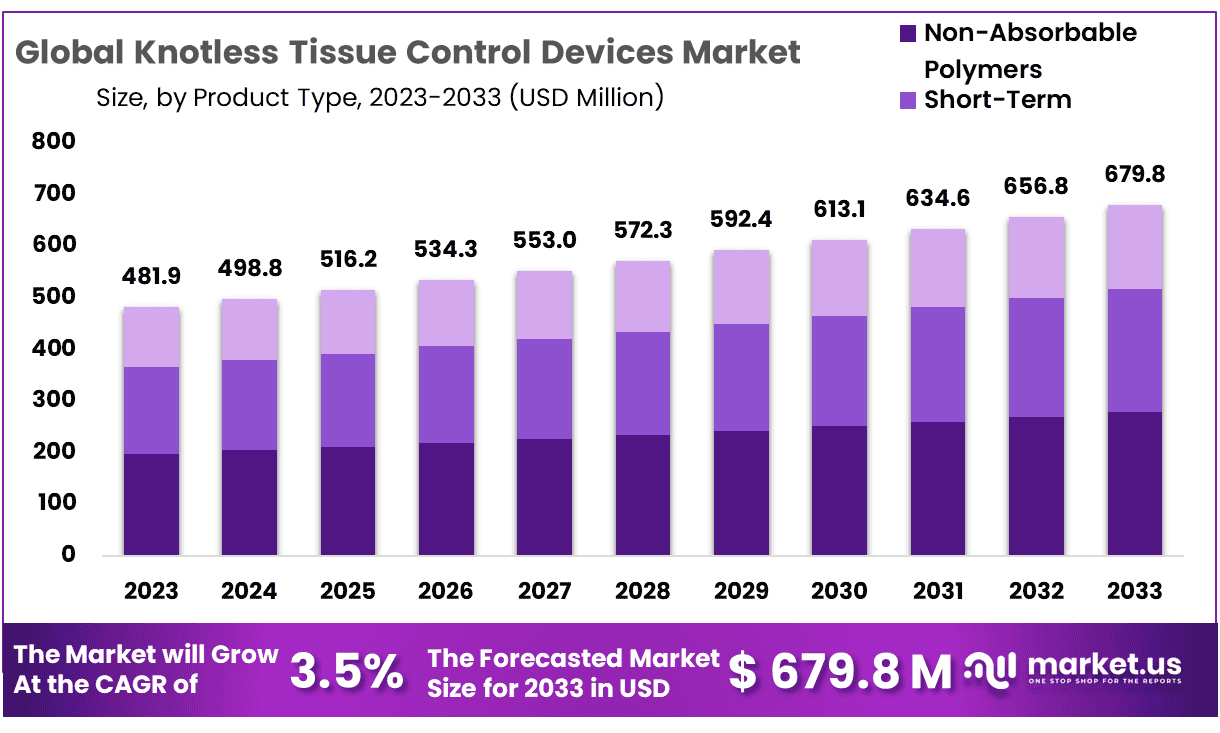
Key Takeaways
- Market Size: The knotless tissue control devices market is projected to reach approximately USD 679.8 million by 2033, increasing from USD 481.9 million recorded in 2023.
- Market Growth: Market expansion is expected to occur at a compound annual growth rate (CAGR) of 3.5% over the forecast period from 2024 to 2033.
- Product Analysis: Non-absorbable polymer-based devices are identified as the leading product segment, accounting for nearly 41% of the total market share.
- Application Analysis: Hospitals represent the primary end-use segment, contributing around 42% of overall market demand.
- Regional Analysis: North America holds a dominant position in the global market, capturing approximately 43.2% share and generating revenues of about USD 208.1 million.
- Reduced Complications: Adoption of knotless tissue control devices has increased due to their effectiveness in reducing surgical complications and supporting improved clinical outcomes.
- Market Expansion: The market has experienced steady expansion, supported by the introduction of diversified and innovative product portfolios designed for multiple surgical indications.
- Competitive Landscape: Leading market participants continue to emphasize research and development activities, resulting in heightened competition and the regular launch of advanced technological solutions.
Regional Analysis
From a regional perspective, North America accounts for a notable 43.2% share of the global market, generating an estimated revenue of USD 208.1 million. Market growth in the region is largely supported by the increasing prevalence of gynecological and cardiovascular disorders, which has contributed to a higher volume of surgical interventions. In addition, growing awareness of advanced surgical technologies, along with strategic initiatives by industry participants to strengthen their competitive positioning across emerging economies within the region, is expected to further support market expansion.
In parallel, detailed assessment of developing markets highlights strong procedural demand. In India, approximately 1,453 surgical procedures are performed annually per 100,000 population. This figure reflects the rising burden of surgical care within the country and indicates significant growth potential for medical device manufacturers and healthcare providers seeking to expand their presence in high-demand healthcare markets.
Emerging Trends
- Growing Adoption in Robotic Surgeries: The adoption of knotless tissue control devices, including barbed sutures, has increased substantially in robotic-assisted procedures. Their use in robotic ventral hernia repairs rose from 12.2% in 2015 to 25.3% in 2022, highlighting a shift toward efficiency-driven surgical tools.
- Expansion into Neurosurgical Applications: Knotless suturing approaches are increasingly being evaluated for cranial and spinal procedures, particularly for cerebrospinal fluid closure. These developments underline the adaptability of knotless devices in handling delicate neural tissues and supporting improved neurosurgical outcomes.
- Advancements in Biocompatible Materials: Ongoing innovations in absorbable and non-absorbable biomaterials have resulted in knotless devices with enhanced tensile strength and lower infection risk. Such advancements are expanding their applicability across diverse surgical procedures while improving patient safety.
Use Cases
- Gynecological Surgeries: In total hysterectomy procedures, the use of knotless tissue control devices has been linked to an average reduction of 19.1 minutes in operating room time compared to conventional suturing, supporting improved efficiency and cost optimization.
- Colorectal Surgeries: Clinical outcomes in colorectal surgeries indicate that patients treated with knotless devices experienced a 2.8% lower 90-day readmission rate versus traditional sutures, suggesting reduced postoperative complications and improved recovery.
- Orthopedic Procedures: In orthopedic interventions such as total hip arthroplasty, barbed sutures have demonstrated reduced wound closure time and lower suture consumption, contributing to streamlined surgical workflows and potentially faster patient rehabilitation.
Frequently Asked Questions on Knotless Tissue Control Devices
- How do knotless tissue control devices work?
These devices typically use an anchor, suture, and self-locking mechanism that allows surgeons to adjust and maintain tissue tension. Once positioned, the system locks in place, eliminating the need for knot formation. - What are the key benefits of knotless tissue control devices?
Key advantages include reduced operative time, uniform tension distribution, simplified surgical workflows, and lower risk of knot-related complications. These benefits contribute to improved procedural consistency and enhanced patient outcomes. - Which surgical procedures commonly use knotless tissue control devices?
Knotless tissue control devices are widely used in orthopedic, arthroscopic, cardiovascular, and gynecological procedures. Their suitability for minimally invasive surgeries has further supported adoption across multiple surgical specialties. - What is driving the growth of the knotless tissue control devices market?
Market growth is driven by rising surgical volumes, increasing preference for minimally invasive procedures, and growing awareness of advanced surgical technologies that improve efficiency, safety, and clinical outcomes. - Which product segment dominates the knotless tissue control devices market?
Non-absorbable polymer-based devices dominate the market due to their durability, reliable fixation, and suitability for complex surgical procedures, making them a preferred choice among healthcare professionals globally. - Which end-user segment holds the largest market share?
Hospitals represent the leading end-user segment, supported by high surgical volumes, advanced infrastructure, and greater adoption of innovative surgical devices for both routine and complex procedures. - Which region leads the global knotless tissue control devices market?
North America leads the global market, supported by advanced healthcare systems, high adoption of innovative medical devices, strong presence of key manufacturers, and increasing surgical procedures related to chronic conditions.
Conclusion
In conclusion, knotless tissue control devices have emerged as a critical innovation in modern surgical practice, driven by their ability to enhance efficiency, precision, and clinical consistency. The market demonstrates steady growth, supported by rising surgical volumes, expanding minimally invasive procedures, and continuous advancements in biomaterials and device design.
Strong adoption across hospitals and diverse surgical applications underscores their clinical relevance. Regionally, North America maintains a dominant position, while emerging markets present significant growth opportunities. Ongoing research and development, coupled with expanding use cases, is expected to further strengthen the role of knotless tissue control devices in improving surgical outcomes globally.
Discuss your needs with our analyst
Please share your requirements with more details so our analyst can check if they can solve your problem(s)




