


Table of Contents
Overview
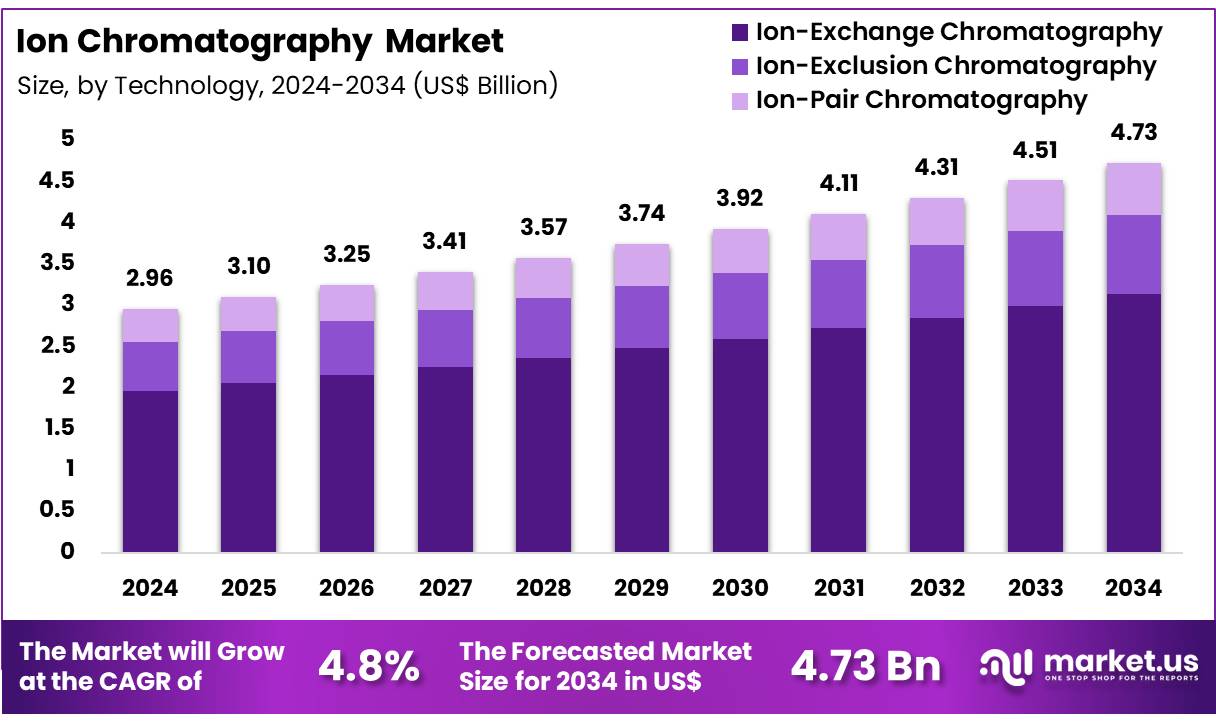
New York, NY – Dec 11, 2025 – Global Ion Chromatography Market size is expected to be worth around US$ 4.73 Billion by 2034 from US$ 2.96 Billion in 2024, growing at a CAGR of 4.8% during the forecast period 2025 to 2034. In 2024, North America led the market, achieving over 33.6% share with a revenue of US$ 994.6 Million.
Ion chromatography has been positioned as a critical analytical technique supporting quality assurance across pharmaceuticals, environmental monitoring, food safety, and industrial processing. The increasing emphasis on high-purity materials and regulatory compliance has driven the wider adoption of this technology. The technique enables the separation and quantification of ions and polar molecules, and its reliability has been recognized across laboratories globally.
The growth of ion chromatography solutions has been attributed to rising environmental surveillance requirements, where accurate detection of contaminants in water and soil is essential. Demand has been further supported by pharmaceutical sector mandates for impurity profiling and excipient analysis. Automated systems with improved detection sensitivity have strengthened operational efficiency, allowing faster and more consistent results.
Recent innovations, including enhanced suppressor technologies and high-pressure ion chromatography systems, have contributed to improved resolution and reduced analysis time. These developments have expanded the application scope in routine and advanced testing workflows. The market has also benefited from increased investments in laboratory infrastructure and continuous upgrades in analytical instrumentation.
Ion chromatography is expected to maintain its relevance as organizations prioritize data integrity and robust analytical performance. The adoption of systems offering higher throughput and lower detection limits is projected to increase. This steady advancement reflects a broader trend toward precision-driven testing technologies that support regulatory adherence and product quality across critical industries.
Key Takeaways
- In 2024, the Ion Chromatography market generated revenue of US$ 2.96 billion and reported a CAGR of 4.8%, with the market size projected to reach US$ 4.73 billion by 2034.
- The Technology segment comprises Ion-Exchange Chromatography, Ion-Exclusion Chromatography, and Ion-Pair Chromatography, with Ion-Exchange Chromatography leading the market in 2024 with a 66.2% share.
- By Detector Type, the market is categorized into Conductivity Detectors, UV/Vis Detectors, and Mass Spectrometry Detectors (IC-MS), where Conductivity Detectors dominated the segment with a 52.6% share.
- In terms of Application, the market is divided into Environmental Testing, Pharmaceutical Industry, Food & Beverage Industry, Chemical & Petrochemical Industry, and Others, with Environmental Testing accounting for the highest share at 37.3%.
- North America emerged as the leading regional market, securing a 33.6% share in 2024.
Regional Analysis
The North American ion chromatography market represents a major portion of the global analytical instrumentation sector, accounting for an estimated 33.6% share in 2024. The expansion of the market can be attributed to stringent regulatory frameworks, advancements in analytical technologies, and rising adoption across multiple end-use industries. Regulatory compliance requirements, particularly in environmental monitoring, continue to influence procurement decisions. In addition, the pharmaceutical sector’s emphasis on quality assurance and drug safety has further strengthened demand for high-precision analytical tools.
The need for accurate techniques to quantify pollutants in water, soil, and air has been increasing, thereby reinforcing the deployment of ion chromatography systems in environmental laboratories. Continuous technological progress in automation, system miniaturization, and integration with mass spectrometry has enhanced operational efficiency and broadened application areas across industrial and research environments.
In the United States, the Environmental Protection Agency’s sub-ng/L limits for PFAS are prompting ongoing upgrades of analytical platforms. In Canada, the advancement of biosimilar programs is sustaining the requirement for sophisticated impurity testing solutions. Mexico’s growing industrial base, supported by recent vendor expansions, is creating additional growth prospects for market participants. The presence of a skilled analytical workforce ensures high throughput capabilities, although elevated labor costs continue to elevate the overall cost of ownership for end users.
Emerging Trends
- More Green and Eco-Friendly Methods: Greener ion chromatography practices are being adopted to reduce hazardous chemicals and waste. Stricter environmental regulations and sustainability goals drive this shift. Safer solvents, waste-recycling, and low-impact processes improve compliance, workplace safety, and long-term costs while maintaining analytical accuracy.
- Faster Testing with Automation: Automation is accelerating ion chromatography workflows by increasing sample throughput and minimizing manual errors. Advanced systems handle multiple analyses simultaneously, improving precision and productivity. This supports industries requiring rapid results, enabling laboratories to meet tight deadlines while reallocating staff resources more efficiently.
- Miniaturization of Equipment: Compact and portable ion chromatography systems enable on-site analysis, reducing sample transport needs and turnaround times. These devices provide highly accurate results despite smaller size. Their increasing demand reflects the need for rapid, reliable testing in remote, field-based, or time-sensitive environments.
- Integration with Other Analytical Technologies: Ion chromatography is increasingly combined with techniques such as mass spectrometry and UV detection to enhance sensitivity and chemical specificity. Integrated platforms support complex analyses, detect trace components, and expand capabilities across pharmaceuticals, environmental monitoring, and food testing applications.
- Growing Use in Food Safety and Healthcare: Its adoption in food safety and healthcare is rising due to its ability to detect contaminants and impurities at low levels. The technique supports regulatory compliance, pharmaceutical quality control, and consumer protection, strengthening global reliance on precise analytical testing.
- Digital Data Management and Remote Monitoring: Modern ion chromatography instruments connect with digital platforms for real-time data storage, analysis, and remote oversight. Automated alerts, improved collaboration, and secure data handling enhance operational efficiency across multi-lab organizations, supporting more streamlined and future-ready analytical workflows.
Use Cases
- Environmental Testing: Ion chromatography provides accurate detection of pollutants in water, soil, and air, supporting regulatory compliance and early pollution identification. Its precision aids environmental protection efforts, helping agencies and industries safeguard natural resources while meeting increasingly strict environmental standards.
- Pharmaceutical Quality Control: The technique ensures drug purity by identifying ionic impurities that affect effectiveness or safety. It supports stringent quality requirements, regulatory compliance, and consistent batch performance, helping pharmaceutical companies avoid costly recalls and maintain high safety standards.
- Food and Beverage Safety: Ion chromatography detects contaminants, preservatives, and additives in food and beverages, ensuring regulatory compliance and consumer protection. It enables early identification of impurities and maintains product quality as consumer expectations and global safety standards continue to rise.
- Industrial Process Monitoring: Industries use ion chromatography to monitor water, chemicals, and raw materials essential for production. It identifies impurities that could damage equipment or compromise product quality, ensuring efficient operations and supporting stringent quality control in sectors such as chemicals, energy, and semiconductors.
- Clinical and Biomedical Research: The method measures ions in biological samples to support diagnosis, treatment decisions, and disease research. Its high sensitivity detects subtle biochemical changes, making it essential for personalized medicine, hospital laboratories, and advanced biomedical investigations.
- Agricultural Testing: Ion chromatography evaluates soil nutrients and salinity, helping farmers optimize fertilizer use and maintain soil health. Its precision supports sustainable farming practices, improves crop yields, and guides resource management as global food demand increases.
Frequently Asked Questions on Ion Chromatography
- What are the main types of chromatography?
The primary chromatography types include liquid chromatography, gas chromatography, ion-exchange chromatography, affinity chromatography, and size-exclusion chromatography. Each method is applied based on analyte properties, desired resolution, and industry-specific analytical requirements across scientific and manufacturing environments. - Why is chromatography used in laboratories?
Chromatography is used in laboratories to achieve accurate separation and quantification of complex mixtures. The technique is essential for drug development, environmental monitoring, food safety testing, and biochemical research, supporting precise analysis and regulatory compliance across several scientific domains. - What industries rely on chromatography?
Chromatography is widely used in pharmaceuticals, biotechnology, environmental testing, petrochemicals, food and beverage analysis, and forensic science. Its adoption is driven by increasing demand for accurate compound identification, quality assurance, regulatory testing, and advanced research workflows requiring reliable analytical tools. - What are the advantages of chromatography?
Chromatography offers high accuracy, sensitivity, and reproducibility in chemical analysis. The technique provides reliable separation of complex mixtures, supports quantitative and qualitative evaluations, and accommodates diverse sample types, making it essential for research, diagnostics, and quality control activities. - Why is chromatography important in pharmaceuticals?
Chromatography is vital in pharmaceuticals for drug purity assessment, stability testing, impurity profiling, and formulation analysis. The technique ensures compliance with regulatory standards and supports drug development by enabling accurate evaluation of active ingredients and related substances. - Which industries contribute most to chromatography market demand?
Pharmaceutical and biotechnology sectors represent the largest share of chromatography demand, followed by environmental testing, food safety, chemicals, and petrochemicals. Each industry requires accurate analytical tools to support regulatory compliance, quality assurance, and advanced research activities. - What regional markets show strong growth potential?
North America and Europe lead the chromatography market due to advanced research infrastructure and high regulatory standards. Asia-Pacific shows strong growth potential, driven by expanding pharmaceutical manufacturing capacity, increasing R&D investments, and growing demand for analytical testing services.
Conclusion
Ion chromatography is projected to maintain steady relevance as regulatory expectations, precision requirements, and quality assurance demands continue to intensify across key industries. Market growth has been supported by rising environmental surveillance needs, pharmaceutical impurity testing, and broader adoption of automated, high-sensitivity systems.
Advancements in suppressor technologies, high-pressure platforms, and digital data management are expected to strengthen analytical performance and operational efficiency. As industries prioritize accuracy, compliance, and faster turnaround times, ion chromatography will remain a core analytical tool, reinforced by sustained investments in laboratory infrastructure and expanding applications in environmental, pharmaceutical, food, and industrial testing workflows.
Discuss your needs with our analyst
Please share your requirements with more details so our analyst can check if they can solve your problem(s)




