


Table of Contents
Overview
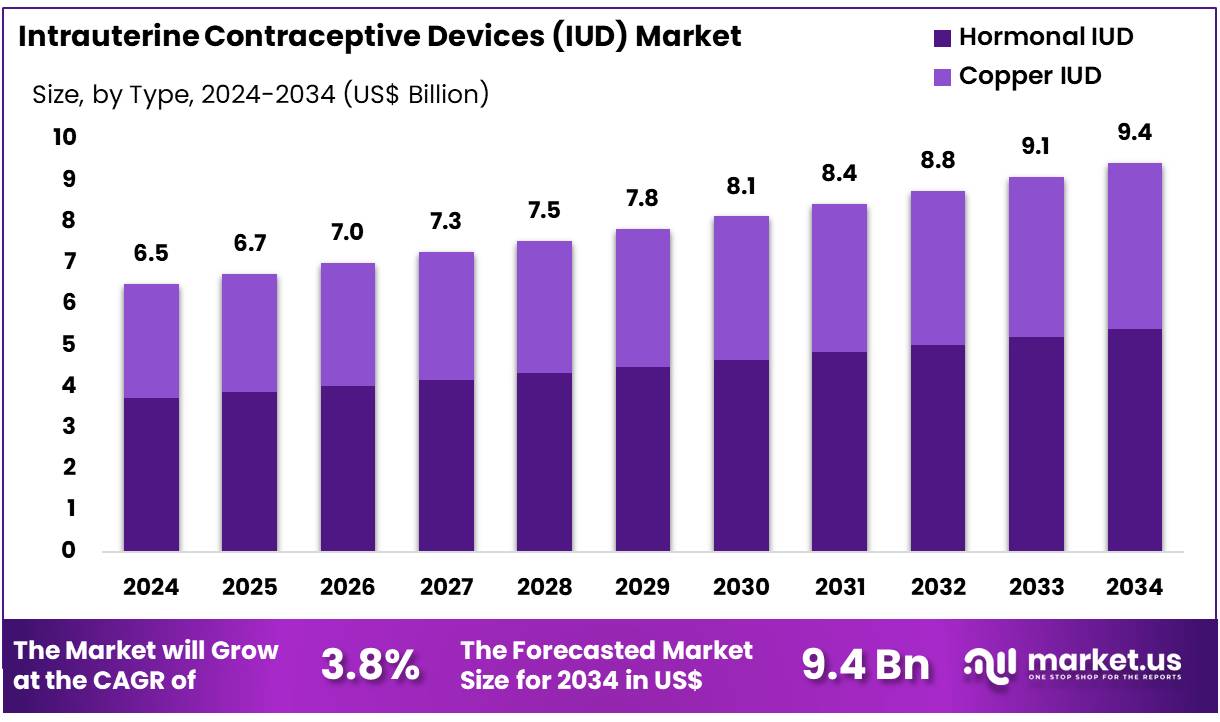
New York, NY – Dec 02, 2025 – Global Intrauterine Contraceptive Devices (IUD) Market size is expected to be worth around US$ 9.4 Billion by 2034 from US$ 6.5 Billion in 2024, growing at a CAGR of 3.8% during the forecast period 2025 to 2034. In 2024, North America led the market, achieving over 39.6% share with a revenue of US$ 2.6 Billion.
The global market for intrauterine contraceptive devices (IUDs) has been experiencing steady expansion as the demand for long-acting reversible contraception continues to rise. IUDs have been recognized as one of the most effective contraceptive methods, achieving efficacy rates above 99%, and their adoption has been driven by growing awareness of reproductive health, supportive governmental programs, and the increasing preference for non-hormonal and low-maintenance birth control options.
The growth of the market has been attributed to improved access to healthcare services, rising family-planning initiatives, and the development of advanced devices designed to enhance safety and user comfort. Copper IUDs and hormonal IUDs remain the dominant categories, with copper devices accounting for a significant share due to their long lifespan and non-hormonal mechanism of action. Hormonal IUDs have also gained considerable traction because of their dual benefits of contraception and menstrual regulation.
North America and Europe currently represent leading regional markets, supported by favorable reimbursement structures and strong clinical adoption. However, Asia-Pacific is projected to exhibit the fastest growth, driven by large population bases, expanding healthcare infrastructure, and increased governmental focus on maternal health.
Continued product innovation, coupled with rising initiatives from public health organizations, is expected to reinforce the market’s upward trajectory. Manufacturers are focusing on research, patient education, and strategic partnerships to strengthen their position as the demand for reliable and long-term contraceptive solutions expands worldwide.
Key Takeaways
- In 2024, the market for intrauterine contraceptive devices generated US$ 6.5 billion, supported by a 3.8% CAGR, and the market value is projected to reach US$ 9.4 billion by 2033.
- The type segmentation comprises hormonal IUDs and copper IUDs, with hormonal IUDs accounting for the leading 57.3% share in 2024.
- Based on distribution channels, the market is categorized into hospitals, gynecology clinics, and others, with hospitals capturing 52.8% of the overall share.
- North America emerged as the dominant regional market, securing a 39.6% share in 2024.
Regional Analysis
North America is Leading the Intrauterine Contraceptive Devices (IUD) Market
North America accounted for the largest revenue share of 39.6%, supported by rising awareness regarding the effectiveness and long-term convenience offered by IUDs. Data from the Centers for Disease Control and Prevention (CDC), particularly through the National Center for Health Statistics (NCHS), indicates a sustained shift toward long-acting reversible contraceptive (LARC) methods, including IUDs. This trend has been reinforced by recommendations from the American College of Obstetricians and Gynecologists (ACOG), which identifies IUDs as safe and effective for a broad population, including adolescents.
The strong endorsement from ACOG has contributed to increased acceptance among healthcare professionals and patients. The availability of multiple IUD variants, such as hormonal devices with extended durations and non-hormonal copper devices, has further supported adoption by offering women diverse options aligned with their individual health needs.
Asia Pacific Expected to Record the Highest CAGR During the Forecast Period
The Asia Pacific region is projected to expand at the highest CAGR due to rapid population growth and strengthened family-planning initiatives. Several countries in the region have introduced targeted programs to enhance access to contraceptive solutions, with IUDs often recognized as a core element due to their high efficacy and cost-effectiveness. Public health initiatives in countries such as India and China continue to promote IUD usage.
Guidance from the World Health Organization (WHO) has also supported the broader acceptance of IUDs across the region. WHO emphasizes the importance of offering women a comprehensive range of contraceptive methods, enabling informed decision-making in reproductive health. Growing attention to women’s health and reproductive rights in Asia Pacific is expected to further accelerate IUD utilization.
Emerging Trends
- The use of long-acting reversible contraception (LARC), including intrauterine devices, increased among U.S. women aged 15–44, rising from 8.0 % to 11.3 % between the periods 2011–2015 and 2015–2017.
- Adoption among adolescents showed notable progress. LARC utilization among U.S. girls aged 15–19 reached 19 % in 2015–2019, representing a threefold rise compared with 2011–2015, a shift attributed to broader access and improved education.
- Post-placental and intra-cesarean IUD insertion (PPIUCD) gained visibility, as 68.7 % of women were aware of the method, while 30.0 % consented to insertion according to one assessment.
- Task-sharing models enabled nurse-midwives and auxiliary health workers to conduct IUD insertions, thereby enhancing service availability in low-resource environments.
- The typical-use failure rate for IUDs remained below 1 %, indicating high effectiveness relative to short-term contraceptive options.
Use Cases
- Long-Term Pregnancy Prevention: IUDs provide reversible contraception with fewer than 1 pregnancy per 100 users in the first year of typical use, offering dependable and low-maintenance protection.
- Emergency Contraception: A copper IUD may be inserted within 5 days following unprotected intercourse to prevent pregnancy, while simultaneously delivering continued contraceptive coverage.
- Immediate Postpartum Use: Copper IUDs may be placed directly after childbirth or abortion without requiring backup methods, supporting timely postpartum fertility management.
- Adolescent and Young Adult Use: Expanded education and service delivery have supported increased uptake among younger users, with 19 % of girls aged 15–19 using LARC during 2015–2019.
Frequently Asked Questions on Intrauterine Contraceptive Devices (IUD)
- How does an IUD work?
The device prevents fertilization by altering cervical mucus and creating a uterine environment unfavorable to sperm movement. Hormonal variants release progestin, while copper IUDs use copper ions. Both mechanisms provide highly effective, long-term contraception. - What are the main types of IUDs?
Two major types are available: copper-based IUDs and hormonal IUDs. Copper devices provide non-hormonal protection, while hormonal options release progestin to prevent pregnancy. Their selection depends on medical suitability and patient preference. - How effective are IUDs at preventing pregnancy?
IUDs demonstrate effectiveness exceeding 99%, making them one of the most reliable reversible contraceptive methods. Their long-term action and minimal maintenance requirements contribute to high satisfaction and continuation rates among users globally. - How long does an IUD last?
Depending on type, IUDs remain effective for three to ten years. Their extended duration reduces the need for frequent contraceptive interventions, contributing to cost-effectiveness and strong adoption in long-acting reversible contraception programs. - Which types of IUDs dominate the market?
Hormonal IUDs hold significant market share due to added clinical benefits, including reduced menstrual bleeding. Copper IUDs remain important for users preferring non-hormonal options. Together, these segments shape the competitive landscape. - How is technology influencing the IUD market?
Material innovations, improved hormone-release mechanisms, and enhanced device designs strengthen product performance and user comfort. These advancements are supporting higher acceptance rates and promoting competitive differentiation among manufacturers. - Who are the key players in the IUD market?
Leading companies include Bayer, CooperSurgical, and SMB Corporation. These organizations invest in technology enhancements, clinical trials, and global distribution strategies to strengthen their market presence and meet growing contraception demand.
Conclusion
The intrauterine contraceptive devices market is positioned for sustained growth as long-acting reversible contraception gains wider acceptance globally. Rising awareness, supportive clinical guidelines, and advancements in device design have strengthened market penetration across both developed and emerging regions.
North America continues to lead, while Asia Pacific is expected to expand rapidly due to strong public health initiatives and growing reproductive health focus. Dominance of hormonal and copper IUDs, supported by high efficacy and long-term cost-effectiveness, is expected to reinforce demand. Continued innovation, strategic collaborations, and improved service delivery will remain central to the market’s upward trajectory over the forecast period.
Discuss your needs with our analyst
Please share your requirements with more details so our analyst can check if they can solve your problem(s)




