


Table of Contents
Overview
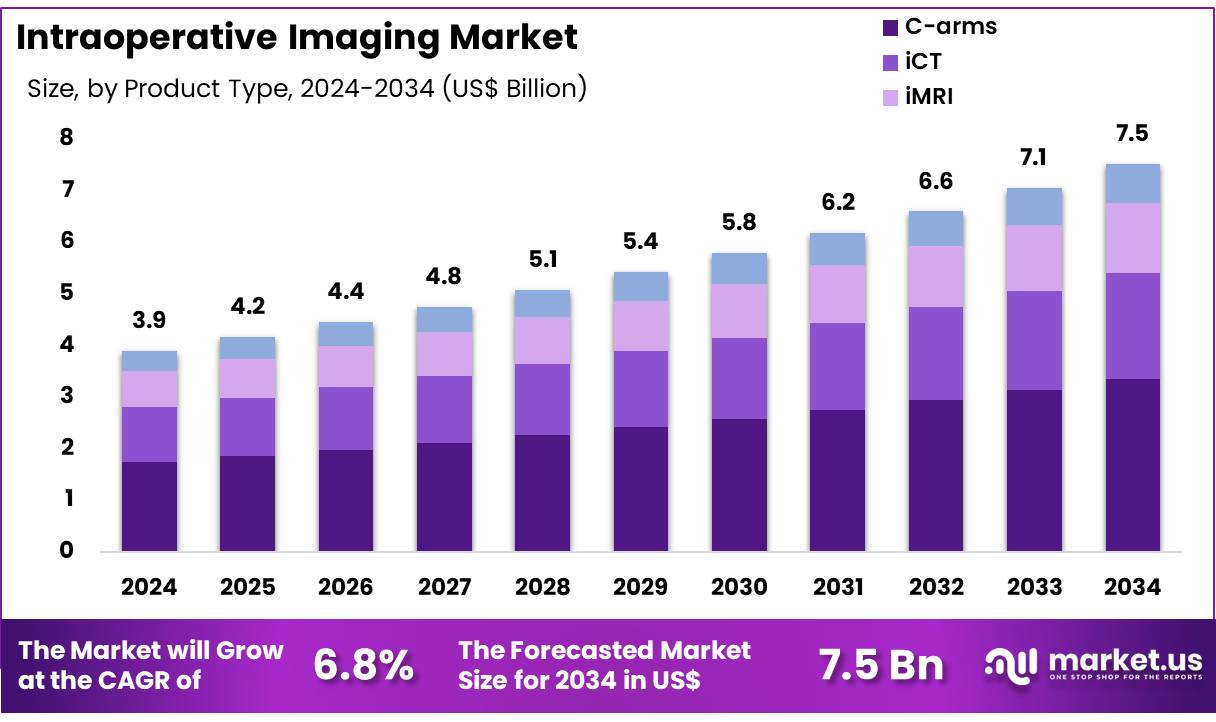
New York, NY – Dec 02, 2025 – The Global Intraoperative Imaging Market size is expected to be worth around US$ 7.5 Billion by 2034 from US$ 3.9 Billion in 2024, growing at a CAGR of 6.8% during the forecast period 2025 to 2034. In 2024, North America led the market, achieving over 37.6% share with a revenue of US$ 1.5 Billion.
Intraoperative imaging has emerged as a critical technological advancement that enhances surgical precision and improves patient outcomes. It is defined as the real-time visualization of anatomical structures during surgical procedures, enabled through modalities such as intraoperative MRI, CT, ultrasound, and fluoroscopy. The adoption of these systems has been driven by the growing demand for minimally invasive procedures, where continuous image guidance ensures higher accuracy and reduced complication rates.
The global market for intraoperative imaging has observed sustained growth due to the increasing prevalence of neurological, orthopedic, and cardiovascular disorders. The growth of the market has been attributed to continuous innovation in imaging technologies, the integration of navigation systems, and the rising number of advanced surgical centers worldwide. Hospitals and specialty clinics are increasingly investing in high-resolution imaging platforms to support complex interventions and enhance surgeon confidence.
Significant improvements in detector sensitivity, image processing, and workflow automation have contributed to the wider acceptance of intraoperative imaging systems. These advancements have enabled surgeons to make immediate treatment decisions, lower the likelihood of revision surgeries, and improve overall procedural efficiency.
The outlook for the sector remains positive as healthcare providers prioritize technologies that support accuracy, safety, and patient-centric care. Continued strategic investments by medical device manufacturers, along with collaborations between healthcare institutions and technology developers, are expected to strengthen the market trajectory in the coming years.
Key Takeaways
- In 2024, the intraoperative imaging market generated US$ 3.9 billion in revenue, recorded a CAGR of 6.8%, and is projected to reach US$ 7.5 billion by 2033.
- The product type segment includes C-arms, iCT, iMRI, and intraoperative ultrasound, with C-arms leading the market in 2024 at a 44.5% share.
- By application, the market is categorized into neurosurgery, trauma/emergency room surgery, orthopedic surgery, oncology surgery, ENT surgery, cardiovascular surgery, and others, with neurosurgery accounting for 42.4% of the total share.
- In terms of end users, the market is segmented into hospitals, ambulatory surgical centers, specialty clinics, and others, where hospitals dominated the sector with a 55.6% revenue share.
- North America emerged as the leading regional market, capturing 37.6% of the global share in 2024.
Regional Analysis
North America is Leading the Intraoperative Imaging Market
North America maintained a leading position in the intraoperative imaging market by accounting for 37.6% of total revenue, supported by the rapid adoption of advanced surgical procedures. The region continues to benefit from strong regulatory support, as the FDA has approved multiple intraoperative imaging systems between 2022 and 2024, enabling broader deployment of these technologies across hospitals in the United States.
In addition, the National Institutes of Health (NIH) plays a crucial role in fostering innovation through research funding aimed at enhancing intraoperative imaging capabilities. These initiatives have supported projects focused on improving surgical visualization and precision. The combined impact of regulatory clearances and research funding has strengthened the integration of intraoperative imaging solutions within North American medical centers.
Asia Pacific Expected to Register the Highest CAGR
The Asia Pacific region is projected to record the fastest CAGR during the forecast period due to rising healthcare investments and growing demand for minimally invasive surgical procedures. Governments across the region continue to modernize healthcare infrastructure, which is expected to accelerate the adoption of advanced surgical technologies, including intraoperative imaging systems.
Countries such as Japan and China are actively promoting the use of sophisticated medical devices to enhance surgical accuracy and patient outcomes. Increasing awareness regarding the advantages of minimally invasive procedures among surgeons and patients further supports market growth, driving the demand for imaging solutions that provide real-time, high-precision surgical guidance.
Use Cases
- Breast Cancer Margin Assessment: In April 2023, the FDA authorized Lumisight (pegulicianine), a fluorescent imaging agent used to detect residual malignant tissue during lumpectomy. Clinical evidence showed that margin-detection sensitivity increased from 72% to 90%, contributing to an estimated 20% reduction in repeat surgical procedures.
- Perfusion Monitoring in Gastrointestinal Surgery: Systems such as ActivSight utilize near-infrared fluorescence to deliver real-time visualization of tissue perfusion. Surgeons reported that tissue viability becomes assessable within 5 seconds following ICG administration, contributing to a 15% reduction in anastomotic leak incidence in colorectal operations.
- Neurosurgical Tumor Resection: High-field intraoperative MRI suites provide updated imaging that compensates for brain shift and identifies residual tumor tissue. Studies reported that complete resection rates increased from 65% to 85% with iMRI integration, with procedures requiring an additional 30–45 minutes of operating room time.
- Sentinel Lymph Node Mapping: Near-infrared fluorescence imaging with ICG supports intraoperative visualization of lymphatic pathways in breast and melanoma surgeries. Detection performance consistently exceeds 95%, while mapping can typically be completed in less than 10 minutes, enhancing staging precision and reducing operative duration.
- Hyperspectral Perfusion Analysis: Hyperspectral imaging platforms quantify tissue oxygen saturation within approximately 170 milliseconds, generating real-time perfusion maps for surgical guidance. Early evaluations indicated strong alignment with surgeon assessment and demonstrated a 40% reduction in adjudication time during visceral procedures.
Frequently Asked Questions on Intraoperative Imaging
- What types of intraoperative imaging systems are commonly used?
Common systems include intraoperative MRI, CT, ultrasound, and fluoroscopy. Each modality provides specific visualization benefits, supporting precise resection, navigation, and localization during complex neurosurgical, orthopedic, cardiovascular, and oncological procedures. - How does intraoperative imaging improve surgical outcomes?
Surgical outcomes are improved by enabling high-resolution, real-time imaging that facilitates precise tissue differentiation and targeted intervention. This contributes to lower error rates, enhanced tumor resection accuracy, and reduced postoperative complications, improving overall procedural efficiency. - Which medical specialties use intraoperative imaging?
Usage spans neurosurgery, orthopedics, cardiovascular surgery, ENT, and trauma care. These fields adopt intraoperative imaging to support real-time navigation, verify resection margins, and ensure minimally invasive approaches for enhanced patient safety. - Which regions dominate the intraoperative imaging market?
North America leads due to strong healthcare infrastructure, high surgical volumes, and rapid technology adoption. Europe follows with extensive clinical integration, while Asia-Pacific is experiencing accelerated growth driven by improving healthcare facilities and expanding patient populations. - Who are the major players in the intraoperative imaging market?
Key players include Siemens Healthineers, Medtronic, GE Healthcare, Philips, and Brainlab. These companies provide advanced imaging platforms, navigation systems, and integrated surgical solutions that strengthen market competitiveness and accelerate technological innovation. - What technological advancements are shaping the market?
Advancements include AI-enhanced imaging, robotic-integrated visualization, high-resolution 3D modalities, and portable intraoperative scanners. These innovations improve surgical efficiency, accuracy, and workflow integration, contributing to increased clinical adoption.
Conclusion
The intraoperative imaging market is expected to continue demonstrating stable expansion, supported by sustained investments in advanced surgical technologies and the rising emphasis on minimally invasive procedures. Growth has been driven by strong adoption across neurosurgery, orthopedics, and oncology, while technological improvements in detector sensitivity, workflow automation, and real-time visualization enhance clinical value.
North America maintains a dominant position, with Asia Pacific projected to exhibit the fastest growth. The sector is anticipated to benefit further from ongoing regulatory support, research funding, and strategic collaborations, reinforcing its role in improving surgical accuracy, patient outcomes, and overall healthcare efficiency.
Discuss your needs with our analyst
Please share your requirements with more details so our analyst can check if they can solve your problem(s)




