


Table of Contents
Overview
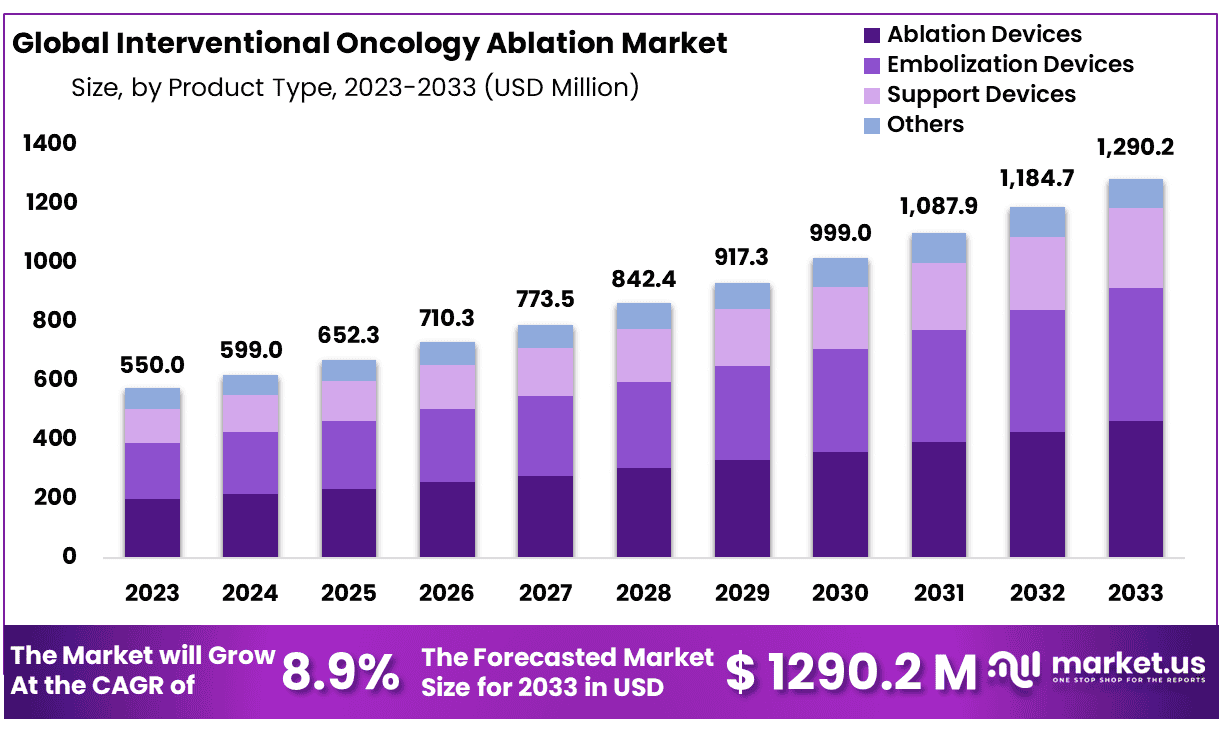
New York, NY – Jan 27, 2026 – The Global Interventional Oncology Ablation Market size is expected to be worth around USD 1290.2 Million by 2032 from USD 550.0 Million in 2023, growing at a CAGR of 8.9% during the forecast period from 2024 to 2033.
Interventional oncology ablation is increasingly being recognized as a minimally invasive treatment approach for patients with primary and metastatic tumors. This technique uses image guidance to precisely target and destroy cancerous tissue while preserving surrounding healthy structures. The formation and adoption of interventional oncology ablation have been driven by the growing demand for effective, organ-sparing cancer treatments with reduced recovery times.
Ablation procedures are typically performed using advanced imaging modalities such as computed tomography (CT), ultrasound, or magnetic resonance imaging (MRI). These tools enable accurate probe placement and real-time monitoring of treatment. Common ablation technologies include radiofrequency ablation, microwave ablation, cryoablation, and irreversible electroporation. Each modality works through a distinct mechanism, such as heat, cold, or electrical energy, to induce tumor cell death.
The basic formation of interventional oncology ablation programs within healthcare systems has been supported by advancements in imaging technology, improved ablation devices, and growing clinical evidence demonstrating safety and efficacy. These procedures are commonly used in the management of liver, lung, kidney, and bone tumors, particularly for patients who are not suitable candidates for surgery.
From a clinical perspective, interventional oncology ablation is associated with shorter hospital stays, lower complication rates, and faster patient recovery compared to conventional surgical approaches. As a result, it is increasingly being integrated into multidisciplinary cancer care pathways.
Overall, interventional oncology ablation represents a significant evolution in cancer treatment, supporting personalized, image-guided therapy and contributing to improved patient outcomes across multiple oncology indications.
Key Takeaways
- Market Size: The Interventional Oncology Ablation market is projected to reach approximately USD 1,290.2 million by 2032, increasing from USD 550.0 million in 2023.
- Market Growth: The market is anticipated to expand at a compound annual growth rate (CAGR) of 8.9% over the forecast period from 2024 to 2033.
- Product Type Analysis: Ablation devices represented the leading product segment, capturing around 35% of the total market share in 2023.
- Procedure Analysis: Radioembolization emerged as a key treatment modality, accounting for approximately 29% of the market share.
- Indication Analysis: Liver cancer remained the dominant indication, holding nearly 36% of the Interventional Oncology Ablation market share.
- End-Use Analysis: Hospitals constituted the primary end-use segment, contributing close to 60% of the overall market share.
- Regional Analysis: The Asia-Pacific region led the global market with a 38.2% share, generating revenues of approximately USD 210.1 million in 2023.
Segmentation Analysis
- Product Type Analysis: Interventional oncology ablation relies mainly on ablation devices, holding 35% share in 2023, using radiofrequency, microwave, cryoablation, and irreversible electroporation, supported by embolization systems, microcatheters, guidewires, and accessories globally today.
- Procedure Analysis: Radioembolization represented 29% market share in 2023, enabling targeted internal radiation through microsphere delivery, limiting healthy tissue damage, while RFA, microwave, cryoablation, irreversible electroporation, TACE, and TARE expand treatment options.
- Indication Analysis: Liver cancer led indications with 36% share in 2023, where radiofrequency, microwave, and cryoablation precisely treat tumors, while adoption grows for renal cell carcinoma and lung cancer minimally invasive therapies.
- End-Use Analysis: Hospitals dominated end use with 60% share in 2023, supported by advanced infrastructure and multidisciplinary teams, while ambulatory surgical centers provide cost effective, accessible ablation procedures with shorter recovery periods.
Regional Analysis
Asia-Pacific region dominate 38.2% market share and holding USD 210.1 Million revenue in 2023. Thanks to an increased expenditure on cancer treatments and the establishment of state-of-the-art cancer centers. However, north america region appears set for rapid market expansion during its forecast period.
This remarkable growth can be attributed to numerous factors, including government initiatives to provide more funding for oncological treatments, the commercialization of advanced interventional procedures and products, supportive regulatory frameworks that foster their development, rising healthcare expenditure and expansion of research facilities across verious countries like China, Japan and India – all factors which contributed to its robust expansion in Asia-Pacific region. These collectively contribute to its robust growth.
Emerging Trends
Adoption of Irreversible Electroporation (IRE): Irreversible Electroporation (IRE) is emerging as a non-thermal ablation technique that induces cell death through electrical pulses while preserving blood vessels and ducts. Its precision supports treatment of tumors near critical structures, particularly in pancreatic, hepatic, renal, and prostate cancers.
Integration of Imaging Techniques: Advances in real-time imaging, including ultrasound, CT, and MRI, are improving procedural accuracy in interventional oncology ablation. Image-guided techniques enable precise tumor localization, real-time monitoring, and immediate treatment assessment, reducing collateral tissue damage and enhancing clinical outcomes.
Personalized Treatment Approaches: Personalized ablation strategies are increasingly adopted, incorporating tumor size, anatomical location, and molecular characteristics into treatment planning. This approach improves therapeutic effectiveness and reduces recurrence risk, aligning interventional oncology with broader precision medicine trends across oncology care pathways.
Combination Therapies: The integration of ablation with chemotherapy, immunotherapy, or radiation therapy is gaining traction as a multimodal cancer treatment approach. Combination strategies aim to improve local tumor control and stimulate systemic immune responses, with ongoing clinical trials evaluating synergistic therapeutic benefits.
Technological Innovations in Ablation Devices: Continuous innovation in ablation technologies is enhancing procedural safety and effectiveness. Improvements include refined energy delivery systems, advanced needle designs, and robotic-assisted platforms. These developments support greater precision, reduced procedure time, and expanded treatment eligibility for complex tumor cases.
Use Cases
- Liver Cancer Treatment: Interventional oncology ablation is widely applied in primary and metastatic liver cancer management. Techniques such as radiofrequency and microwave ablation achieve high local control rates for small hepatocellular carcinomas, offering minimally invasive alternatives with shorter recovery times for non-surgical candidates.
- Renal Tumor Management: Ablation therapies provide nephron-sparing options for patients with small renal masses who are unsuitable for surgery. Modalities including cryoablation and IRE demonstrate favorable safety profiles and renal function preservation, although long-term oncological outcomes require further clinical validation.
- Lung Tumor Ablation: While ablation is utilized in lung tumor management, clinical evidence indicates limited effectiveness of IRE in pulmonary malignancies. Challenges such as electrode placement and tissue conductivity differences contribute to higher disease progression rates, highlighting the need for further procedural optimization.
- Prostate Cancer Therapy: Ablation techniques are emerging as focal therapies for localized prostate cancer. IRE allows selective tumor destruction while preserving surrounding nerves, supporting favorable functional outcomes. Early studies report promising results, though larger trials are required to establish standardized clinical protocols.
- Pancreatic Cancer Intervention: IRE is increasingly explored for locally advanced pancreatic cancer due to its non-thermal mechanism and ability to preserve surrounding vital structures. Clinical studies indicate improved median survival compared to chemotherapy alone, positioning IRE as a potential adjunct within multimodal pancreatic cancer treatment strategies.
Frequently Asked Questions on Interventional Oncology Ablation
- What is interventional oncology ablation?
Interventional oncology ablation is a minimally invasive cancer treatment that uses image-guided techniques to destroy tumors through heat, cold, or electrical energy, while preserving surrounding healthy tissues and reducing recovery time. - Which cancers are commonly treated using ablation techniques?
Ablation techniques are widely used for liver, lung, kidney, and bone tumors, particularly in patients who are ineligible for surgery or require localized tumor control with minimal systemic impact. - What are the main types of ablation technologies used?
Common ablation technologies include radiofrequency ablation, microwave ablation, cryoablation, and irreversible electroporation, each differing in energy source, depth of penetration, and suitability for specific tumor locations. - What are the clinical benefits of interventional oncology ablation?
Key benefits include reduced procedural risk, shorter hospital stays, faster patient recovery, repeatability of treatment, and compatibility with systemic therapies, making ablation an effective option in multidisciplinary cancer care. - What imaging modalities support ablation procedures?
Ablation procedures are typically guided by imaging modalities such as computed tomography, ultrasound, and magnetic resonance imaging, which ensure precise probe placement, real-time monitoring, and improved treatment accuracy. - Which ablation technology segment holds a significant market share?
Microwave and radiofrequency ablation technologies hold substantial market share due to their clinical effectiveness, shorter procedure times, broad tumor applicability, and strong adoption in liver and lung cancer treatments. - How does reimbursement influence market adoption?
Favorable reimbursement policies in developed healthcare systems support wider adoption of ablation procedures, while limited or inconsistent reimbursement in developing regions continues to restrain market penetration and technology uptake. - Which regions dominate the interventional oncology ablation market?
North America and Europe dominate the market due to advanced healthcare infrastructure, high awareness of interventional oncology, strong presence of medical device manufacturers, and early adoption of innovative ablation technologies.
Conclusion
Interventional oncology ablation has emerged as a critical component of modern cancer care, offering minimally invasive, image-guided solutions for patients with primary and metastatic tumors. Driven by technological advancements, strong clinical evidence, and demand for organ-preserving therapies, its adoption continues to expand across multiple indications, particularly liver, lung, and renal cancers.
The market demonstrates steady growth, supported by hospital-based utilization, innovation in ablation devices, and increasing integration into multidisciplinary treatment pathways. With rising healthcare investment, especially in Asia-Pacific, and growing emphasis on personalized and combination therapies, interventional oncology ablation is expected to play an increasingly important role in improving oncological outcomes worldwide.
Discuss your needs with our analyst
Please share your requirements with more details so our analyst can check if they can solve your problem(s)




