


Table of Contents
Overview
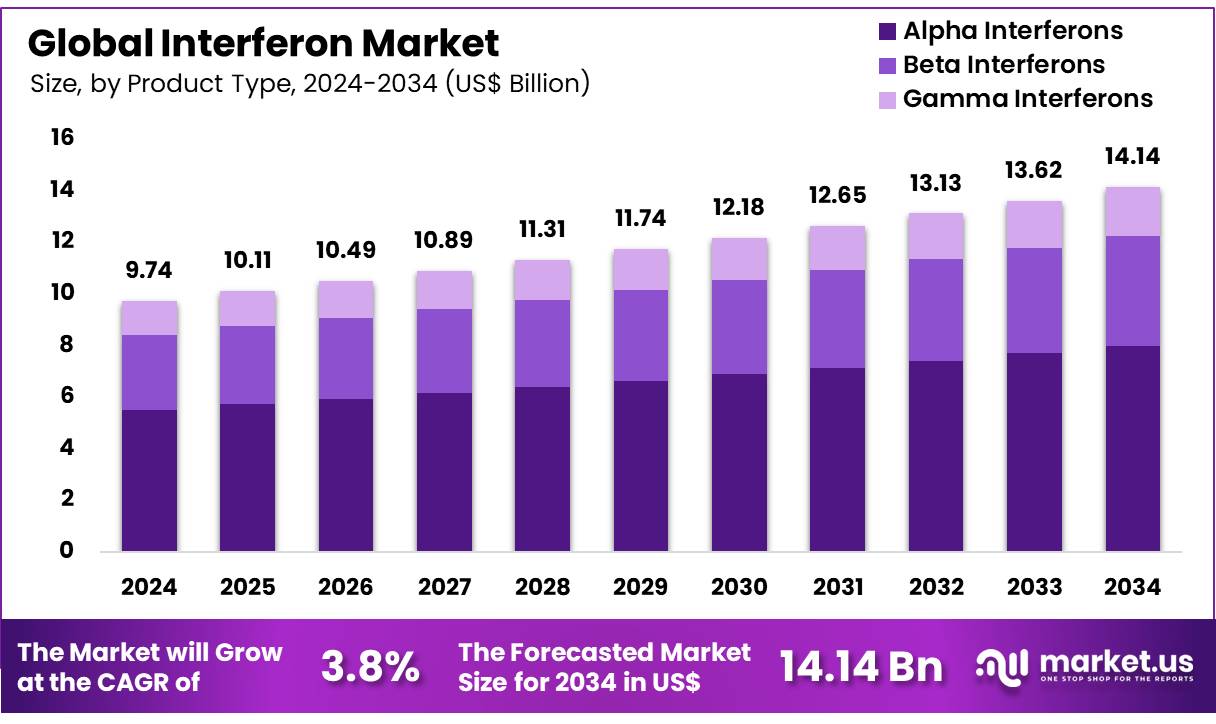
New York, NY – Dec 10, 2025 – Global Interferon Market size is expected to be worth around US$ 14.14 Billion by 2034 from US$ 9.74 Billion in 2024, growing at a CAGR of 3.8% during the forecast period 2025 to 2034. In 2024, North America led the market, achieving over 38.8% share with a revenue of US$ 3.78 Billion.
Interferon represents a critical class of naturally occurring signaling proteins that play a central role in the body’s innate immune response. These proteins are produced when viral, bacterial, or other pathogenic threats are detected, and their activity triggers a cascade of cellular defenses. The mechanism of action is characterized by the activation of intracellular pathways that inhibit viral replication, enhance antigen presentation, and stimulate immune cell activity. Owing to these properties, interferon has been widely recognized as a key therapeutic agent across various infectious and immune-related disorders.
The global interest in interferon-based therapies has been rising, supported by advancements in biotechnology and an increased focus on immune-modulating treatments. The application of interferon in conditions such as hepatitis, multiple sclerosis, and certain cancers has been well established, and ongoing research continues to broaden its therapeutic potential. The development of recombinant technologies has facilitated production at scale, enabling consistent quality and improved clinical performance.
Market demand has been influenced by a growing emphasis on antiviral preparedness and the rising prevalence of chronic diseases that benefit from immunomodulatory interventions. Regulatory approvals across major regions have further strengthened the clinical integration of interferon products. Continued investment in research pipelines, coupled with emerging studies highlighting synergistic effects with novel biologics, has supported a positive outlook for future adoption.
Interferon remains positioned as a significant component of modern immunotherapy, with its foundational role in cellular defense underscoring continued relevance in healthcare and biopharmaceutical innovation.
Key Takeaways
- The global Interferons market generated revenue of US$ 74 billion in 2024, exhibiting a CAGR of 3.8%, and is projected to reach US$ 14.14 billion by 2034.
- Alpha Interferons dominated the Product Type segment in 2024, accounting for 56.50% of the market.
- In terms of Application, Cancer Treatment emerged as the leading segment with a 38.4% market share.
- By Route of Administration, Subcutaneous Injection held the highest share in 2024, contributing 45.8% to the market.
- Within the End-User segment, Hospitals and Clinics represented the largest share, accounting for 52.4% of global revenue.
- North America led the regional landscape with a 38.8% share of the market in 2024.
Regional Analysis
North America remains the leading regional market for Interferons, accounting for 38.8% of the global share. This dominance is supported by advanced healthcare infrastructure, a high burden of chronic and infectious diseases, and sustained research and development activities. The United States and Canada contribute significantly to regional revenue, aided by a strong biopharmaceutical industry, well-defined regulatory systems, and substantial healthcare spending.
The United States reports an estimated 1.75 million new cancer cases each year, accompanied by approximately 600,000 cancer-related deaths, which drives the need for advanced therapeutic solutions, including interferon-based treatments. The growing prevalence of hepatitis and multiple sclerosis also reinforces the demand for these therapies. The availability of technologically advanced medical facilities enhances the effective administration and adoption of interferon formulations.
Ongoing investments in biotechnology and pharmaceutical innovation support the development of novel interferon therapies and biosimilars, improving treatment accessibility and broadening clinical applications. Data released by the Centers for Disease Control and Prevention (CDC) in April 2024 indicated 13,300 new cases of hepatitis B in 2022 in the United States, highlighting a persistent public health concern. Rising hepatitis B prevalence is anticipated to further strengthen the market demand, with interferons positioned as a key therapeutic option in disease management.
Emerging Trends
- Personalized Medicine: Interferon therapies are increasingly tailored to patient-specific genetic profiles, improving treatment precision and reducing adverse effects. Growing genomic data supports better-targeted regimens, enhancing therapeutic outcomes and safety while advancing the adoption of individualized interferon-based care.
- Combination Therapies: Interferons are increasingly paired with antivirals or immunotherapies to enhance treatment effectiveness. This multimodal approach strengthens immune responses, improves recovery rates, and broadens clinical applications, positioning combination regimens as a preferred strategy for complex cancers and viral infections.
- Advanced Drug Delivery: Innovative delivery systems such as patches and inhalers aim to improve comfort, convenience, and adherence in interferon therapy. These methods reduce treatment burden, support better compliance, and make interferon usage more accessible across diverse patient groups.
- New Interferon Types: Research on Beta and Gamma interferons is expanding therapeutic potential beyond traditional uses. These studies aim to uncover new disease applications, support market growth, and drive innovation toward treatments for conditions lacking effective therapeutic options.
- Emerging Infectious Diseases: Interferons are gaining prominence in managing new viral outbreaks, driven by their ability to enhance immune defense. Increased research investment supports their potential role in pandemic preparedness and broadens their relevance beyond established infectious disease indications.
- Reduced Side Effects: New interferon formulations aim to lessen flu-like adverse effects, improving tolerability and adherence. Enhanced patient comfort supports higher completion rates and better outcomes, positioning optimized interferons as more acceptable therapeutic options in long-term treatment regimens.
Use Cases
- Viral Infections: Interferons remain essential in treating chronic viral diseases like hepatitis B and C by slowing viral replication and activating immune defenses. Their role supports infection control, symptom reduction, and long-term disease management across persistent viral conditions.
- Cancer Therapy: Interferons enhance the immune system’s ability to detect and destroy cancer cells, slowing tumor progression in melanoma and certain leukemias. Their use alongside chemotherapy improves survival outcomes and supports broader exploration of interferon responsiveness across additional cancer types.
- Multiple Sclerosis Management: Beta interferons reduce relapse frequency and severity in multiple sclerosis by regulating immune activity and limiting nervous system inflammation. Their continued use slows disease progression, maintains functional ability, and supports long-term stability for MS patients.
- Chronic Disease Immune Support: Interferons regulate dysregulated immune responses in chronic conditions, preventing flare-ups and reducing symptom severity. Their balancing effect aids patients with persistent immune dysfunction and provides therapeutic value when other treatments fail to offer adequate disease control.
- Research & Experimental Use: Interferons are being evaluated for emerging viruses and autoimmune disorders, with clinical trials exploring expanded applications. Early findings indicate potential benefits in immune regulation and infection control, supporting future development of innovative interferon-based therapies.
- Adjunct Therapy: Interferons are frequently combined with chemotherapy or antiviral agents to improve overall treatment efficacy. Their immune-enhancing effects strengthen drug performance, supporting longer remission periods and optimized outcomes across cancer and viral infection treatment plans.
Frequently Asked Questions on Interferon
- How does Interferon work?
Interferon functions by activating immune-response pathways that restrict viral replication and stimulate immune cells. This mechanism enhances the body’s defensive capacity and contributes to improved clinical outcomes across several infectious and immune-mediated disease conditions. - What are the main types of Interferon?
Interferon is broadly classified into Type I, Type II, and Type III categories. Each type demonstrates distinct biological functions, receptor interactions, and therapeutic applications across conditions such as hepatitis, multiple sclerosis, and certain hematological malignancies. - What are the key medical applications of Interferon?
Interferon is mainly used for treating viral infections, immune disorders, and several cancers. Its antiviral and immunomodulatory properties support disease management strategies where enhanced immune support or targeted immune activity becomes clinically beneficial. - What are the common side effects of Interferon therapy?
Interferon therapy is often associated with flu-like symptoms, fatigue, and mood changes. These effects arise due to immune activation and are typically monitored closely to ensure patient safety and adherence throughout treatment cycles. - Which regions dominate the Interferon market?
North America and Europe dominate due to advanced healthcare infrastructure, high therapeutic adoption, and active biotechnology research. Emerging economies in Asia-Pacific demonstrate rising demand driven by expanding healthcare investment and increasing patient awareness. - Who are the major players in the Interferon market?
Major market participants include multinational pharmaceutical manufacturers and biotechnology developers that supply recombinant and pegylated Interferon products. Their competitive advantage is shaped by research strength, production capabilities, and strategic distribution networks. - How is technological advancement influencing the Interferon market?
Technological progress supports development of improved formulations with enhanced efficacy, stability, and administration convenience. Innovations in recombinant technologies and targeted delivery systems contribute to expanded clinical utility and broader therapeutic acceptance.
Conclusion
The global market for interferons continues to demonstrate stable expansion, supported by sustained demand across infectious diseases, cancer, and autoimmune disorders. Growth has been reinforced by advancements in recombinant technologies, improved delivery systems, and rising emphasis on immune-modulating therapies.
Strong adoption in developed regions, coupled with increasing healthcare investment in emerging markets, has strengthened market performance. Expanding research on combination regimens, personalized therapies, and next-generation interferon types is expected to enhance clinical utility and broaden future applications. Overall, interferons remain a vital component of modern immunotherapy, with continued relevance driven by their established efficacy and expanding therapeutic potential.
Discuss your needs with our analyst
Please share your requirements with more details so our analyst can check if they can solve your problem(s)




