


Table of Contents
Overview
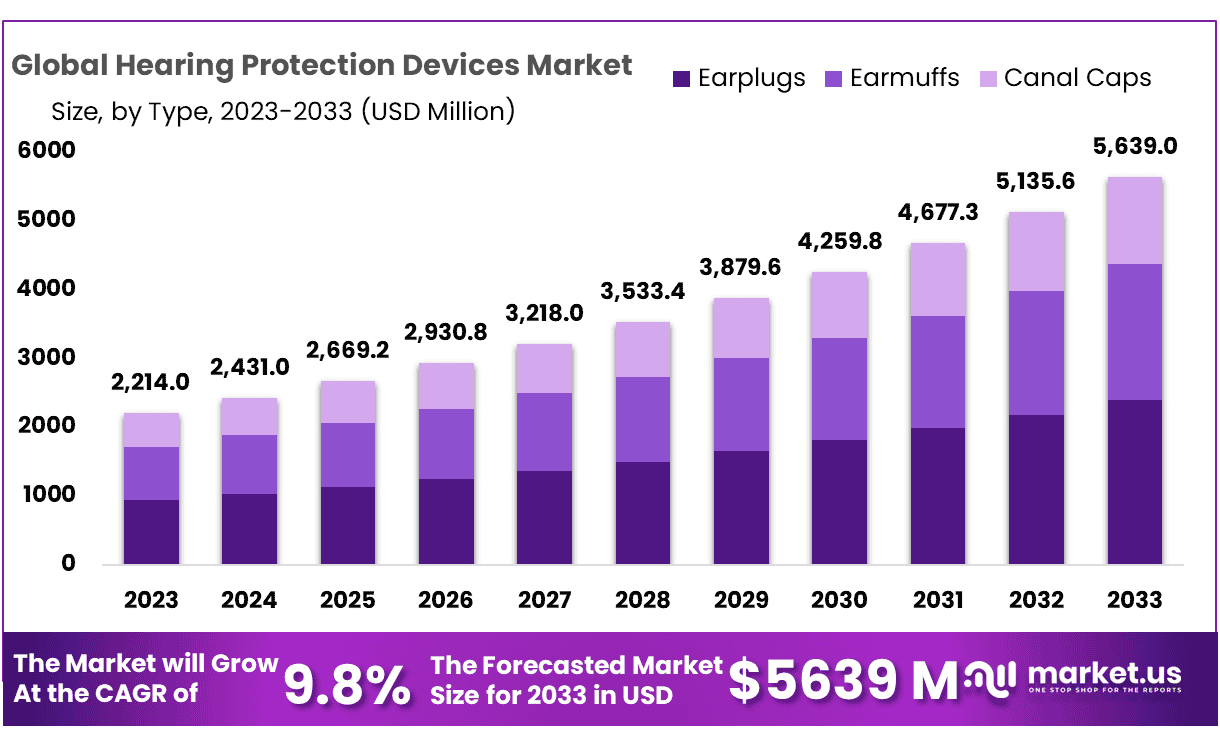
New York, NY – Jan 16, 2026 – The Global Hearing Protection Devices Market size is expected to be worth around USD 5639.0 Million by 2033 from USD 2214.0 Million in 2023, growing at a CAGR of 9.8% during the forecast period from 2024 to 2033.
Hearing Protection Devices (HPDs) are essential safety products designed to reduce exposure to harmful noise levels and prevent noise-induced hearing loss. These devices are widely used across industrial, construction, manufacturing, military, and recreational environments where prolonged or sudden exposure to high-decibel sound is common.
Hearing Protection Devices function by attenuating sound before it reaches the inner ear. The most commonly used HPDs include earplugs, earmuffs, and semi-insert devices. Earplugs are inserted into the ear canal and are typically manufactured from foam, silicone, or rubber materials. Earmuffs consist of sound-attenuating cups that fully cover the ears and are connected by an adjustable headband. Semi-insert devices combine features of both earplugs and earmuffs and are often used for intermittent noise exposure.
The adoption of Hearing Protection Devices has been driven by increasing occupational safety regulations and growing awareness of long-term hearing health. Regulatory agencies across multiple regions mandate the use of HPDs in workplaces where noise exposure exceeds permissible limits. As a result, demand for certified and ergonomically designed hearing protection solutions has increased steadily.
Technological advancements have contributed to the development of advanced Hearing Protection Devices that offer improved comfort, durability, and acoustic performance. Features such as noise reduction rating (NRR), electronic sound modulation, and customized fit are increasingly being incorporated to enhance user compliance and effectiveness.
Overall, Hearing Protection Devices play a critical role in occupational health and safety frameworks. Their continued adoption is expected to support workforce well-being, reduce healthcare costs related to hearing loss, and promote safer working environments across noise-intensive industries.
Key Takeaways
- Market Size & Growth: The Hearing Protection Devices market is projected to reach approximately USD 5,639.0 million by 2033, rising from USD 2,214.0 million in 2023, registering a compound annual growth rate (CAGR) of 9.8% over the forecast period.
- Type Analysis: Earplugs emerged as a key product category within the Hearing Protection Devices market, accounting for a dominant market share of 44.9% in 2023.
- Application Analysis: Manufacturing applications held a leading position in the Hearing Protection Devices market, representing a substantial 33.6% share of total market demand in 2023.
- By Distribution Channels: Supermarkets and hypermarkets led the distribution landscape, capturing an estimated 32% share of the overall market in 2023.
- Regional Analysis: North America maintained market leadership, accounting for 43.6% of the global share and generating revenue of approximately USD 965.3 million in 2023.
- Market Dominance: The market structure remains consolidated, with a limited number of major players controlling a significant portion of global revenues.
- Innovation Focus: Continuous investment in research and development is supporting the advancement of technologically enhanced hearing protection solutions, strengthening product performance and user adoption.
Hearing Protection Devices Statistics
- An estimated 22 million workers in the United States are regularly exposed to workplace noise levels that can cause hearing damage.
- Hearing protection devices are proven to significantly reduce the risk of noise-induced hearing loss, which remains one of the most prevalent occupational health conditions.
- Noise exposure above 85 decibels (dB) is classified as hazardous, and the use of hearing protection is recommended at or above this threshold.
- The National Institute for Occupational Safety and Health (NIOSH) advocates the implementation of comprehensive hearing conservation programs, including noise monitoring, use of protective devices, and periodic hearing assessments.
- Effective noise reduction is highly dependent on the correct selection, proper fit, and consistent use of hearing protection devices.
- Hearing protection solutions include earplugs, earmuffs, and custom-molded devices, each designed to address specific noise levels, work conditions, and user comfort requirements.
- The Noise Reduction Rating (NRR) is the standard metric used to quantify the level of sound attenuation provided by hearing protection devices.
- Despite established guidelines, compliance with hearing protection use in noisy workplaces is frequently below 50%, indicating gaps in training, awareness, and enforcement.
- According to the World Health Organization (WHO), approximately 1.1 billion young people globally are at risk of hearing loss due to unsafe listening behaviors.
- Occupational hearing loss is largely preventable; however, it continues to be among the most common work-related illnesses worldwide.
- The use of hearing protection is increasingly recommended beyond industrial settings, including recreational environments with high noise exposure such as concerts and heavy machinery use.
- Advancements in technology have enabled the development of intelligent hearing protection devices that adjust to changing noise levels while maintaining communication clarity.
- Ongoing evaluation of hearing protection programs is essential to confirm compliance with safety standards and ensure adequate worker protection.
- Education and structured training programs play a critical role in reinforcing the importance of hearing protection and promoting long-term hearing health.
- Research indicates that offering workers a range of hearing protection options can enhance comfort, acceptance, and overall compliance rates.
Regional Analysis
North America maintained its leading position in the hearing protection devices market, accounting for approximately 32% of the global share and generating revenue of USD 965.3 million in 2023. The region was closely followed by Asia-Pacific and Western Europe, which continued to demonstrate steady demand driven by industrial growth and workplace safety regulations.
Looking ahead, Eastern Europe and the Middle East are expected to witness accelerated growth in the hearing protection devices market. These regions are projected to register robust compound annual growth rates of around 14.3% during the 2023–2033 period, supported by expanding industrial activity and increasing awareness of occupational health standards.
In parallel, South America and Africa are anticipated to experience notable market expansion over the same forecast period. Compound annual growth rates of approximately 10.6% are projected between 2023 and 2033, reflecting rising investments in infrastructure, manufacturing, and workforce safety initiatives.
Overall, these trends indicate that emerging regions are expected to play an increasingly important role in shaping the global hearing protection devices market. Their rapid industrialization and evolving regulatory frameworks are likely to contribute significantly to market growth over the coming decade.
Emerging Trends
- Rising Awareness and Training Programs: Awareness of noise-induced hearing loss is increasing across the workforce. As a result, organizations are strengthening training initiatives to educate employers and employees on the correct and consistent use of hearing protection devices (HPDs).
- Advancements in Technology: Hearing protection devices are increasingly incorporating advanced technologies such as Bluetooth connectivity, active noise control, and adjustable fit features. These enhancements are improving usability, protection efficiency, and communication in high-noise environments.
- Enhanced Comfort and Ease of Use: Product design is being optimized to improve comfort and usability, supporting long-term and consistent wear. Modern earplugs and earmuffs are lighter, ergonomically designed, and easier to handle, which supports higher compliance rates.
- Integration with Other Safety Equipment: Manufacturers are focusing on developing HPDs that seamlessly integrate with other personal protective equipment (PPE), including helmets and safety eyewear, to ensure comprehensive worker protection without interference.
- Growth of Personalized Fit-Testing: The adoption of personalized fit-testing is expanding, ensuring that individuals achieve the intended level of noise attenuation. This approach enhances both protection effectiveness and user acceptance.
- Increased Use of Dual Protection: Dual protection strategies, involving the combined use of earplugs and earmuffs, are gaining traction in environments with extreme noise exposure, such as heavy industrial facilities and shooting ranges.
- Targeted Solutions for High-Risk Sectors: Industries with elevated noise exposure, including construction, manufacturing, and entertainment, are increasingly adopting customized hearing protection solutions tailored to their specific operational requirements.
- Tightening Regulatory Frameworks: Government agencies are implementing stricter noise exposure limits and reinforcing hearing conservation requirements, driving higher adoption of HPDs and improved compliance with occupational safety standards.
- Application of Advanced Materials: Innovation in materials science is supporting the development of HPDs that provide higher noise attenuation, improved comfort, and greater resistance to harsh environmental conditions.
- Focus on Durability and Cost Efficiency: Manufacturers are prioritizing the production of durable and cost-effective hearing protection devices, enabling broader access to reliable protection without compromising performance.
- Rising Demand in Emerging Economies: Rapid industrial growth in emerging markets is contributing to increased demand for hearing protection devices, supported by rising investments in workplace safety and regulatory compliance.
- Continuous Research and Innovation: Ongoing research and development efforts are advancing adaptive hearing protection technologies that respond to varying noise levels and deliver real-time exposure monitoring, further strengthening worker safety outcomes.
Frequently Asked Questions on Hearing Protection Devices
- What are the main types of hearing protection devices?
The primary types include earplugs, earmuffs, and semi-insert devices. These products vary in design, noise reduction rating, comfort level, and suitability for different noise environments and duration of exposure. - How do hearing protection devices work?
Hearing protection devices work by reducing the intensity of sound waves reaching the eardrum. This is achieved through sound-absorbing materials or physical barriers that limit noise transmission without completely blocking auditory awareness. - Who should use hearing protection devices?
These devices are recommended for workers in high-noise industries such as manufacturing, mining, and aviation, as well as for individuals exposed to loud environments during activities like shooting, concerts, or operating power tools. - What standards regulate hearing protection devices?
Hearing protection devices are regulated by safety standards such as OSHA, NIOSH, and EN norms. These standards define permissible noise exposure limits and specify performance requirements like Noise Reduction Rating for compliance. - What factors are driving market growth?
Market growth is driven by stringent workplace safety regulations, increasing industrialization, and higher awareness of hearing health. Expansion in construction, manufacturing, and defense sectors further supports sustained demand globally. - Which regions dominate the hearing protection devices market?
North America and Europe dominate the market due to strict occupational safety laws and high adoption rates. Meanwhile, Asia-Pacific is experiencing faster growth, supported by rapid industrial expansion and improving regulatory frameworks. - How is technology influencing the market?
Technological advancements such as electronic earmuffs, smart hearing protection, and improved ergonomic designs are enhancing user comfort and performance. These innovations are supporting premium product demand and expanding applications across industries.
Conclusion
Hearing Protection Devices remain a vital component of occupational health and safety strategies across noise-intensive industries. The market growth is being supported by stringent safety regulations, rising awareness of noise-induced hearing loss, and continuous technological innovation. Advances in comfort, customization, and intelligent sound management are improving user compliance and effectiveness.
North America continues to dominate market revenues, while emerging regions are expected to contribute significantly to future expansion. Overall, sustained investment in training, innovation, and regulatory enforcement is expected to strengthen adoption, enhance workforce well-being, and reduce the long-term economic burden of preventable hearing loss.
Discuss your needs with our analyst
Please share your requirements with more details so our analyst can check if they can solve your problem(s)




