


Table of Contents
Overview
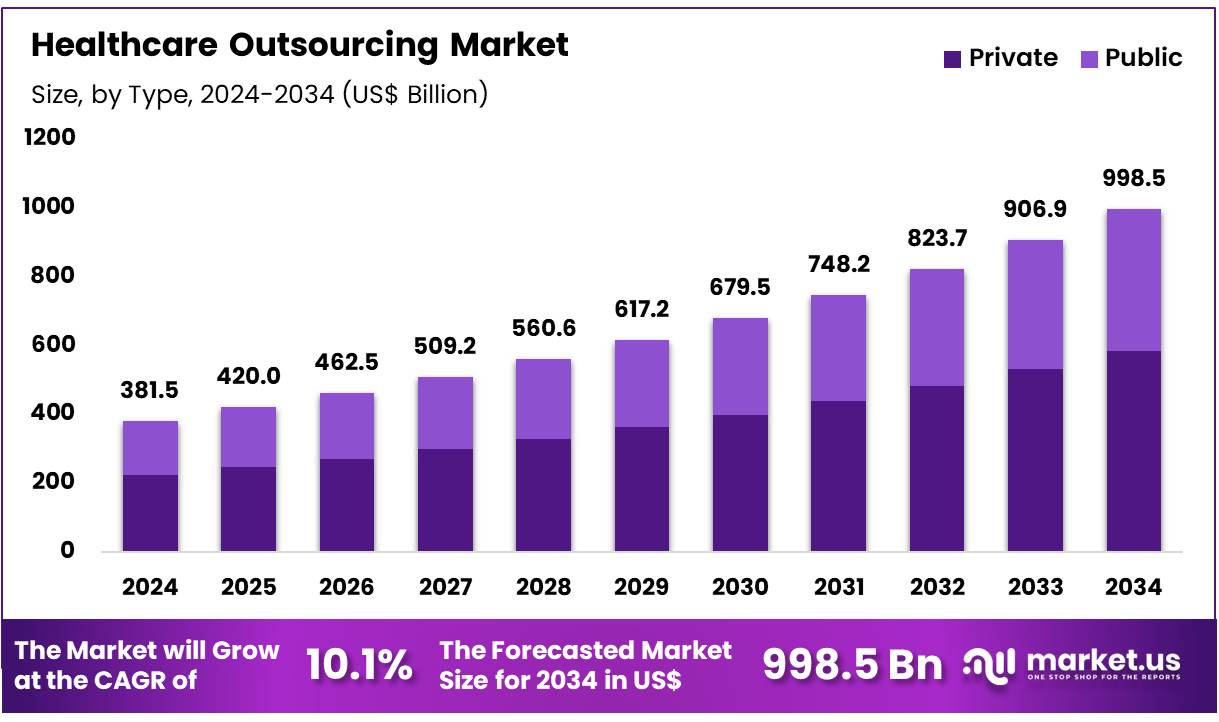
New York, NY – Dec 02, 2025 – Global Healthcare Outsourcing Market size is expected to be worth around US$ 998.5 billion by 2034 from US$ 381.5 billion in 2024, growing at a CAGR of 10.1% during the forecast period 2025 to 2034. In 2024, North America led the market, achieving over 44.6% share with a revenue of US$ 170.1 Billion.
The healthcare outsourcing market has been exhibiting steady growth as healthcare providers continue to adopt externalized services to improve operational efficiency and reduce administrative burdens. The expansion of the market has been supported by increasing patient volumes, rising healthcare expenditures, and the growing need to streamline clinical and non-clinical workflows. Outsourcing has been widely embraced to ensure improved service quality, enhanced patient outcomes, and optimized cost structures.
A significant rise in demand for revenue cycle management, medical billing, clinical research, claims processing, and IT infrastructure support has been observed across hospitals, pharmaceutical companies, and healthcare payers. The growth of the market can be attributed to ongoing digital transformation, the adoption of cloud-based solutions, and the rising complexity of healthcare delivery systems. In addition, the increasing prevalence of chronic diseases has created sustained demand for specialized support services that can be managed more efficiently through outsourcing.
North America has been maintaining a major share due to the strong presence of service providers and advanced healthcare infrastructure. The Asia-Pacific region is projected to demonstrate the fastest growth, supported by expanding medical tourism, skilled labor availability, and cost-effective service offerings.
The healthcare outsourcing industry is expected to continue expanding as organizations prioritize operational optimization and cost control. The integration of artificial intelligence, automation, and analytics is anticipated to further strengthen service capabilities and improve decision-making across the global healthcare ecosystem.
Key Takeaways
- In 2024, the global healthcare outsourcing market generated revenue of US$ 381.5 billion. The market has been expanding at a CAGR of 10.1% and is projected to reach US$ 998.5 billion by 2033.
- Based on type, the market has been segmented into public and private healthcare outsourcing. The private segment dominated in 2024, accounting for 58.6% of the total market share.
- In terms of service categories, the market has been classified into clinical services, healthcare IT, and other services. Among these, clinical services represented the leading segment, capturing 54.2% of the market share in 2024.
- From a regional perspective, North America emerged as the leading market, contributing 44.6% of global revenue in 2024.
Regional Analysis
North America Holds the Leading Position in the Healthcare Outsourcing Market
North America remained the leading regional market, accounting for 44.6% of global revenue in 2024. The dominance of the region can be attributed to the increasing emphasis on cost containment and improved operational efficiency within healthcare delivery systems. The Centers for Medicare & Medicaid Services (CMS) has projected that national health expenditures in the United States will continue to rise, increasing at an average annual rate of 5.4% between 2023 and 2032. This sustained upward trend in spending has encouraged healthcare providers to outsource non-core functions to reduce administrative burdens and operational costs.
The rising adoption of digital health technologies has further strengthened outsourcing activities, as providers increasingly rely on external expertise in areas such as data management and IT support. According to the Office of the National Coordinator for Health Information Technology (ONC), the adoption rate of electronic health records (EHRs) among US hospitals has surpassed 80% in recent years. This widespread use of digital systems has created significant demand for outsourced data processing, analytics, and health IT services. The need for healthcare organizations to concentrate on core clinical activities continues to drive the outsourcing of administrative and operational tasks across the region.
Asia Pacific Expected to Record the Fastest Growth Rate
The Asia Pacific region is projected to register the highest CAGR during the forecast period. Growth in the region is supported by the rising demand for quality healthcare services and the rapid expansion of healthcare providers across emerging economies. Many countries in the region are investing in healthcare infrastructure upgrades and adopting digital health solutions to strengthen service delivery, which in turn supports the adoption of outsourcing models.
Government-led initiatives promoting digital transformation have increased reliance on external partners for services such as IT support, data management, and clinical process outsourcing. Furthermore, growing awareness of the advantages of outsourcing including access to advanced technologies, specialized skills, and cost-effective service options is expected to accelerate market expansion across the Asia Pacific region.
Emerging Trends
- Growing Financialisation of Outpatient Services: Financial participation in outpatient care has expanded significantly. Around half of the 20 OECD countries surveyed indicated that the financialisation of outpatient services represents a high or moderate trend, reflecting increasing investor interest in non-hospital healthcare segments.
- Rapid Consolidation in Dental Practices: Dental service consolidation has accelerated across Europe. Between 2015 and 2018, the proportion of dental practices operated by dental service organisations doubled in Denmark, Norway, Spain, and the United Kingdom, driven by investor pursuit of scale efficiencies and structured operational models.
- Shift in Outpatient Laboratory Ownership in France: Ownership patterns in France’s outpatient laboratory sector have undergone a substantial shift. Investor-controlled laboratories increased from 16% in 2010 to 78% in 2022, underscoring the attractiveness of diagnostics as a stable, recurring revenue business within healthcare services.
- Increasing Private Equity Presence in Swedish Primary Care: Private ownership plays a prominent role in Sweden’s primary care landscape. By 2020, 40% of primary care centres were privately operated, with one-third of these controlled by international private equity firms, resulting in approximately one in eight clinics under private equity ownership.
Use Cases
- Accelerated Clinical Trial Execution through Outsourcing: Clinical trials represent nearly 70% of pharmaceutical R&D expenditure. Outsourcing has enabled trials to conclude approximately 30% faster than in-house studies, translating into time savings of four to five months and earlier access to market opportunities.
- Outsourced Cybersecurity Support for Hospitals: Hospitals have rapidly expanded reliance on outsourced cybersecurity services. Adoption increased from 16% in 2015 to 86% in 2020, driven by escalating cyber threats, rising data breach costs, and the need for advanced security expertise.
- Growing Adoption of Cloud-Based IT Infrastructure: Healthcare providers are increasingly shifting IT operations to cloud service partners. The healthcare cloud computing market is projected to reach between USD 20 billion and USD 50 billion by 2025, supported by the demand for scalable, secure, and cost-efficient digital infrastructure.
Frequently Asked Questions on Healthcare Outsourcing
- What is healthcare outsourcing?
Healthcare outsourcing refers to the transfer of administrative or clinical functions to external specialized providers. The approach enables healthcare organizations to reduce operational burdens, optimize resources, and maintain service quality through expert support across various non-core and core activities. - Why do healthcare providers outsource services?
Healthcare providers outsource services to improve efficiency, reduce operating costs, and streamline workflows. External expertise ensures consistent performance levels, enhanced patient support, and improved management of complex back-office operations such as billing, revenue cycle management, and administrative data processing. - Which services are commonly outsourced in healthcare?
Commonly outsourced services include medical billing, medical coding, revenue cycle management, telemedicine support, claims processing, IT infrastructure management, and laboratory services. Outsourcing helps healthcare institutions focus on clinical priorities while ensuring operational accuracy and compliance across multiple administrative functions. - How does outsourcing improve patient care quality?
Outsourcing improves patient care quality by enabling providers to allocate more time and resources to clinical activities. Administrative efficiency, enhanced technology capabilities, and specialized vendor support help healthcare organizations deliver faster, more coordinated, and patient-centric care outcomes. - How does healthcare outsourcing reduce operational cost?
Operational cost reduction is achieved by eliminating the need for additional staffing, technology investments, and administrative overheads. External providers operate at scale, offering cost-efficient solutions that enable healthcare organizations to optimize expenditure across routine administrative and clinical support processes. - Which segments dominate the healthcare outsourcing market?
Key market segments include revenue cycle management outsourcing, IT services outsourcing, pharmaceutical outsourcing, and laboratory service outsourcing. Revenue cycle management continues to dominate due to rising claims volume and the need for accurate, streamlined billing operations across healthcare institutions. - How is technology influencing the healthcare outsourcing market?
Technology influences the market by enabling advanced automation, AI-driven analytics, and cloud-based solutions. These technologies improve accuracy, accelerate workflow processing, and enhance transparency, strengthening the adoption of outsourced services across hospitals, clinics, and health insurance companies. - What regions hold the largest share of the healthcare outsourcing market?
North America holds the largest market share due to advanced healthcare infrastructure, high administrative costs, and early adoption of outsourcing services. Asia-Pacific is emerging rapidly, supported by cost-efficient service providers and expanding healthcare digitalization initiatives across the region.
Conclusion
The global healthcare outsourcing market is expected to maintain a strong growth trajectory as healthcare systems increasingly depend on external partners to manage administrative, clinical, and technological functions. The expansion of digital health infrastructure, rising healthcare expenditures, and growing service complexity continue to drive outsourcing adoption across regions.
Strong market participation in North America and rapid expansion in Asia-Pacific reflect the widening demand for scalable and cost-efficient solutions. The integration of advanced technologies, including automation, artificial intelligence, and cloud-based platforms, is anticipated to further enhance operational efficiency, strengthen decision-making, and support long-term market growth across the global healthcare ecosystem.
Discuss your needs with our analyst
Please share your requirements with more details so our analyst can check if they can solve your problem(s)




