


Table of Contents
Overview
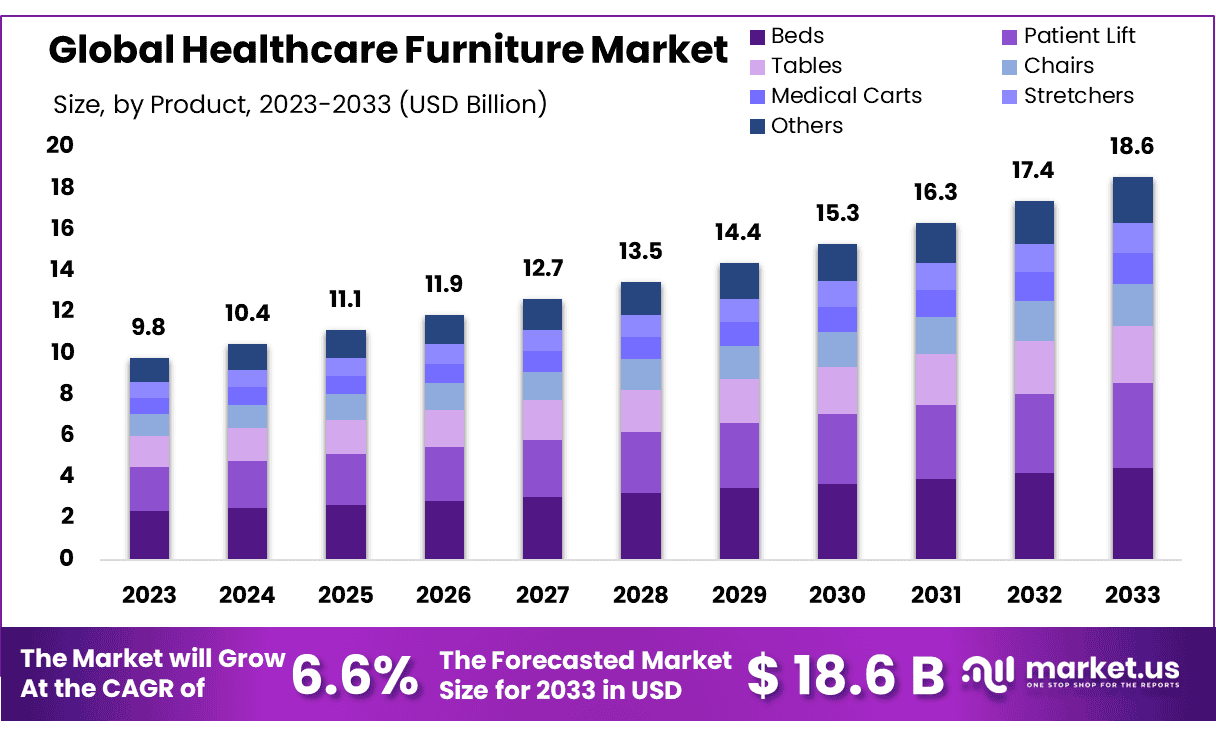
New York, NY – Jan 16, 2026 – The Global Healthcare Furniture Market size is expected to be worth around USD 18.6 Billion by 2033 from USD 9.8 Billion in 2023, growing at a CAGR of 6.6% during the forecast period from 2024 to 2033.
The global healthcare furniture market is experiencing consistent growth, supported by rising investments in healthcare infrastructure and increasing demand for patient-centric medical environments. Healthcare furniture includes hospital beds, medical chairs, tables, cabinets, trolleys, and other essential furnishings used across hospitals, clinics, diagnostic centers, and long-term care facilities.
The growth of the market can be attributed to the increasing number of hospitals and outpatient facilities worldwide. Aging populations and the rising prevalence of chronic diseases have resulted in higher patient admissions, which has increased the demand for durable, ergonomic, and infection-resistant healthcare furniture. In addition, government initiatives aimed at improving healthcare access have further supported market expansion.
Technological advancements in furniture design have also contributed to market development. Adjustable beds, mobile workstations, and modular furniture solutions are being increasingly adopted to improve patient comfort and enhance workflow efficiency for healthcare professionals. The use of antimicrobial materials and easy-to-clean surfaces has become a key focus, particularly in infection control and patient safety.
Regionally, developed markets continue to show stable demand due to ongoing facility upgrades, while emerging economies are witnessing faster growth driven by new hospital construction and healthcare modernization efforts. The market remains competitive, with manufacturers focusing on product innovation, quality compliance, and cost efficiency.
Overall, the healthcare furniture market is expected to maintain a positive growth trajectory, supported by long-term trends in healthcare expansion, patient care standards, and infrastructure development.
Key Takeaways
- Market Size & Growth: The healthcare furniture market is projected to reach approximately USD 18.6 billion by 2033, increasing from USD 9.8 billion in 2023, and expanding at a CAGR of 6.6% over the forecast period.
- Product Analysis: The bed segment dominated the market in 2023, accounting for 24.03% of the total revenue share.
- Application Analysis: Patient furniture emerged as the leading application segment, capturing over 46.7% of the market share in 2023.
- Distribution Channel Analysis: Offline distribution channels maintained market leadership by contributing more than 65.5% of the overall revenue in 2023.
- Material Type Analysis: Metal-based furniture represented the largest material segment in 2023, accounting for 40.5% of global market revenue.
- End-Use Analysis: Ambulatory Surgery Centers (ASCs) are anticipated to register the highest CAGR of 7.8% during the 2024–2033 period.
- Regional Analysis: North America led the global market in 2023 with a 38.02% share, generating approximately USD 3.7 billion in revenue.
Key Highlights and Statistics
- Stryker Achieves Historic Revenue Milestone: In December 2023, Stryker surpassed the USD 20 billion mark in annual sales for the first time, indicating sustained expansion across its global operations.
- Introduction of Stryker’s 1788 Camera Platform: In September 2023, Stryker launched the 1788 camera platform, designed to enhance surgical visualization by offering a broader color spectrum and advanced fluorescence imaging functionality.
- Stryker’s Robust Financial Performance in 2023: During 2023, Stryker recorded an 11.8% year-on-year increase in net sales, reaching USD 20.498 billion. Operating income grew significantly by 54.4%, reflecting strong operational efficiency and market demand.
- Invacare’s Regional Sales Performance: Invacare reported a 15.8% rise in European revenues, supported by strong demand for mobility and seating solutions. In contrast, North American revenues declined by 6.9%, primarily due to supply chain disruptions and ERP system implementation challenges.
- Steris Plc’s Fiscal 2024 Growth Outlook: Steris Plc projects revenue growth of 9–10% for fiscal 2024, with adjusted earnings per share expected to range between USD 8.60 and USD 8.80. Free cash flow is forecasted at approximately USD 685 million.
- Expansion of Steris Plc’s Healthcare Segment: In the second quarter of 2024, Steris’s Healthcare segment posted a 19% increase in revenue, reaching USD 870.1 million, driven by the recovery of elective medical procedures, including orthopedic and gastrointestinal surgeries.
- Strategic Divestment by Steris: Steris announced the divestment of its Dental business to Peak Rock Capital for USD 787.5 million, reinforcing its strategic focus on core healthcare and life sciences segments.
- Medline’s Investment in Supply Chain Infrastructure: In 2023, Medline allocated USD 300 million toward expanding its supply chain and manufacturing capabilities, including the establishment of new distribution centers across the United States.
- Hill-Rom’s COVID-19 Response Measures: In March 2020, Hill-Rom increased production of critical care equipment, including hospital beds and ventilators, to support pandemic response efforts. The company also committed USD 5.5 million in donations to strengthen healthcare systems.
- GF Health Products’ Advanced Bed Innovation: GF Health Products launched the Basic American 7200 Bed, incorporating laser welding and robotic assembly technologies to deliver improved durability while reducing overall cost-in-use.
- Launch of Sunrise Medical’s QUICKIE QS5 X Wheelchair: In June 2023, Sunrise Medical introduced the QUICKIE QS5 X wheelchair, engineered to improve user efficiency by reducing energy consumption by more than 40% during folding.
- Herman Miller’s Focus on Sustainable Design: Herman Miller continues to prioritize sustainability by utilizing up to 58% recycled materials and ensuring that 99.9% of new products are PVC-free, with designs emphasizing durability, modularity, and reduced environmental impact.
Regional Analysis
North America accounted for the largest share of the healthcare furniture market at 38.02%, generating approximately USD 3.7 billion in revenue in 2023. This dominance can be attributed to the rising incidence of chronic health conditions, including obesity, diabetes, and cardiac disorders, which continue to drive hospital admissions across the region.
According to the American Heart Association, a significant proportion of patients require emergency medical care, with nearly 89% of out-of-hospital cardiac arrest (OHCA) cases resulting in fatal outcomes, underscoring the persistent demand for well-equipped healthcare facilities and, consequently, advanced healthcare furniture solutions.
Use Cases for Healthcare Furniture
- Patient Room Furnishings: Healthcare facilities such as hospitals and long-term care centers require robust and comfortable furniture, including hospital beds, bedside cabinets, and patient chairs. These products are designed to comply with safety and infection-control standards, while accommodating medical equipment such as IV poles and oxygen support systems and allowing frequent cleaning and disinfection.
- Waiting Area Seating: Waiting rooms in clinics, outpatient centers, and emergency departments demand seating solutions that balance comfort with space efficiency. Furniture in these areas is required to endure high footfall, support easy maintenance, and maintain a clean and reassuring environment for patients and visitors.
- Examination Room Furniture: Examination rooms rely on adjustable exam tables, clinician stools, chairs, and work surfaces that support clinical efficiency. These furnishings are required to be ergonomic, highly functional, and constructed from materials that enable rapid and thorough sanitation.
- Administrative and Office Furniture: Administrative areas, including nurse stations and physician offices, utilize ergonomic desks, task chairs, storage units, and visitor seating. These furnishings are designed to support extended working hours, reduce fatigue, and enhance overall workflow and productivity.
- Furniture for Shared and Public Spaces: Public areas such as hospital lobbies, cafeterias, waiting lounges, and family areas require durable seating and table solutions, including sofas, chairs, benches, and tables. These furnishings are engineered to withstand intensive daily use while providing comfort and ease of cleaning for patients, staff, and visitors.
Frequently Asked Questions on Healthcare Furniture
- Why is healthcare furniture important in medical facilities?
Healthcare furniture is important because it improves patient outcomes, reduces caregiver strain, and ensures infection control. Properly designed furniture supports ergonomics, enhances mobility, and helps healthcare providers deliver safe, efficient, and high-quality medical services. - What are the common types of healthcare furniture?
Common types of healthcare furniture include hospital beds, examination tables, medical carts, bedside cabinets, waiting chairs, and overbed tables. Each category is designed to meet specific clinical, operational, and patient-care requirements across healthcare settings. - What materials are used in healthcare furniture manufacturing?
Materials used in healthcare furniture typically include steel, aluminum, engineered plastics, and antimicrobial laminates. These materials are selected for durability, ease of cleaning, resistance to corrosion, and compliance with strict healthcare safety and hygiene regulations. - What regulations apply to healthcare furniture?
Healthcare furniture must comply with regulations related to patient safety, fire resistance, ergonomics, and infection control. Compliance with standards set by healthcare authorities ensures furniture suitability for clinical use and minimizes operational and legal risks. - Which end users dominate the healthcare furniture market?
Hospitals account for the largest share of healthcare furniture demand due to high patient volumes and frequent equipment replacement. However, clinics, ambulatory surgical centers, and long-term care facilities are showing faster growth rates. - Which regions lead the healthcare furniture market?
North America holds a significant share of the healthcare furniture market due to advanced healthcare infrastructure and high spending. Meanwhile, Asia-Pacific is experiencing rapid growth, supported by expanding hospitals and improving healthcare access. - What are the key trends in the healthcare furniture market?
Key trends in the healthcare furniture market include adoption of smart and connected furniture, focus on infection-resistant materials, and demand for modular designs. Sustainability and ease of maintenance are also becoming important purchasing considerations.
Conclusion
The global healthcare furniture market is positioned for sustained growth, driven by expanding healthcare infrastructure, rising patient volumes, and increasing emphasis on patient-centric care. Demand is being reinforced by aging populations, higher prevalence of chronic diseases, and continuous investments in hospitals and outpatient facilities.
Technological innovation, including ergonomic, modular, and infection-resistant designs, has improved both patient comfort and clinical efficiency. While North America remains the leading regional market, emerging economies are expected to register faster growth. Overall, long-term healthcare modernization, regulatory compliance, and quality-focused product development are expected to support a stable and positive market outlook.
Discuss your needs with our analyst
Please share your requirements with more details so our analyst can check if they can solve your problem(s)




