


Table of Contents
Overview
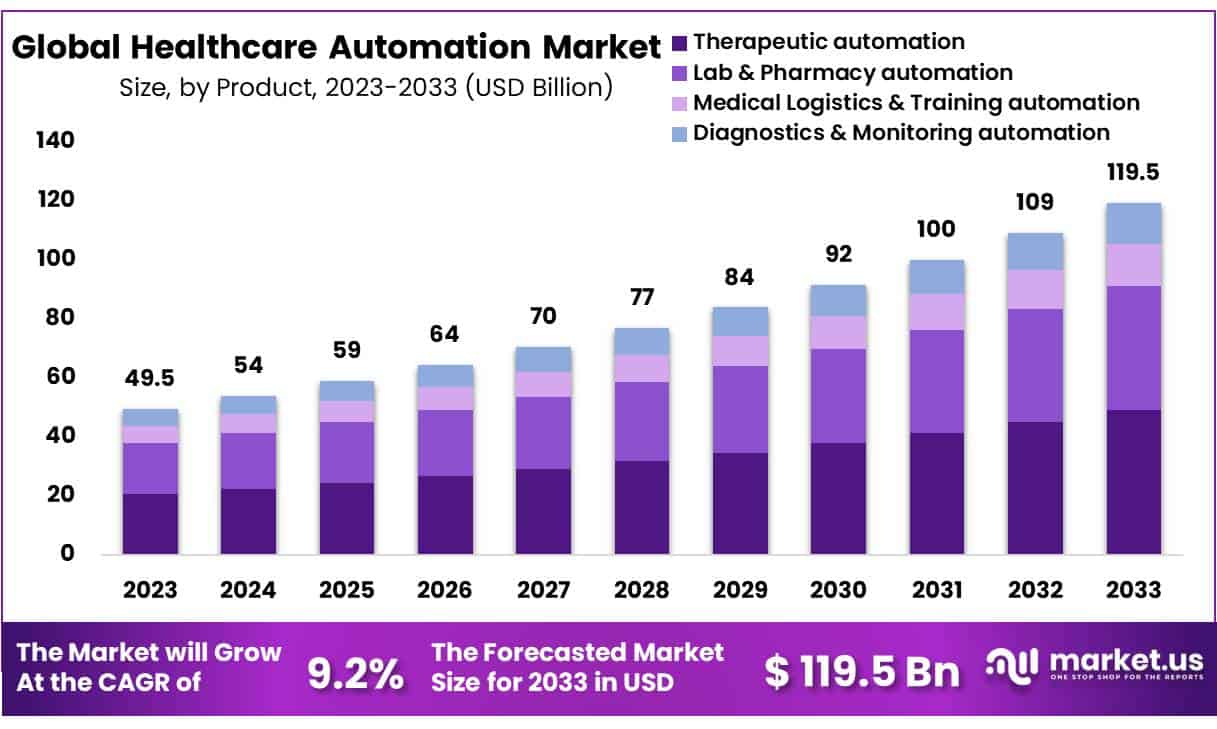
New York, NY – Dec 24, 2025 – The Global Healthcare automation Market size is expected to be worth around USD 119.5 Billion by 2033 from USD 49.5 Billion in 2023, growing at a CAGR of 9.2% during the forecast period from 2024 to 2033.
Healthcare automation is increasingly being adopted across hospitals, clinics, and diagnostic centers as part of broader efforts to improve operational efficiency and care delivery. Automation in healthcare refers to the use of digital technologies, software platforms, and intelligent systems to streamline clinical, administrative, and operational processes.
The growing demand for healthcare services, combined with workforce shortages and rising operational costs, has accelerated the adoption of automated solutions. Processes such as patient scheduling, billing, claims management, laboratory workflows, and electronic health records management are being automated to reduce manual workload and minimize human error. As a result, healthcare providers are able to allocate more time and resources toward direct patient care.
Automation technologies are also supporting clinical decision-making through data integration and real-time analytics. Automated systems can assist in monitoring patient data, flagging abnormalities, and supporting early diagnosis, which contributes to improved patient safety and treatment outcomes. In addition, automation enables better compliance with regulatory standards by ensuring consistent documentation and standardized workflows.
The integration of healthcare automation is being supported by advancements in artificial intelligence, machine learning, and cloud-based platforms. These technologies allow healthcare organizations to scale operations, improve data accuracy, and enhance interoperability across systems.
Overall, healthcare automation is positioned as a foundational component of modern healthcare infrastructure. Its adoption is expected to support cost containment, operational resilience, and quality improvement, while enabling healthcare systems to respond more effectively to growing patient demands and evolving care models.
Key Takeaways
- Market Size: The healthcare automation market is projected to reach approximately USD 119.5 billion by 2033, increasing from USD 49.5 billion in 2023.
- Market Growth: The market is anticipated to expand at a compound annual growth rate (CAGR) of 9.2% over the forecast period from 2024 to 2033.
- Product Analysis: The therapeutic automation segment accounted for a significant market share of 56.2% in 2023, indicating strong adoption across clinical applications.
- End-Use Analysis: Hospitals and diagnostic centers emerged as the leading end-use segment, holding a dominant share of 52.4% in 2023.
- Regional Analysis: North America maintained its leadership position in the global healthcare automation market, capturing 42.3% of total market revenue in 2023.
- Cost Reduction: The adoption of automation contributes to lower operational costs by reducing human errors, accelerating workflows, and improving overall resource efficiency, resulting in measurable cost savings for healthcare providers.
- Technological Innovations: Continuous advancements in robotics, artificial intelligence, and machine learning are strengthening automation across healthcare functions such as surgical procedures, diagnostics, and patient management, thereby supporting market expansion.
- Challenges: Market growth is constrained by factors including high upfront investment requirements, complexities in integrating automation with legacy systems, and rising concerns related to data privacy and cybersecurity.
- Regulatory Landscape: Strict regulatory frameworks governing the deployment of automated healthcare systems emphasize patient safety and clinical effectiveness, simultaneously encouraging the adoption of compliant and dependable automation solutions.
Regional Analysis
North America commands a substantial share of the global healthcare automation market, accounting for approximately 42.3% of total revenue in 2023. This dominant position is largely driven by continuous advancements in healthcare delivery systems and the widespread integration of advanced information technology across the region.
Moreover, the increasing adoption of automation across healthcare operations, supported by significant investments in research and development, is strengthening market growth in North America. Rapid modernization of healthcare infrastructure, combined with heightened patient awareness of chronic conditions such as cardiovascular diseases, diabetes, and cancer, has accelerated the deployment of automated solutions across healthcare facilities. As a result, the region continues to demonstrate strong demand for healthcare automation technologies, reinforcing its leading market position.
Emerging Trends
- Integration of Artificial Intelligence (AI): Artificial intelligence is being increasingly adopted to improve diagnostic accuracy and optimize administrative operations. Advanced AI algorithms are capable of analyzing large and complex clinical datasets to support early disease identification. In parallel, robotic process automation (RPA) is being applied to routine administrative functions such as appointment scheduling, claims processing, and billing. These applications reduce manual errors, enhance operational efficiency, and allow healthcare professionals to focus on patient-centric activities.
- Expansion of Telehealth and Remote Patient Monitoring: The expansion of telehealth solutions has significantly improved access to healthcare services, particularly for populations in geographically remote or underserved areas. Remote patient monitoring technologies enable continuous tracking of patient health indicators, supporting real-time clinical decision-making. This approach facilitates timely medical interventions and the development of personalized treatment plans, contributing to improved continuity of care.
- Adoption of the Internet of Medical Things (IoMT): The Internet of Medical Things represents a growing ecosystem of connected medical devices capable of collecting and transmitting health data. Wearable sensors and smart medical devices support continuous monitoring of vital parameters, enabling proactive health management. Early identification of abnormalities through IoMT solutions is contributing to preventive care and reduced disease progression risks.
- Implementation of Clinical Workflow Automation: Healthcare organizations are transitioning beyond standalone RPA toward integrated clinical workflow automation solutions. These systems unify multiple operational and clinical processes, including patient intake, documentation, and care coordination. The integration of workflows enhances operational efficiency, reduces process fragmentation, and improves patient experience across the care continuum.
- Emphasis on Data Security and Regulatory Compliance: As digital health adoption accelerates, data security and regulatory compliance have become critical priorities. Automated healthcare systems are increasingly designed with robust security frameworks to protect sensitive patient information. Compliance with regulations such as the Health Insurance Portability and Accountability Act (HIPAA) is being embedded into system architectures to ensure confidentiality, data integrity, and regulatory adherence.
Use Cases
- Predictive Analytics for High-Risk Patient Identification: AI-enabled predictive analytics platforms analyze historical and real-time patient data to identify individuals at elevated risk of adverse clinical events. By detecting patterns and risk indicators early, healthcare providers can implement preventive interventions, potentially lowering hospitalization rates and improving long-term patient outcomes.
- Automated Medical Imaging Analysis: Artificial intelligence is being widely used in medical imaging to assist clinicians in identifying abnormalities such as tumors and other pathological conditions. Automated image analysis enhances diagnostic precision, accelerates image interpretation, and supports earlier treatment initiation, particularly in oncology and radiology applications.
- Remote Patient Monitoring (RPM): Wearable and sensor-based devices continuously collect physiological data, including heart rate, blood pressure, and oxygen levels. This data is transmitted to healthcare providers in real time, enabling continuous patient oversight. RPM solutions are particularly effective in managing chronic diseases, reducing emergency interventions, and supporting post-discharge care.
- Robotic-Assisted Surgical Procedures: Robotic-assisted surgery systems enable surgeons to perform complex procedures with enhanced precision and control. These systems reduce surgical invasiveness, minimize postoperative complications, and shorten patient recovery times, resulting in improved clinical outcomes and patient satisfaction.
- Virtual Health Assistants: AI-driven virtual assistants and chatbots are being deployed to support patient engagement. These tools provide appointment scheduling, medication reminders, and basic medical guidance, improving accessibility to healthcare services while reducing the administrative burden on clinical staff.
- Clinical Workflow Automation: Automation platforms streamline clinical operations by integrating patient information across multiple systems and departments. Improved data interoperability enhances care coordination, reduces administrative inefficiencies, and supports optimized resource utilization, leading to more effective and timely patient care.
Frequently Asked Questions on Healthcare automation
- What factors are driving the growth of the healthcare automation market?
The market growth is driven by rising healthcare costs, workforce shortages, increasing patient volumes, and the need for error reduction. Technological advancements and growing adoption of digital health solutions further support market expansion globally. - How does healthcare automation improve patient care?
Healthcare automation enhances patient care by reducing manual errors, improving diagnostic accuracy, accelerating treatment processes, and enabling personalized care delivery. Automated systems also support faster decision-making, leading to improved clinical outcomes and patient satisfaction. - Which technologies are commonly used in healthcare automation?
Common technologies include artificial intelligence, machine learning, robotic process automation, electronic health records, automated laboratory systems, and smart medical devices. These technologies collectively streamline workflows and enhance data-driven decision-making across healthcare settings. - What are the key applications of healthcare automation?
Healthcare automation is widely applied in laboratory automation, pharmacy automation, medical imaging, patient scheduling, billing, and remote patient monitoring. These applications help healthcare providers optimize operations and manage increasing demand efficiently. - How does healthcare automation benefit healthcare providers?
Healthcare providers benefit through improved operational efficiency, reduced administrative burden, lower operational costs, and enhanced workforce productivity. Automation enables staff to focus more on patient-centric activities rather than repetitive manual tasks. - What is the future outlook of the healthcare automation market?
The healthcare automation market is expected to witness sustained growth, supported by digital transformation initiatives, increasing chronic disease prevalence, and rising investments in healthcare IT infrastructure, particularly across developed and emerging healthcare economies.
Conclusion
Healthcare automation is becoming a core element of modern healthcare systems, driven by rising service demand, workforce shortages, and cost pressures. The adoption of automation across clinical, administrative, and operational functions is improving efficiency, accuracy, and care quality. Technologies such as artificial intelligence, machine learning, robotics, and cloud platforms are strengthening clinical decision-making, workflow integration, and regulatory compliance.
While challenges related to investment costs, system integration, and data security remain, continued technological advancements and supportive regulatory frameworks are expected to sustain market growth. Overall, healthcare automation is positioned to enhance operational resilience, optimize resource utilization, and support improved patient outcomes globally.
Discuss your needs with our analyst
Please share your requirements with more details so our analyst can check if they can solve your problem(s)




