


Table of Contents
Overview
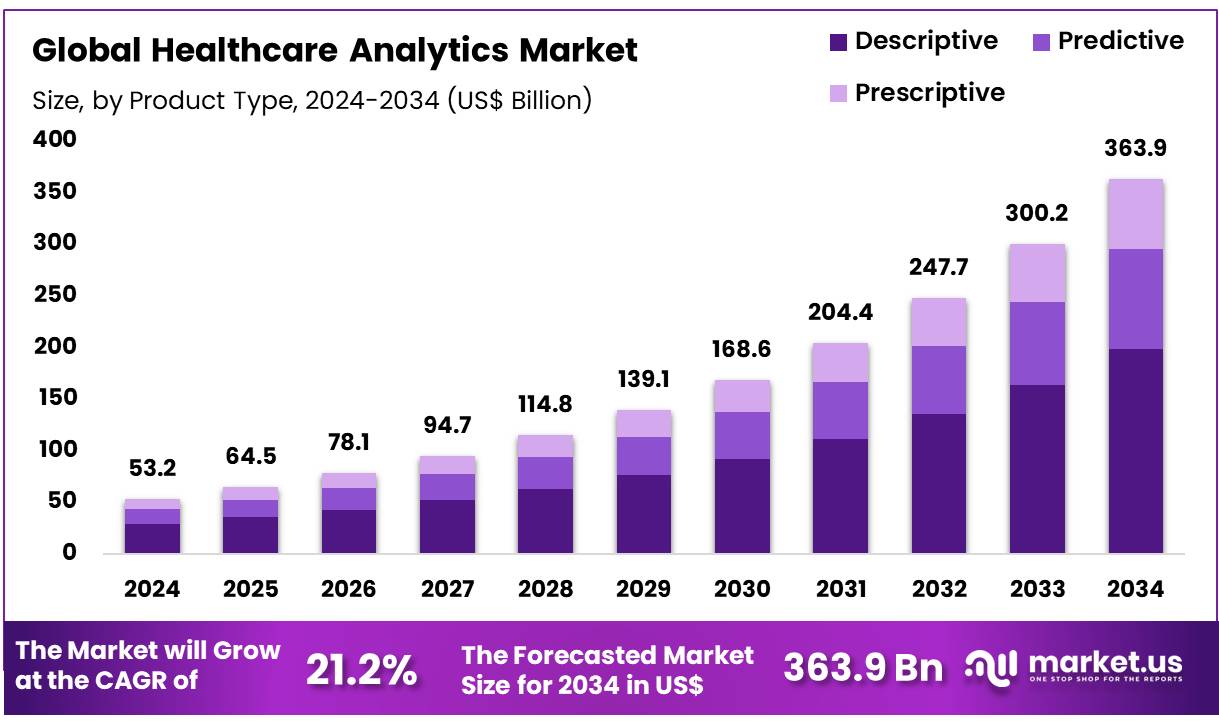
New York, NY – Dec 15, 2025 – Global Healthcare Analytics Market size is expected to be worth around US$ 363.9 Billion by 2034 from US$ 53.2 Billion in 2024, growing at a CAGR of 21.2% during the forecast period 2025 to 2034. In 2024, North America led the market, achieving over 39.3% share with a revenue of US$ 20.9 Billion.
The global healthcare analytics market is witnessing steady expansion, supported by the growing adoption of data driven decision making across healthcare systems. Healthcare analytics refers to the systematic use of data, statistical tools, and predictive models to improve clinical outcomes, operational efficiency, and cost management.
The growth of the market is primarily attributed to the rising volume of healthcare data generated from electronic health records (EHRs), medical imaging systems, wearable devices, and claims databases. As healthcare providers focus on improving patient outcomes while controlling costs, analytics solutions are increasingly being deployed to support population health management, clinical decision support, and fraud detection.
Technological advancements in artificial intelligence (AI), machine learning, and cloud computing are further strengthening the adoption of healthcare analytics platforms. Predictive and prescriptive analytics are gaining traction as they enable early disease detection, personalized treatment planning, and proactive risk management. In addition, regulatory initiatives promoting healthcare digitization and value based care models are accelerating market penetration across developed and emerging economies.
Hospitals, payers, and pharmaceutical companies represent key end users of healthcare analytics solutions. Among application areas, clinical analytics continues to hold a significant share, while operational and financial analytics are expected to register consistent growth due to increasing pressure on healthcare organizations to optimize resources.
Overall, the healthcare analytics market is positioned for sustained growth, supported by continuous innovation, expanding data ecosystems, and the increasing emphasis on evidence‑based healthcare delivery.
Key Takeaways
- In 2024, the global healthcare analytics market recorded revenues of US$ 53.2 billion and is projected to expand at a CAGR of 21.2%, reaching approximately US$ 363.9 billion by 2034.
- Based on product type, the market is categorized into descriptive, predictive, and prescriptive analytics, with descriptive analytics emerging as the leading segment in 2024, accounting for 54.6% of total market share.
- By technology, the market is segmented into web-hosted, cloud-based, and on-premises solutions. Among these, on-premises deployments dominated the market, capturing a 48.8% revenue share.
- In terms of application, the market is classified into clinical, financial, and operational & administrative analytics. The financial analytics segment held the dominant position, contributing 40.7% of overall market revenue.
- On the basis of components, the market is divided into software, services, and hardware, with the services segment leading the market and accounting for a 42.5% revenue share.
- By end user, the market includes life science companies, healthcare payers, and healthcare providers. Life science companies represented the largest end-user segment, holding a 43.9% market share.
- North America maintained its leadership position in 2024, securing a 39.3% share of the global healthcare analytics market.
Regional Analysis
North America accounted for the largest share of the healthcare analytics market in 2024, capturing 39.3% of total revenue. This dominance is supported by the rising volume of digital health data, the strong adoption of value-based care models, and extensive government initiatives focused on data interoperability. In the United States, national health expenditures were projected to grow by 8.2% in 2024, reflecting increased utilization of healthcare services and generating substantial volumes of structured and unstructured data.
The widespread implementation of electronic health records and advanced health IT systems continues to strengthen analytics adoption. Regulatory efforts by the Office of the National Coordinator for Health Information Technology, including the launch of TEFCA and the finalization of the HTI-1 rule in late 2023, have further accelerated interoperable data exchange and responsible use of analytics and artificial intelligence. In Canada, healthcare spending was expected to reach US$372 billion in 2024, reinforcing a growing digital data environment supported by Canada Health Infoway.
The Asia Pacific region is anticipated to register the fastest CAGR over the forecast period. Growth is driven by rising healthcare expenditures, rapid digital transformation, and increasing recognition of data-driven healthcare delivery. Government-led initiatives in China, Japan, India, and Singapore, combined with expanding digital health ecosystems and private sector innovation, are expected to significantly accelerate healthcare analytics adoption across the region.
Healthcare Analytics Statistics
- U.S. Healthcare Expenditure: Per capita healthcare spending in the United States reached USD 12,914 in 2021, which remained substantially higher than the USD 6,003 average observed across other large, high-income countries.
- Spending Growth Trend: U.S. healthcare expenditure continued to expand at pre-pandemic growth rates through 2022, indicating sustained structural cost pressures within the system.
- Electronic Case Reporting (eCR) Adoption: Utilization of electronic case reporting increased by 27%, with approximately 380 critical access hospitals implementing eCR by early 2024, compared to around 300 facilities in early 2023.
- CDC Data Utilization: The CDC’s Respiratory Virus Data Channel recorded approximately 4 million user visits since its launch in September 2023, reflecting strong engagement with real-time public health analytics.
- Hospital Network Participation: In 2021, about 39% of U.S. hospitals were connected to more than one of the four national healthcare data networks, supporting multi-network data exchange.
- Hospital Data Interoperability: By 2021, nearly 88% of hospitals were electronically sending and receiving patient health information, demonstrating significant progress in interoperability capabilities.
- Rural Telehealth Expansion: Telehealth adoption remained a strategic priority in rural healthcare settings, contributing to improved access to care and reduced geographic barriers.
- Health IT Adoption: Almost 90% of hospitals had implemented 2015 Edition certified health IT by 2021, enabling compliance with advanced interoperability and data-sharing requirements.
- Bulk Data Export Capabilities: Approximately 74% of hospitals had implemented bulk data export functions by 2021, supporting large-scale analytics, reporting, and population health initiatives.
- Health IT Certification Compliance: Nearly 90% of hospitals adopted updated certification standards under the 21st Century Cures Act, strengthening nationwide interoperability through standardized criteria.
- TEFCA Implementation: Launched in early 2022, the Trusted Exchange Framework and Common Agreement (TEFCA) established a national governance model to enable secure and standardized health data exchange across the U.S. healthcare system.
Emerging Trends in Healthcare Analytics
- Artificial Intelligence in Diagnostics: The application of AI in clinical diagnostics has enhanced accuracy, with improvements of approximately 17% in chest X-ray interpretation, supporting earlier and more reliable disease detection.
- Evolution of Wearable Devices: Wearable technologies have advanced into comprehensive health monitoring solutions, generating continuous, high-quality patient data and enabling actionable clinical insights.
- Expansion of 3D Printing: The number of U.S. hospitals operating centralized 3D printing facilities increased from 3 in 2010 to more than 110 by 2019, highlighting rapid adoption for surgical planning and customized medical devices.
- AI in Healthcare Administration: Artificial intelligence is increasingly being deployed to automate and optimize administrative functions, including appointment scheduling, billing processes, and medical record management.
- Growth of Telehealth Services: Telehealth adoption continues to expand, with particularly strong impact in rural and underserved regions, improving access to timely and cost-effective care.
- Data Infrastructure Limitations: Approximately 64% of healthcare leaders identify inadequate data quality and integration as a major constraint limiting large-scale AI deployment.
- Impact of Generative AI: Generative AI technologies are projected to reduce administrative costs by 13–25%, lower medical costs by 5–11%, and increase healthcare provider revenues by 3–12%.
- Transformation of Primary Care: The convergence of AI, wearable technologies, and telehealth is enabling a shift toward proactive, preventive, and continuous care models in primary care settings.
Key Use Cases of Healthcare Analytics
- Emergency Department Optimization: Predictive analytics supports improved staffing and resource allocation during peak demand periods, leading to shorter wait times and enhanced patient throughput.
- Advanced Diagnostic Support: Machine learning algorithms analyze historical and real-time data to detect subtle clinical patterns, improving diagnostic precision beyond traditional manual assessment.
- Personalized Care Pathways: Data-driven insights enable clinicians to design individualized treatment plans, improving clinical outcomes and patient satisfaction.
- Fraud and Abuse Detection: Analytics identifies anomalous billing and claims activity, helping prevent financial losses and ensuring resources are directed toward legitimate patient care.
- Quality and Outcome Measurement: Continuous data analysis enables monitoring of patient outcomes, supporting ongoing quality improvement initiatives across healthcare organizations.
- Population Health Management: Demographic, clinical, and socioeconomic data are analyzed to guide targeted public health strategies, improving chronic disease management and reducing health inequities.
- Clinical Trial Optimization: Advanced analytics enhances trial efficiency through optimized participant selection, real-time performance monitoring, and faster insights, accelerating drug and therapy development.
- AI-Driven Medical Imaging: Artificial intelligence improves the speed and accuracy of medical image interpretation, particularly in oncology and neurology, where early detection is critical.
- Telehealth Performance Analytics: Data analytics evaluates virtual care effectiveness, optimizing appointment workflows, follow-up processes, and access in underserved populations.
- Behavioral and Mental Health Insights: Analytics uncovers behavioral and mental health trends, enabling more targeted interventions and personalized patient support.
- Hospital Readmission Reduction: Risk stratification models identify patients at high risk of readmission, enabling proactive follow-up and improved post-discharge care.
- Medication Adherence Monitoring: Prescription and adherence data are analyzed to flag deviations, allowing timely provider intervention and improved treatment effectiveness.
Frequently Asked Questions on Healthcare Analytics
- What types of data are used in healthcare analytics?
Healthcare analytics utilizes clinical records, electronic health records, claims data, genomic data, operational data, and patient-generated data, which are collectively analyzed to identify trends, predict outcomes, and optimize healthcare delivery processes. - What are the main types of healthcare analytics?
The main types include descriptive, diagnostic, predictive, and prescriptive analytics. These approaches help understand historical performance, identify root causes, forecast future events, and recommend actionable strategies for improving healthcare quality and efficiency. - How does healthcare analytics improve patient care?
Healthcare analytics improves patient care by enabling early disease detection, personalized treatment plans, reduced medical errors, and better population health management through data-driven insights that support proactive and preventive healthcare interventions. - What factors are driving the growth of the healthcare analytics market?
Market growth is driven by rising healthcare costs, increasing adoption of electronic health records, demand for value-based care, advancements in artificial intelligence, and the growing need for data-driven decision-making across healthcare organizations. - Which end users dominate the healthcare analytics market?
Healthcare providers and payers represent the dominant end users, as analytics solutions are widely adopted for clinical decision support, claims management, fraud detection, risk assessment, and improving overall healthcare delivery and financial performance. - What is the future outlook of the healthcare analytics market?
The market is expected to experience sustained growth due to expanding digital health initiatives, increasing focus on population health management, and continuous integration of advanced technologies such as machine learning and predictive analytics in healthcare operations.
Conclusion
The global healthcare analytics market is expected to demonstrate sustained and robust growth over the coming decade, supported by expanding digital health ecosystems and the increasing reliance on data-driven decision making. The rising volume of healthcare data, combined with advancements in artificial intelligence, machine learning, and cloud technologies, is strengthening analytics adoption across clinical, financial, and operational domains.
Strong participation from healthcare providers, payers, and life science companies continues to reinforce market expansion. Additionally, supportive regulatory frameworks, growing emphasis on value-based care, and increasing focus on population health management are expected to further enhance long-term market prospects.
Discuss your needs with our analyst
Please share your requirements with more details so our analyst can check if they can solve your problem(s)




