


Table of Contents
Overview
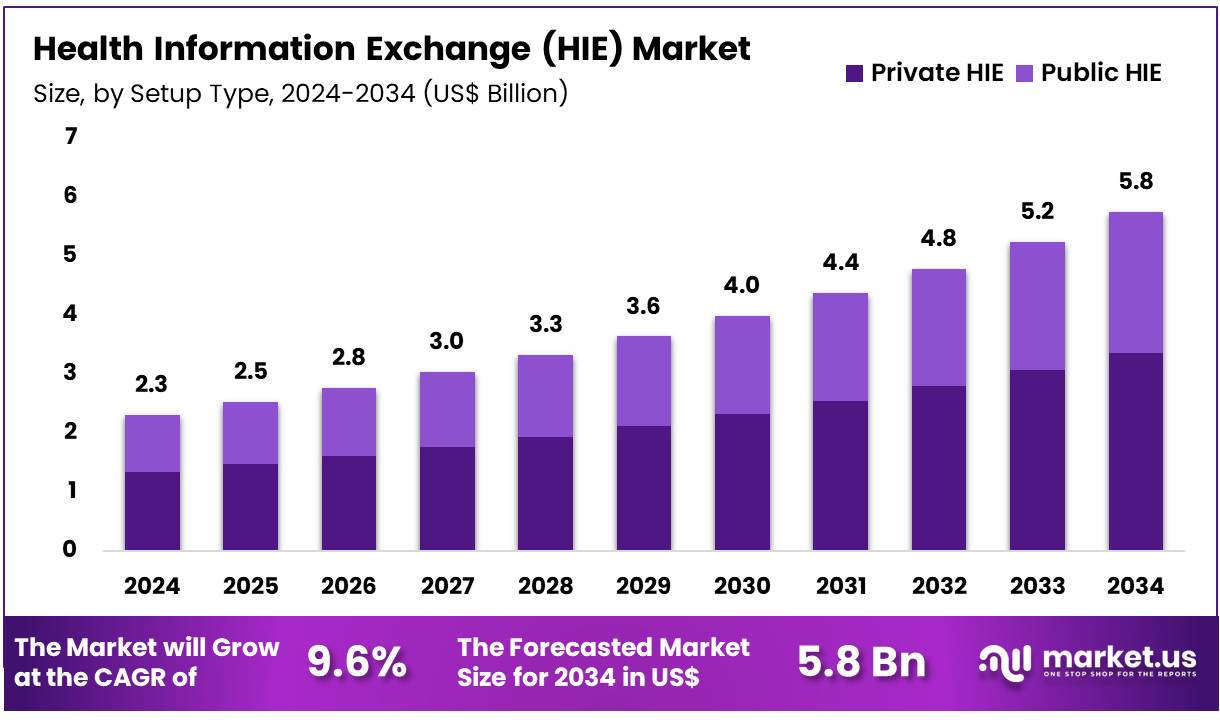
New York, NY – Dec 04, 2025 – Global Health Information Exchange (HIE) Market size is expected to be worth around US$ 5.8 Billion by 2034 from US$ 2.3 Billion in 2024, growing at a CAGR of 9.6% during the forecast period 2025 to 2034. In 2024, North America led the market, achieving over 37.9% share with a revenue of US$ 0.9 Billion.
A Health Information Exchange (HIE) is being introduced to strengthen the secure, real-time sharing of clinical data across healthcare organizations. The initiative is designed to improve care coordination, enhance patient safety, and support data-driven decision-making throughout the healthcare ecosystem. Through this system, patient information such as medical histories, laboratory results, imaging reports, and prescribed medications will be exchanged seamlessly among authorized providers.
The deployment of the HIE has been driven by the growing need for integrated digital health infrastructure. Healthcare delivery systems have increasingly relied on interoperable platforms to reduce redundant tests, minimize administrative inefficiencies, and ensure accurate treatment pathways. The adoption of the HIE is expected to improve the speed and quality of clinical interventions, as care teams will be empowered with complete and up-to-date patient information at the point of care.
The platform operates under strict data-protection protocols, ensuring compliance with national privacy and security standards. Robust encryption, consent management tools, and continuous monitoring have been incorporated to maintain confidentiality and safeguard sensitive health information. The system also supports analytics capabilities that enable healthcare administrators and policymakers to examine population-health trends, identify service gaps, and optimize resource allocation.
The creation of this HIE reflects a broader commitment to transforming healthcare delivery through digital innovation. The initiative is anticipated to contribute to improved clinical outcomes, reduced operational costs, and a more connected healthcare environment. Stakeholders, providers, and community partners are encouraged to participate as the exchange moves toward full implementation.
Key Takeaways
- In 2024, the health information exchange (HIE) market generated revenue of US$ 2.3 billion and recorded a CAGR of 9.6%, with the market projected to reach US$ 5.8 billion by 2034.
- The type segment comprises directed exchange, consumer-mediated exchange, and query-based exchange, with directed exchange accounting for the leading share of 47.6% in 2024.
- Based on setup type, the market is categorized into private HIE and public HIE, where private HIE accounted for a significant 58.3% share.
- Within the application segment, the market is classified into internal interfacing, workflow management, web portal development, secure messaging, patient safety, and others, with web portal development emerging as the leading category with a 36.2% revenue share.
- The implementation model includes hybrid, decentralized, and centralized models, with the hybrid model holding the dominant position at 52.8% revenue share.
- North America led the global market landscape, capturing a 37.9% share in 2024.
Regional Analysis
North America Leading the Health Information Exchange (HIE) Market
North America accounted for the largest revenue share of 37.9%, supported by continued federal initiatives aimed at strengthening interoperability and enabling secure data exchange across healthcare systems. Regulatory efforts led by the Office of the National Coordinator for Health Information Technology (ONC) have reinforced this progress through established standards and funding programs.
The 21st Century Cures Act, with its emphasis on open APIs, has further encouraged broader data-sharing capabilities. According to ONC updates released in early 2024, the proportion of hospitals engaging in electronic information exchange with external providers has shown substantial growth over the past decade. This ongoing commitment to interoperability, intended to enhance care coordination and clinical outcomes, has been a central factor driving market expansion in the region.
Asia Pacific Expected to Exhibit the Highest CAGR
Asia Pacific is projected to record the fastest CAGR during the forecast period, driven by increasing government measures aimed at advancing digital health infrastructure and improving the overall efficiency of healthcare services. Several countries in the region are implementing national digital health strategies that rely on strong data exchange frameworks.
National HIE platforms are gaining traction in markets such as Australia and Singapore as part of broader health system modernization initiatives. The rising adoption of electronic health records (EHRs) and the growing focus on universal health coverage are also expected to accelerate the demand for solutions that support seamless sharing of patient data across diverse healthcare organizations.
Emerging Trends
- A stable pattern of comprehensive data exchange has been observed across the U.S. hospital landscape. In 2023, 70% of hospitals engaged in all four core domains of interoperable exchange query, send, receive, and integrate maintaining the same level reported in 2022.
- Participation in the Trusted Exchange Framework and Common Agreement (TEFCA) has increased sharply. Planned hospital involvement rose from 10% in 2022 to 39% in 2023, which illustrates strong institutional momentum toward a unified, nationwide exchange infrastructure.
- The adoption of standardized data sets continues to advance. The United States Core Data for Interoperability (USCDI) is being utilized to define and transmit essential clinical data elements, supporting greater uniformity across heterogeneous electronic health record systems.
- Use of health information exchange (HIE) platforms for external data queries shows continued growth. More than 60% of hospitals used an HIE to electronically locate patient health information from outside organizations in 2021, reflecting rising dependence on shared clinical data for informed decision-making.
Use Cases
- Laboratory Result Sharing: Laboratory results are transmitted through HIE networks, enabling clinicians to access up-to-date diagnostic information without manual intervention. In 2021, over 60% of hospitals queried external patient information through HIEs, which reduced delays in diagnosis and treatment.
- Public Health Reporting: Hospitals transmit data electronically to public health registries to support surveillance and outbreak management. In 2022, 63% of hospitals submitted immunization and disease-case data to public health registries, while 51% reported to clinical data registries. This electronic transmission has improved the timeliness and completeness of public health datasets.
- Automated Case Reporting (eCR): Real-time case reports for notifiable conditions are sent from electronic health records to public health agencies. This automated and bidirectional process improves data accuracy and accelerates public health response efforts by securely routing clinical case information to state or local authorities.
- Care Coordination Across Settings: Patient summaries, medication lists, and imaging reports are exchanged among hospitals, primary care clinicians, and post-acute care providers. With TEFCA participation increasing to 39%, a broader share of facilities will be positioned to exchange data across jurisdictions, supporting smoother care transitions and reducing the likelihood of readmissions.
Frequently Asked Questions on Health Information Exchange (HIE)
- Why is HIE important for healthcare providers?
HIE is considered essential because it reduces duplicated tests, avoids medication errors, improves care coordination, and supports timely access to patient information. Its adoption has strengthened clinical efficiency and helped healthcare providers enhance patient outcomes while reducing administrative burdens. - How does HIE improve patient care?
HIE strengthens patient care by ensuring clinicians receive the patient’s complete medical history during consultations. This comprehensive data access enables faster diagnoses, fewer unnecessary procedures, and improved continuity, resulting in safer, more informed, and better managed treatment pathways for individuals. - What types of HIE models exist?
Three main HIE models exist: directed exchange for secure information transfer between providers, query-based exchange that retrieves patient records from multiple sources, and consumer-mediated exchange that allows individuals to control and manage their health data accessibility. - How does HIE support public health systems?
HIE strengthens public health by offering real-time access to aggregated clinical data for disease surveillance, outbreak monitoring, immunization tracking, and population health analytics. This capability assists authorities in developing informed responses and improving community health outcomes. - Can patients access their health information through HIE?
Patients can access their information depending on the system’s design and provider policies. Consumer-mediated HIE models allow individuals to retrieve, review, and share their medical records, empowering improved engagement and personal oversight in healthcare decisions. - Which regions lead the HIE market?
North America leads the market due to strong regulatory frameworks, advanced healthcare IT infrastructure, and significant EHR adoption. Europe follows closely, while Asia-Pacific exhibits rapid growth supported by government modernization efforts and increasing investments in digital health ecosystems. - Who are the major participants in the HIE market?
Market participants include healthcare IT vendors, EHR providers, interoperability solution developers, and government-backed exchange networks. These stakeholders collectively support system integration, analytics capabilities, and secure data-sharing processes within healthcare organizations across regions.
Conclusion
The expansion of Health Information Exchange (HIE) systems reflects a sustained commitment to advancing healthcare interoperability, improving clinical efficiency, and supporting data-driven decision-making. Strong regulatory initiatives, rising TEFCA participation, and the adoption of standardized data sets have accelerated the integration of secure, real-time information exchange across care settings.
Market growth is expected to remain robust, supported by increasing digital health investments, expanding use cases, and heightened demand for coordinated care. As regions continue to modernize their health infrastructures, HIE platforms are anticipated to play a central role in enhancing patient outcomes, reducing system inefficiencies, and strengthening population-health management globally.
Discuss your needs with our analyst
Please share your requirements with more details so our analyst can check if they can solve your problem(s)




