


Table of Contents
Overview
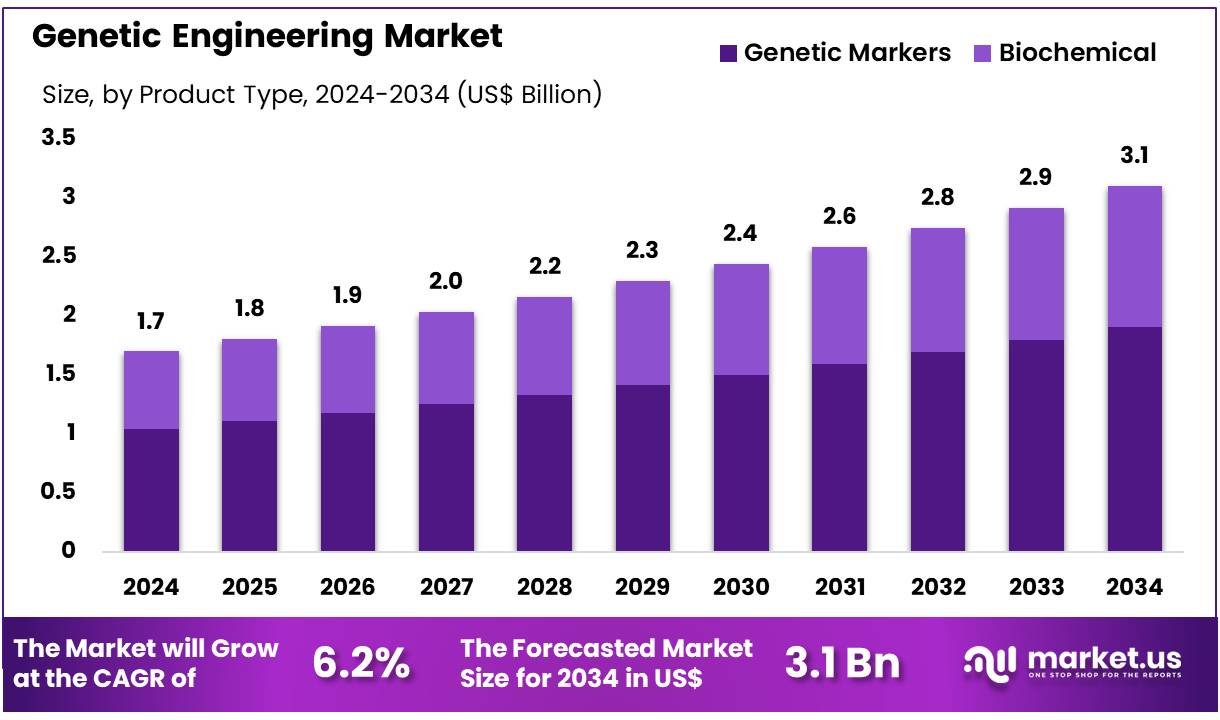
New York, NY – Dec 02, 2025 – The Global Genetic Engineering Market size is expected to be worth around US$ 3.1 Billion by 2034 from US$ 1.7 Billion in 2024, growing at a CAGR of 6.2% during the forecast period 2025 to 2034. In 2024, North America led the market, achieving over 42.1% share with a revenue of US$ 0.7 Billion.
The global landscape of genetic engineering continues to advance as scientific progress, expanding research applications, and supportive regulatory frameworks are driving accelerated adoption. Genetic engineering has been defined as a set of technologies that enable the direct modification of an organism’s DNA to achieve specific and desirable traits. Significant growth has been observed across sectors such as healthcare, agriculture, biotechnology, and industrial manufacturing, as organizations integrate engineered genetic solutions to enhance efficiency and outcomes.
Recent developments indicate that the demand for precision-based gene editing systems, including CRISPR-Cas platforms, has increased due to their high accuracy and lower operational cost. The growth of the market has been attributed to rising investments in genetic research, the development of targeted therapies, and the growing requirement for sustainable agricultural production. The technology has been widely applied in the production of disease-resistant crops, personalized medicines, and advanced biologics, supporting long-term improvements in global health and food security.
Industry analysis suggests that collaboration between academic institutions, biotechnology firms, and government agencies has strengthened the innovation pipeline. An increase in clinical trials related to gene therapies and the expansion of bio-manufacturing capabilities have contributed to a more robust commercial ecosystem.
As the sector evolves, greater emphasis is being placed on ethical standards, safety evaluations, and transparent regulatory practices to ensure responsible implementation. The continued advancement of genetic engineering is expected to create substantial economic and scientific value, positioning the industry for stable, long-term growth.
Key Takeaways
- In 2024, the genetic engineering market generated revenue of US$ 1.7 billion, recorded a CAGR of 6.2%, and is projected to reach US$ 3.1 billion by 2033.
- The product type segment comprises genetic markers and biochemical , with genetic markers leading in 2024 with a 61.5% market share.
- By technology, the market is categorized into artificial selection and gene splicing , where gene splicing accounted for a significant 54.7% share.
- In the application segment, the market is divided into agriculture and medical industry , with the medical industry dominating at 52.6% revenue share.
- The device segment includes PCR , gel assemblies , and gene gun , with the PCR segment holding the leading 53.2% revenue share.
- North America emerged as the leading regional market, capturing 42.1% of the overall market share in 2024.
Regional Analysis
North America is leading the Genetic Engineering Market
North America held the largest revenue share of 42.1%, supported by rising investments in research and development and substantial funding from institutions such as the National Institutes of Health (NIH). Although the total NIH allocation specifically for genetic engineering spans multiple programs, continuous funding toward gene editing and gene therapy projects has strengthened research activity in the region.
In addition, the US Food and Drug Administration (FDA) has demonstrated a consistent increase in approvals for gene therapies from 2022 to 2024, indicating a more established regulatory environment. This regulatory advancement has enabled faster translation of scientific innovations into clinical practice. The growing emphasis on personalized medicine for conditions such as genetic disorders and cancer has further supported the adoption of advanced genetic modification technologies.
Asia Pacific is expected to experience the highest CAGR during the forecast period
The Asia Pacific region is anticipated to record the fastest growth rate, driven by strong government support for biotechnology, genomics, and advanced research. India’s Department of Biotechnology (DBT) continues to invest in genetic engineering initiatives, supported by facilities such as the DST-ICGEB Bio-Foundry, which enhances regional research capabilities.
Precision medicine programs, including Singapore’s National Precision Medicine Program, which aims to sequence a large population of Asian genomes, are expected to accelerate the adoption of genetic modification technologies in diagnostics and therapeutics. Rising cases of genetic disorders and the increasing focus on agricultural biotechnology to improve crop productivity are additional factors contributing to the region’s robust market expansion.
Emerging Trends
- Expansion of Precision Gene-Editing Tools: The deployment of CRISPR-Cas platforms has been widely expanded for high-accuracy genome modification. Refinement of base editing and prime editing systems is enabling single-nucleotide alterations without double-strand breaks, supporting more precise correction of pathogenic mutations in human cells and model organisms.
- Integration of Multi-Omics and Computational Design: Multi-omics frameworks integrating genomics, transcriptomics, proteomics, metabolomics, and epigenomics are increasingly utilized to guide engineering strategies. These approaches enhance evaluation of both targeted and unintended outcomes, strengthening safety and performance, particularly within advanced crop-improvement initiatives.
- Strengthened Governance and Ethical Frameworks: Newly established guidelines have reinforced global oversight for human genome editing. Recommendations address research-registry requirements, harmonized international standards, and ethical review mechanisms, ensuring responsible progress in somatic and heritable editing while protecting public health and equitable access.
- Advancements in Agricultural Gene Editing: Gene-editing applications in agriculture are advancing rapidly, producing crops with enhanced disease resistance and environmental tolerance. Recent outcomes include mildew-resistant wheat, rice with improved blight tolerance, and virus-resistant tomatoes, supporting higher yields and reduced dependence on chemical pesticides.
Use Cases
- Approved Therapeutic Products: By May 15, 2025, a total of 45 cellular and gene therapy products had received U.S. FDA approval. These therapies span cancer immunotherapies, rare-disease treatments, and enzyme-replacement platforms, reflecting accelerating clinical translation of engineered biological systems.
- Treatment of Sickle Cell Disease: In late 2023, the FDA authorized Casgevy and Lyfgenia for patients aged 12 and above with sickle cell disease. These approvals represent the first genome-editing-based therapies for this condition, establishing a significant milestone in precision medicine.
- Regulatory Exemptions for Engineered Plants: Since 2020, at least 99 genetically engineered crop varieties have qualified for regulatory exemptions under updated USDA-APHIS rules. These exemptions have expedited field testing and commercialization of new agronomic traits across both row crops and specialty produce.
- Vector Control for Malaria Reduction: Genetically engineered mosquitoes are being investigated as a novel vector-management tool to mitigate malaria. WHO estimates from 2023 reported 263 million cases and 597,000 deaths globally, highlighting the strategic need for gene-drive technologies in disease-transmitting mosquito populations.
Frequently Asked Questions on Genetic Engineering
- How does genetic engineering work?
Genetic engineering operates through techniques such as gene editing, recombinant DNA, and vector-based delivery. These techniques enable the precise manipulation of genetic sequences, supporting controlled biological expression for medical therapies, agricultural improvements, and industrial biotechnology applications. - What are the main applications of genetic engineering?
Applications have been concentrated in healthcare, agriculture, and industrial biotechnology. The technology has enabled therapeutic development, high-yield crops, enhanced nutritional profiles, and optimized microbial strains for manufacturing enzymes, biofuels, and specialty chemicals. - What are the benefits of genetic engineering?
Benefits include improved disease treatment, enhanced crop productivity, reduced chemical inputs, and efficient bio-manufacturing processes. These advantages have supported sustainable production systems and advanced innovation across medical, agricultural, and industrial value chains. - What are the risks associated with genetic engineering?
Risks involve potential ecological imbalance, unintended genetic effects, ethical concerns, and regulatory uncertainties. These risks have encouraged the adoption of stringent testing, controlled field trials, and comprehensive safety assessments to maintain responsible technology deployment. - How is genetic engineering regulated?
Regulation is managed through national biosafety frameworks, international guidelines, and sector-specific evaluation standards. Approval processes typically involve risk assessments, environmental reviews, and compliance checks to ensure safe application in food systems, healthcare, and industrial environments. - Which industries are the major adopters of genetic engineering?
Major adoption has been observed in pharmaceuticals, agriculture, food processing, and industrial biotechnology. These industries utilize engineered organisms for therapeutic development, yield enhancement, nutritional improvement, and efficient bio-based manufacturing processes. - Which regions are leading the genetic engineering market?
North America and Europe have maintained leading positions due to strong research infrastructure, supportive regulations, and major biotechnology investments. Asia-Pacific has shown accelerating growth, driven by expanding healthcare systems, agricultural modernization, and government-funded innovation programs.
Conclusion
The genetic engineering industry is positioned for sustained expansion as rising investments, supportive regulations, and technological advancements continue to strengthen global adoption. Market growth has been driven by increasing clinical activity, expanding agricultural innovation, and the accelerated deployment of precision-editing platforms such as CRISPR.
Strong participation from academic, commercial, and government stakeholders has reinforced scientific and economic value creation. Regional momentum remains robust, led by North America and rapidly advancing Asia Pacific markets. As ethical governance and safety frameworks evolve, the field is expected to deliver long-term benefits across healthcare, agriculture, and industrial biotechnology, ensuring steady and responsible growth.
Discuss your needs with our analyst
Please share your requirements with more details so our analyst can check if they can solve your problem(s)




