


Table of Contents
Overview
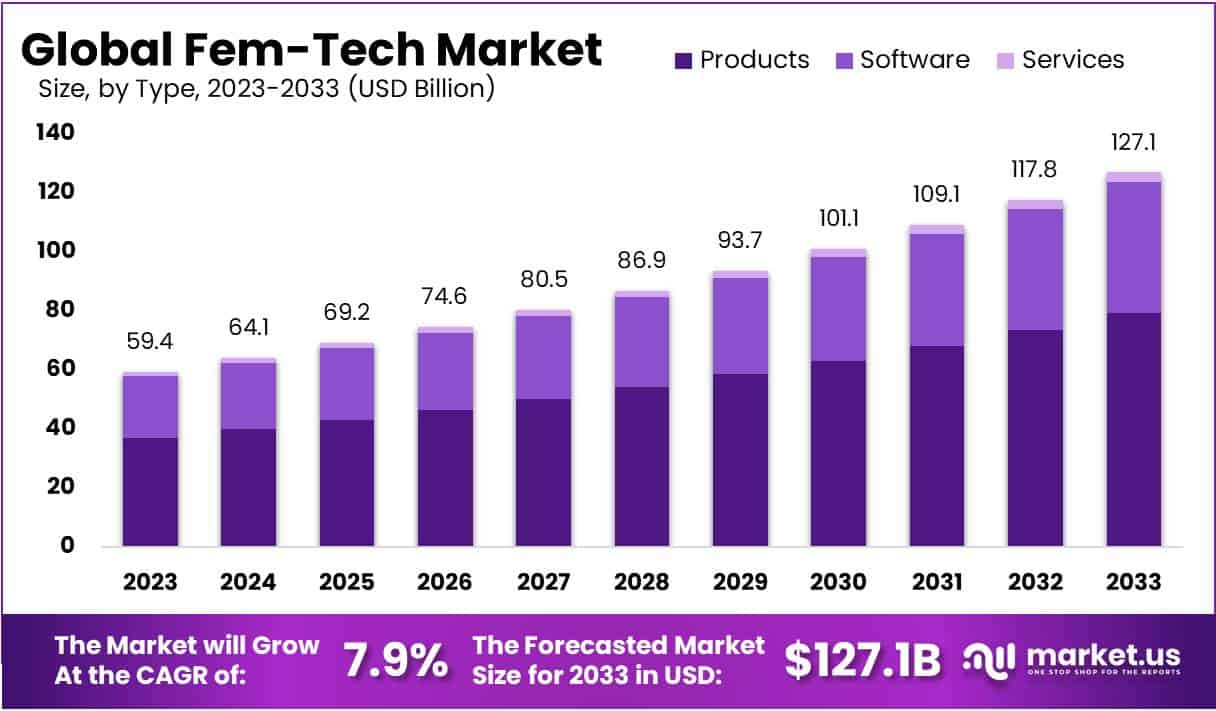
New York, NY – Jan 12, 2026 – Global FemTech Market size is expected to be worth around USD 127.1 Billion by 2033 from USD 59.4 Billion in 2023, growing at a CAGR of 7.9% during the forecast period from 2024 to 2033.
The FemTech sector refers to technology-driven products and services designed to address women’s health needs across the life course. The basic formation of FemTech has been shaped by growing awareness of unmet clinical, social, and economic gaps in women’s healthcare, combined with advances in digital health, data analytics, and mobile technologies.
FemTech initially emerged through consumer-focused solutions, particularly in menstrual cycle tracking and fertility monitoring. Over time, the sector expanded into broader health domains, including pregnancy and postnatal care, contraception, menopause management, sexual wellness, pelvic health, and chronic conditions that disproportionately affect women. The integration of mobile applications, wearable devices, artificial intelligence, and telehealth platforms has been central to this evolution.
The formation of FemTech has also been supported by structural shifts in healthcare delivery. Increased patient engagement, demand for personalized care, and the normalization of remote health solutions have accelerated adoption. In parallel, rising female workforce participation and higher health literacy levels have contributed to stronger consumer demand for accessible and discreet health solutions.
From an investment perspective, the FemTech market has benefited from growing venture capital interest and policy-level discussions around gender equity in healthcare research and funding. Historically underfunded areas of women’s health have increasingly been recognized as commercially viable and socially essential.
Overall, the basic formation of the FemTech sector can be attributed to technological innovation, changing healthcare consumption patterns, and a global emphasis on improving health outcomes for women. The sector is positioned as a foundational component of the broader digital health ecosystem, with continued expansion expected as clinical validation and regulatory frameworks mature.
Key Takeaways
- The global FemTech market was valued at USD 59.4 billion in 2023.
- The market size is projected to reach USD 127.1 billion by 2033.
- Growth of the FemTech market is expected to occur at a compound annual growth rate (CAGR) of 7.9% during the period 2024–2033.
- Based on type, the global FemTech market is classified into Products, Software, and Services.
- Among these categories, the Products segment accounts for the largest share of the market.
- By application, Pregnancy & Nursing Care is anticipated to remain the most dominant segment within the FemTech market.
- In terms of distribution channel, the Direct-to-Consumer (DTC) segment holds the highest market share.
- North America represents the leading regional market, contributing the largest share of global FemTech revenues.
- Clue and Natural Cycles are among the FDA-approved digital contraceptive applications.
- Clue received FDA approval in March 2021, strengthening its regulatory position in the market.
- A FemTech startup secured USD 3.2 million in seed funding in August 2022, reflecting continued investor interest in early-stage innovation.
- Maven Clinic raised USD 90 million in Series E funding in November 2022.
- Cumulatively, Maven Clinic has raised more than USD 300 million in total funding.
- The companion diagnostics market is highly fragmented, characterized by the presence of numerous local and regional players.
FemTech Market Statistics
- Investment Momentum: In 2020, total investments in FemTech startups exceeded USD 1 billion, reflecting strong and growing investor interest in the sector.
- Industry Scope: The FemTech market encompasses a wide range of women’s health areas, including reproductive health, pregnancy and postnatal care, nursing, pelvic and uterine health, menstrual care, and overall wellness.
- Technology Adoption: Nearly 58% of women have used digital health solutions such as mobile applications and wearable devices to monitor and manage their health, underscoring the central role of technology in FemTech adoption.
- Menstrual Products Market Size: The global menstrual products market was valued at USD 21.9 billion in 2021 and is forecast to reach USD 31.7 billion by 2028, expanding at a compound annual growth rate (CAGR) of 5.7%.
- Startup Ecosystem: More than 200 startups globally are focused on FemTech innovations, contributing to advancements across multiple women’s health segments.
- Healthcare Accessibility: Approximately 70% of women report improved access to healthcare services as a result of FemTech solutions, highlighting their impact on care delivery.
- Pregnancy and Nursing Segment Growth: The pregnancy and nursing care segment is projected to grow at a CAGR of 16% between 2020 and 2027, driven by rising awareness and increased adoption of digital health platforms.
- Reproductive Health Revenue Outlook: FemTech solutions targeting reproductive health are expected to generate revenues of approximately USD 2.3 billion by 2025.
- Telehealth Expansion: Since 2019, telehealth usage among women has risen by 45%, largely supported by FemTech-enabled service models and platforms.
- Mental Health Solutions: FemTech offerings focused on women’s mental health are gaining traction, with the segment projected to reach a market value of USD 3.3 billion by 2027.
- Pelvic and Uterine Health Growth: The pelvic and uterine health segment is anticipated to expand at a CAGR of 14% from 2020 to 2027, supported by increased adoption of diagnostic and therapeutic technologies.
- Funding Trends: Venture funding for FemTech startups increased by 10% in 2021, indicating sustained investor confidence in the market’s long-term potential.
- Consumer Adoption: FemTech solutions are used by approximately 65% of women aged 18–34, demonstrating strong uptake among younger demographics.
- Global Health Impact: FemTech innovations have the potential to address up to 80% of common women’s health conditions, significantly improving health outcomes on a global scale.
Regional Analysis
In 2023, North America maintained a leading position in the global FemTech market, accounting for more than 29.7% of total market share and generating approximately USD 17.6 billion in market value. This dominance was primarily driven by a rising patient base and increasing awareness of women’s health solutions across the region.
The strong market presence can be attributed to well-established healthcare infrastructure and a mature technology and innovation ecosystem, which together create favorable conditions for the development and adoption of FemTech solutions. Advanced digital health integration and supportive regulatory frameworks have further strengthened market growth.
Additionally, North America is home to several major technology hubs, including Silicon Valley, where both startups and established companies benefit from substantial venture funding, research capabilities, and institutional support. The region also has a large, tech-savvy consumer population, characterized by early adoption of digital health technologies, which continues to accelerate the uptake of FemTech products and services.
Emerging Trends in the FemTech Market
- AI and Big Data Integration: The integration of artificial intelligence and big data is transforming FemTech by improving the precision of health insights. By 2026, AI-driven healthcare solutions are projected to generate annual cost savings exceeding USD 150 billion through enhanced diagnostics and more personalized treatment pathways.
- Expansion of Telehealth Services: The adoption of FemTech within telehealth platforms has accelerated significantly, largely due to the COVID-19 pandemic. Utilization levels have increased by nearly 38 times compared to pre-pandemic benchmarks, reflecting a structural shift toward remote and digital care delivery.
- Rising Emphasis on Mental Health: Mental health applications, including those designed specifically for women, represented a market value of approximately USD 4.2 billion in 2021. This segment is expected to expand at a compound annual growth rate (CAGR) of 17.6% through 2028, driven by increasing awareness and digital accessibility.
- Growth of Wearable Health Technologies: Women-focused wearable health devices are experiencing rapid adoption. The market is forecast to reach USD 20 billion by 2025, supported by demand for continuous monitoring of health indicators such as menstrual cycles, ovulation, and overall wellness metrics.
- Personalized Nutrition and Fitness Solutions: Demand for customized nutrition and fitness programs tailored to women’s health needs is increasing. The personalized nutrition market is projected to reach USD 11.5 billion by 2025, growing at a CAGR of 15.7%, supported by data-driven personalization and preventive health trends.
- Advancements in Reproductive Health Technologies: Innovations in fertility tracking and at-home reproductive health testing are enhancing accessibility and user engagement. The fertility tracking market is expected to reach approximately USD 400 million by 2026, driven by technological advancements and rising fertility awareness.
- Integration into Corporate Wellness Programs: FemTech solutions are increasingly being embedded into corporate wellness initiatives, a market valued at around USD 55 billion. Employers are leveraging these technologies to support comprehensive health monitoring, reproductive health benefits, and mental well-being for female employees.
- Increase in Investment and Funding Activity: Investor interest in FemTech continues to strengthen, with startups in the sector securing more than USD 1 billion in funding in 2021. This trend reflects growing confidence in the long-term commercial and societal potential of women-focused health technologies.
- Supportive Regulatory Environment: Regulatory agencies, including the U.S. Food and Drug Administration (FDA), have demonstrated increased support by fast-tracking several FemTech innovations. This regulatory backing highlights the sector’s expanding role in advancing public health outcomes.
Frequently Asked Questions on FemTech
- What is FemTech?
FemTech refers to technology-driven products and services designed to address women’s health needs, including menstrual health, fertility, pregnancy, menopause, and reproductive disorders, using digital platforms, medical devices, diagnostics, and health-focused mobile applications. - What does the FemTech market include?
The FemTech market includes mobile health applications, wearable devices, diagnostic tools, therapeutic products, and software platforms focused on female-specific conditions such as fertility tracking, pregnancy care, pelvic health, menopause management, and chronic gynecological disorders. - What factors are driving the growth of the FemTech market?
Market growth is driven by rising awareness of women’s health issues, increasing smartphone penetration, growing venture capital investments, supportive digital health policies, and a shift toward personalized, preventive, and remote healthcare solutions for female populations. - Which segments dominate the FemTech market?
Fertility and menstrual health solutions dominate the FemTech market due to high user adoption, frequent application usage, and strong demand for cycle tracking, ovulation prediction, and pregnancy planning tools across both developed and emerging economies. - Who are the primary end users of FemTech solutions?
Primary end users include women across reproductive and post-reproductive age groups, healthcare providers, fertility clinics, hospitals, and research institutions that leverage FemTech tools for patient monitoring, diagnostics, treatment planning, and long-term health management. - How does digital health influence the FemTech market?
Digital health technologies enhance FemTech adoption by enabling real-time health monitoring, data-driven insights, teleconsultations, and personalized care delivery, while improving accessibility, reducing healthcare costs, and supporting continuous patient engagement through connected platforms. - What is the future outlook of the FemTech market?
The FemTech market is expected to witness sustained growth, supported by technological advancements, artificial intelligence integration, expanding healthcare digitization, and increasing focus on underserved women’s health conditions across global healthcare ecosystems.
Conclusion
The FemTech sector has evolved into a critical component of the global digital health ecosystem, driven by technological innovation, rising health awareness, and long-standing unmet needs in women’s healthcare. Strong market growth is supported by expanding applications across reproductive health, pregnancy, menopause, mental health, and chronic conditions.
Increasing adoption of mobile health platforms, wearables, artificial intelligence, and telehealth has enhanced accessibility and personalization of care. Sustained venture funding, supportive regulatory developments, and growing consumer acceptance further reinforce market momentum. Overall, FemTech is positioned for continued expansion, with significant potential to improve health outcomes and address structural gaps in women’s healthcare worldwide.
Discuss your needs with our analyst
Please share your requirements with more details so our analyst can check if they can solve your problem(s)




