


Table of Contents
Overview
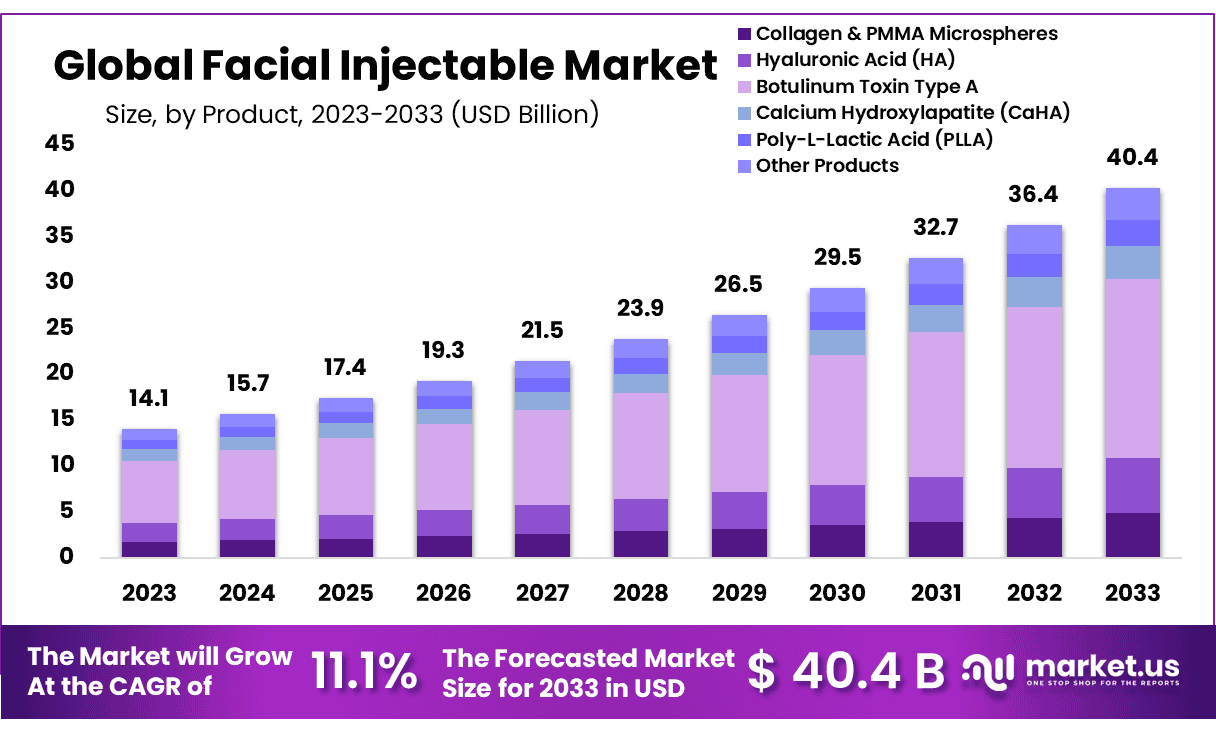
New York, NY – Jan 13, 2026 – The Global Facial Injectables Market size is expected to be worth around USD 40.4 Billion by 2033 from USD 14.1 Billion in 2023, growing at a CAGR of 11.1% during the forecast period from 2024 to 2033.
The global facial injectables market is experiencing sustained growth, supported by increasing consumer preference for minimally invasive aesthetic treatments and continuous advancements in injectable technologies. Facial injectables, including botulinum toxin and dermal fillers, are widely used to reduce facial wrinkles, restore volume, and enhance facial contours with limited downtime and predictable outcomes.
Market expansion is being driven by rising awareness of aesthetic procedures, particularly among middle-aged and aging populations. The growing influence of social media, increased focus on physical appearance, and wider acceptance of non-surgical cosmetic treatments have further contributed to market adoption. In addition, the availability of advanced formulations with improved safety profiles and longer-lasting effects has strengthened patient confidence and physician adoption.
Botulinum toxin products continue to account for a significant share of total market revenue, owing to their established clinical efficacy in treating dynamic facial lines. Dermal fillers are also witnessing strong demand, supported by their application in facial volumization, lip enhancement, and contour correction. Hyaluronic acid-based fillers remain the most widely used due to their biocompatibility and reversible nature.
From a regional perspective, North America holds a leading position in the facial injectables market, supported by high procedure volumes, advanced healthcare infrastructure, and the presence of key industry participants. Meanwhile, the Asia-Pacific region is expected to register the fastest growth, driven by rising disposable income, medical tourism, and expanding aesthetic clinics.
Overall, the facial injectables market is expected to maintain a positive growth trajectory, supported by technological innovation, expanding treatment indications, and growing consumer acceptance of non-invasive aesthetic solutions.
Key Takeaways
- Market Size & Growth: The facial injectables market is projected to reach approximately USD 40.4 billion by 2033, rising from USD 14.1 billion in 2023. This expansion is expected to occur at a compound annual growth rate (CAGR) of 11.1% over the forecast period.
- Product Analysis: Botulinum Toxin Type A emerged as the leading product category, contributing 48.2% of total market revenue in 2023, supported by its widespread clinical use and established efficacy.
- Application Analysis: Facial line correction represented the largest application segment, accounting for 34.2% of total revenue in 2023, driven by high demand for wrinkle reduction and anti-aging treatments.
- Regional Analysis: North America maintained its position as the dominant regional market, capturing over 40.5% of global revenue in 2023. The region accounted for a market value of approximately USD 5.7 billion, supported by high procedure volumes and advanced aesthetic infrastructure.
- Key Trends: Demand for non-surgical cosmetic procedures is increasing steadily, as these treatments offer reduced recovery time, lower procedural risk, and cost advantages compared to surgical alternatives.
- Competitive Landscape: The global facial injectables market remains highly fragmented, characterized by the presence of numerous international and regional manufacturers competing on product innovation and brand positioning.
- Future Outlook: The market is expected to sustain robust growth in the coming years, driven by expanding adoption of minimally invasive aesthetic treatments and increasing consumer awareness of facial injectable solutions.
Facial Injectables Statistics
- Hyaluronic acid–based fillers typically provide aesthetic results lasting between six and twelve months on average.
- Calcium hydroxylapatite fillers generally deliver longer-lasting effects, with results sustained for approximately eighteen months.
- Poly-L-lactic acid fillers are designed to stimulate collagen production and can maintain visible improvements for up to two years.
- Polymethylmethacrylate fillers are considered permanent, as the material is not absorbed or broken down by the body.
- Dermal fillers are approved by the FDA for use in individuals aged twenty-one years and older.
- Temporary dermal fillers are authorized for the treatment of moderate to severe facial wrinkles and skin folds.
- Permanent fillers are approved for correcting nasolabial folds and treating acne scars on the cheeks.
- Dermal fillers are commonly used for volume enhancement in areas such as the lips, cheeks, chin, and hands.
- Fillers are also approved for addressing facial fat loss in patients affected by HIV-related lipoatrophy.
- Injectable cosmetic treatments among patients under thirty years of age increased by twenty-four percent between 2013 and 2018.
- In 2018, seventy-two percent of facial plastic surgeons reported growth in injectable procedures among patients younger than thirty.
- Rhinoplasty was reported as the most frequently performed surgical procedure, conducted by ninety-six percent of surgeons in 2018.
- Botox was identified as the most popular cosmetic procedure performed in 2018.
- Celebrity influence on plastic surgery trends was reported by ninety-seven percent of surgeons during 2018.
- Non-surgical cosmetic procedures accounted for eighty percent of all treatments performed by facial plastic surgeons in 2018.
Emerging Trends
- Expanded applications: Injectable treatments are increasingly being applied beyond the face, including body contouring for the neck, cellulite reduction, and rejuvenation of the hands and chest areas.
- Technological advancements: Continuous innovation in product formulations and injection techniques is improving treatment precision, effectiveness, and the longevity of aesthetic outcomes.
- Combination therapies: The combined use of botulinum toxin and dermal fillers is gaining popularity, as it delivers more comprehensive and balanced facial rejuvenation results.
- Preventive treatments: Younger consumer groups are adopting injectables as preventive aesthetic solutions to delay the onset of wrinkles, fine lines, and skin laxity.
- Increased male interest: A rising number of male patients are opting for injectable treatments to achieve subtle enhancements while maintaining a natural and masculine appearance.
- Regenerative injectables: Emerging products incorporating growth factors and stem cell–based technologies are enhancing skin quality by stimulating natural repair and collagen regeneration processes.
- Safety and regulation: Strengthened regulatory frameworks and stricter safety standards are improving clinical practices and reducing the incidence of treatment-related complications.
- Focus on natural results: Market demand is shifting toward injectables that deliver softer, more natural-looking outcomes rather than exaggerated or dramatic aesthetic changes.
- Educational efforts: Increased educational initiatives and awareness programs are improving practitioner expertise and helping patients develop realistic expectations regarding injectable treatments.
Regional Analysis
North America remained the leading regional market for facial injectables, accounting for over 40.5% of total revenue in 2023 and representing a market value of approximately USD 5.7 billion. This dominance is primarily attributed to the high and growing geriatric population in the United States and Canada, which is expected to sustain long-term demand for facial injectable treatments.
Aging-related aesthetic concerns continue to drive procedure volumes across the region. According to data published by the American Society of Plastic Surgeons, the use of Botox injections increased by 835% between 2004 and 2020, highlighting the strong and sustained adoption of non-surgical cosmetic procedures.
Looking ahead, North America is expected to remain a major revenue contributor to the global facial injectables market, supported by advanced healthcare infrastructure, high consumer awareness, and continued product innovation. However, the Asia-Pacific region is projected to register the highest compound annual growth rate (CAGR) during the forecast period.
Countries such as South Korea, Australia, and India are playing a key role in regional expansion, supported by the rapid growth of aesthetic clinics and increasing acceptance of cosmetic procedures. Rising emphasis on physical appearance and social image is expected to further accelerate demand. Among Asia-Pacific countries, India is anticipated to experience the fastest growth, driven by a large patient base, improving disposable income levels, and expanding access to aesthetic treatments.
Frequently Asked Questions on Facial Injectables
- What types of facial injectables are commonly used?
The facial injectables segment primarily includes botulinum toxin and dermal fillers such as hyaluronic acid, calcium hydroxylapatite, and poly-L-lactic acid. These products are selected based on treatment goals, facial anatomy, and desired longevity. - How long do facial injectable results typically last?
The duration of facial injectable results varies by product type and patient factors. Botulinum toxin effects generally last three to six months, while dermal fillers may provide aesthetic benefits ranging from six months to two years. - Are facial injectables considered safe?
Facial injectables are considered safe when administered by trained medical professionals using approved products. Adverse effects are typically mild and temporary, including swelling or bruising, while serious complications remain relatively uncommon in regulated clinical settings. - Who is an ideal candidate for facial injectables?
Ideal candidates for facial injectables include adults seeking non-surgical facial rejuvenation with realistic expectations. Suitability is influenced by skin condition, age-related volume loss, medical history, and overall aesthetic objectives evaluated during professional consultation - What factors are driving market growth?
Market expansion is driven by aging populations, rising disposable incomes, social media influence, and growing acceptance of cosmetic treatments. Additionally, product innovation and improved safety profiles have significantly enhanced adoption across both developed and emerging economies. - Which regions dominate the facial injectables market?
North America and Europe dominate the facial injectables market due to advanced healthcare infrastructure and high procedure volumes. However, Asia-Pacific is experiencing rapid growth, supported by medical tourism, urbanization, and expanding aesthetic service availability. - What is the future outlook of the facial injectables market?
The facial injectables market is expected to experience steady growth, supported by increasing demand for preventive aesthetics and natural-looking results. Continued research, product diversification, and expanding consumer demographics are anticipated to strengthen long-term market prospects.
Conclusion
The global facial injectables market is positioned for sustained and robust growth, supported by rising demand for minimally invasive aesthetic solutions and continuous technological advancements. Increasing awareness of cosmetic procedures, broader social acceptance, and expanding applications across age groups are reinforcing market expansion.
Strong performance of botulinum toxin and dermal fillers, particularly hyaluronic acid–based products, continues to underpin revenue growth. While North America remains the leading market due to advanced infrastructure and high procedure volumes, Asia-Pacific is emerging as a high-growth region. Overall, innovation, safety enhancements, and evolving consumer preferences are expected to support long-term market momentum.
Discuss your needs with our analyst
Please share your requirements with more details so our analyst can check if they can solve your problem(s)




