


Table of Contents
Overview
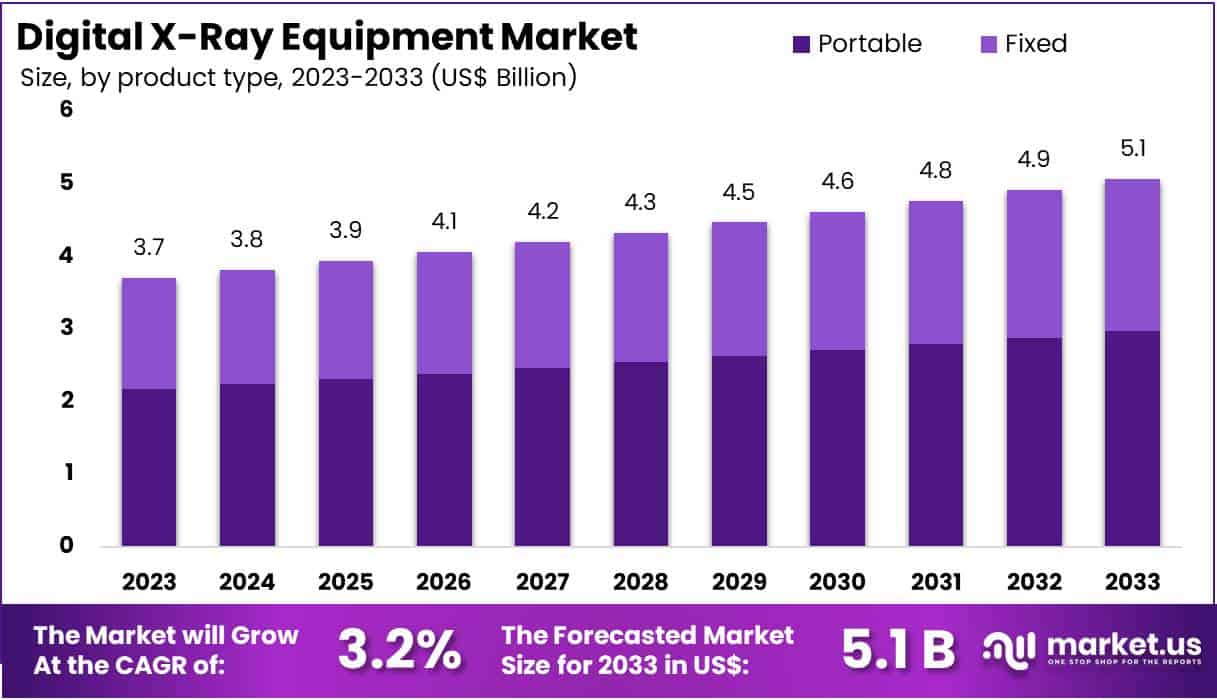
New York, NY – March 04, 2026 – The Global Digital X-Ray Equipment Market size is expected to be worth around US$ 5.1 Billion by 2033, from US$ 3.7 Billion in 2023, growing at a CAGR of 3.2% during the forecast period from 2024 to 2033.
Digital X-Ray Equipment represents a critical advancement in modern diagnostic imaging systems. The technology is designed to convert X-ray signals directly into digital images using flat-panel detectors or computed radiography systems. Unlike conventional film-based systems, digital X-ray equipment enables immediate image acquisition, processing, storage, and transmission across integrated healthcare networks.
The basic formation of digital X-ray equipment consists of an X-ray generator, X-ray tube, digital detector, image acquisition workstation, and display system. The X-ray generator produces controlled radiation, while the X-ray tube emits X-rays directed toward the patient. The digital detector captures transmitted radiation and converts it into electronic signals. These signals are processed through specialized software to generate high-resolution diagnostic images. Advanced systems are integrated with Picture Archiving and Communication Systems (PACS) to enable efficient data management and remote accessibility.
The adoption of digital X-ray systems has increased due to improved workflow efficiency, reduced radiation exposure, and enhanced image clarity. Healthcare facilities benefit from faster diagnosis, streamlined reporting, and lower operational costs associated with film processing and storage. Furthermore, technological improvements such as wireless detectors and artificial intelligence-based image enhancement have strengthened clinical performance.
Digital X-ray equipment is widely utilized across hospitals, diagnostic imaging centers, and specialty clinics. Continuous innovation and rising demand for early disease detection are expected to support sustained market expansion in the coming years.
Key Takeaways
- In 2023, the global digital X-ray equipment market generated revenue of US$ 3.7 billion. The market is projected to expand at a CAGR of 3.2% during the forecast period, reaching approximately US$ 5.1 billion by 2033.
- Based on product type, the market is categorized into fixed and portable systems. The portable segment accounted for the largest share in 2023, contributing 58.7% of total market revenue.
- By technology, the market is segmented into computed radiography and direct radiography. Computed radiography maintained a leading position, capturing 52.6% of the overall market share in 2023.
- In terms of application, the market is divided into general imaging, dental, orthopedic, cancer, and other applications. General imaging emerged as the dominant segment, holding a revenue share of 36.9%.
- Considering end users, the market is segmented into hospitals, diagnostic centers, and others. Hospitals represented the leading segment, accounting for 47.8% of total revenue in 2023.
- Regionally, North America dominated the digital X-ray equipment market, securing a 40.2% revenue share in 2023.
Regional Analysis
North America accounted for the largest share of the digital X-ray equipment market in 2023, contributing 40.2% of total revenue. Market dominance has been supported by strong technological advancements and growing demand for high-quality diagnostic imaging systems. Widespread adoption of advanced digital radiography solutions across healthcare facilities has improved diagnostic precision and operational efficiency.
For instance, Crouse Medical Imaging implemented the Philips DigitalDiagnost C90 VS to enhance image quality and workflow performance. Rising prevalence of chronic diseases, including cardiovascular disorders and cancer, has further strengthened demand. Government support for digital healthcare adoption and continued infrastructure investments have reinforced regional growth.
Asia Pacific is projected to register the fastest CAGR during the forecast period. Expansion of healthcare infrastructure, increasing geriatric population, and higher incidence of chronic diseases are key growth drivers. Strategic collaborations, such as the partnership between Samsung Electronics and VUNO, are expected to enhance AI-integrated imaging capabilities, supporting regional market expansion.
Emerging Trends
- AI-Powered Imaging: Digital X-ray systems integrated with artificial intelligence are increasingly adopted across hospitals to enhance diagnostic speed and precision. Automated detection of fractures, infections, and tumors supports faster clinical decisions, reduces diagnostic errors, and improves overall patient management efficiency.
- Wireless and Portable Systems: Portable and wireless digital X-ray equipment is witnessing strong demand due to operational flexibility and rapid deployment capabilities. These lightweight, battery-operated systems improve emergency response, bedside diagnostics, and rural healthcare access while reducing patient waiting times.
- Cloud-Based Image Storage: Cloud-enabled storage solutions are transforming radiology workflows by enabling secure, remote access to digital X-ray images. This approach enhances collaboration among healthcare professionals, improves data security, reduces physical storage requirements, and accelerates treatment decisions.
- EHR Integration: Integration of digital X-ray equipment with electronic health records streamlines clinical workflows by consolidating imaging data with patient history. This interoperability enhances diagnostic accuracy, simplifies record management, supports longitudinal tracking, and improves healthcare delivery efficiency.
Use Cases
- Emergency Departments: Digital X-ray equipment plays a critical role in emergency departments by enabling rapid diagnosis of fractures, trauma, and internal injuries. High-speed imaging capabilities support immediate clinical decisions, reduce patient wait times, and improve outcomes in urgent care settings.
- Dental Clinics: Dental clinics widely utilize digital X-ray systems to detect cavities, periodontal conditions, and structural abnormalities. Instant image visualization, lower radiation exposure, and simplified storage enhance diagnostic precision, streamline treatment planning, and improve patient communication and satisfaction.
- Orthopedic Care: In orthopedic practice, digital X-ray systems are essential for assessing fractures, joint disorders, and postoperative recovery. High-resolution imaging enables accurate alignment evaluation, continuous healing monitoring, and timely treatment adjustments, thereby supporting improved clinical outcomes.
- Mobile Health Units: Portable digital X-ray systems are extensively deployed in mobile health units to deliver diagnostic services in rural regions. These units facilitate early detection of respiratory diseases, enable remote specialist consultation, and expand healthcare accessibility in underserved communities.
Frequently Asked Questions on Digital X-Ray Equipment
- How does Digital X-Ray Equipment differ from conventional X-ray systems?
Digital X-ray systems utilize digital detectors to capture and process images instantly, eliminating the need for chemical film processing. This transition enhances workflow efficiency, reduces operational costs over time, improves image quality, and supports better data storage and remote consultation capabilities. - What are the major types of Digital X-Ray Equipment available?
The primary types include computed radiography systems, direct radiography systems, and portable digital X-ray units. Direct radiography systems are increasingly preferred due to superior image resolution, faster processing time, and growing adoption across hospitals, diagnostic centers, and outpatient facilities. - What factors are driving the growth of the Digital X-Ray Equipment Market?
Market growth is driven by rising chronic disease prevalence, increasing demand for early diagnostic imaging, expanding healthcare infrastructure, and technological advancements. Additionally, aging populations and higher healthcare expenditure across emerging economies significantly contribute to consistent market expansion. - What is the current outlook of the Digital X-Ray Equipment Market?
The market demonstrates stable growth supported by increasing installation rates in hospitals and diagnostic laboratories. Continuous innovation in detector technology, integration with artificial intelligence tools, and growing preference for minimally invasive diagnostic procedures strengthen long-term market prospects. - Which regions dominate the Digital X-Ray Equipment Market?
North America holds a leading position due to advanced healthcare infrastructure and high technology adoption. Europe follows closely, while Asia-Pacific is witnessing rapid growth attributed to improving healthcare access, rising medical tourism, and expanding investments in healthcare modernization. - Who are the key players in the Digital X-Ray Equipment Market?
The market is characterized by the presence of global manufacturers such as GE HealthCare, Siemens Healthineers, Koninklijke Philips N.V., Canon Medical Systems Corporation, and Fujifilm Holdings Corporation. These companies focus on product innovation, strategic partnerships, and geographic expansion to strengthen competitive positioning.
Conclusion
Digital X-ray equipment has become a fundamental component of modern diagnostic imaging, driven by technological advancements and increasing demand for rapid, accurate diagnosis. The market generated US$ 3.7 billion in 2023 and is projected to reach US$ 5.1 billion by 2033, expanding at a CAGR of 3.2%. Growth is supported by rising chronic disease prevalence, expanding healthcare infrastructure, and integration of AI and cloud technologies.
North America leads in revenue share, while Asia Pacific is expected to witness the fastest growth. Continuous innovation and broader clinical adoption are anticipated to sustain long-term market expansion globally.
Discuss your needs with our analyst
Please share your requirements with more details so our analyst can check if they can solve your problem(s)




