


Table of Contents
Overview
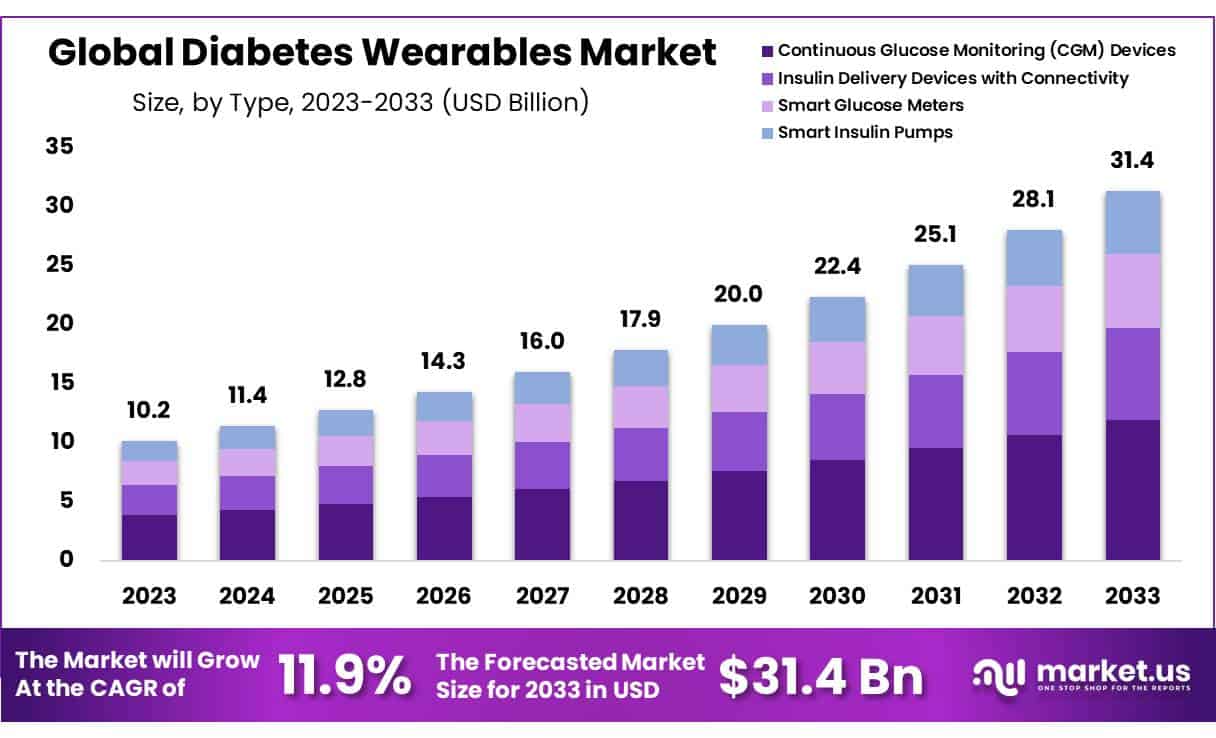
New York, NY – Feb 03, 2026 – Global Diabetes Wearables Market size is expected to be worth around USD 31.4 Billion by 2033 from USD 10.2 Billion in 2023, growing at a CAGR of 11.9% during the forecast period from 2024 to 2033.
The diabetes wearables market is gaining steady traction as the global prevalence of diabetes continues to rise and healthcare systems increasingly adopt digital health solutions. Diabetes wearables refer to smart, non-invasive or minimally invasive devices designed to monitor blood glucose levels, physical activity, insulin delivery, and other vital health parameters in real time. These devices play a critical role in enabling continuous disease management and improving patient outcomes.
The market growth is primarily supported by the increasing incidence of both type 1 and type 2 diabetes, combined with growing awareness regarding early diagnosis and preventive care. According to global health estimates, millions of individuals require regular glucose monitoring, which has accelerated the adoption of continuous glucose monitoring systems and smart insulin pumps. Technological advancements, including sensor miniaturization, wireless connectivity, and integration with mobile applications, have further strengthened market acceptance.
Healthcare providers are increasingly recommending wearable solutions due to their ability to provide accurate data, reduce manual testing, and support personalized treatment plans. In addition, rising healthcare expenditure and favorable reimbursement policies in developed economies are contributing to wider adoption. Emerging markets are also showing promising potential due to improving healthcare infrastructure and expanding access to digital devices.
From a competitive perspective, the market is characterized by continuous product innovation and strategic collaborations aimed at enhancing device accuracy, comfort, and data analytics capabilities. Overall, the diabetes wearables market is expected to witness sustained growth, supported by technological progress, patient-centric care models, and the global shift toward remote and connected healthcare solutions.
Key Takeaways
- Market Size: The diabetes wearables market is projected to reach approximately USD 31.4 billion by 2033, rising from an estimated USD 10.2 billion in 2023.
- Market Growth: The market is anticipated to expand at a compound annual growth rate (CAGR) of 11.9% over the forecast period from 2024 to 2033.
- Type Analysis: Continuous glucose monitoring (CGM) devices represent the leading product segment, accounting for nearly 38% of the total market share.
- Distribution Channels Analysis: Pharmacies remain the primary distribution channel, capturing around 35% of the overall market share.
- Type of Diabetes Analysis: Wearable solutions for type 1 diabetes constitute the largest segment, contributing approximately 53% of total market revenue.
- Application Analysis: Blood glucose monitoring is the dominant application area, holding close to 47% of the market share.
- Regional Analysis: In 2023, North America led the global diabetes wearables market, securing an estimated 44% share.
Regional Analysis
In 2023, North America accounted for approximately 44% of the global diabetes wearables market, supported by a strong emphasis on preventive healthcare practices. Wearable medical devices have become integral tools for continuous health monitoring, allowing individuals to track key health indicators and manage conditions more effectively. The availability of real-time, personalized health data has enhanced patient engagement and supported timely medical interventions.
Rising awareness of personal health and chronic disease prevention has significantly increased the adoption of wearable medical devices across the region. These solutions support healthier lifestyle decisions and facilitate the early identification of potential health risks, thereby reducing long-term complications. This growing adoption reflects a wider transition toward proactive and technology-driven healthcare management, where advanced digital tools are increasingly utilized to maintain overall health outcomes and improve quality of care.
Emerging Trends
- Continuous Glucose Monitoring (CGM) Systems: Continuous glucose monitoring systems have transformed diabetes management by delivering real-time glucose data. Ongoing innovations are focused on enhancing measurement accuracy, extending sensor lifespan, and reducing device size to improve user comfort and long-term adherence.
- Integration with Artificial Intelligence (AI): The integration of artificial intelligence enables advanced analysis of glucose trends and behavioral patterns. AI-driven insights support predictive glucose forecasting and personalized recommendations for nutrition, physical activity, and insulin dosing, strengthening clinical and self-management outcomes.
- Non-Invasive Monitoring Technologies: Non-invasive glucose monitoring technologies are under active development to eliminate traditional finger-prick testing. Methods such as optical spectroscopy and skin-based sensors are being explored to improve patient comfort, accessibility, and adoption across broader diabetic populations.
- Smart Insulin Delivery Systems: Advancements in smart insulin delivery systems are enabling automated insulin adjustments based on real-time glucose readings. Integration between insulin pumps, smart pens, and CGMs reduces manual intervention, minimizes dosing errors, and improves overall glycemic stability.
- Enhanced Connectivity and Data Sharing: Modern diabetes wearables emphasize enhanced connectivity, enabling seamless data transmission to mobile platforms and healthcare providers. Remote data sharing supports continuous clinical monitoring, early intervention, and more personalized, outcome-driven diabetes care strategies.
Use Cases
- Real-Time Glucose Monitoring: Devices such as Abbott’s FreeStyle Libre 2 and 3 provide continuous glucose readings without routine finger-pricks. This real-time visibility supports better glucose control, faster corrective actions, and improved daily disease management.
- Integration with Fitness and Health Trackers: Collaborations such as between Dexcom and ŌURA combine glucose data with activity, sleep, heart rate, and stress metrics. This integrated approach enables users to understand lifestyle impacts on glucose variability more effectively.
- Automated Insulin Delivery: Solutions like the Omnipod 5 automate insulin dosing using CGM inputs. The tubeless and waterproof design supports active lifestyles while reducing cognitive burden and improving consistency in insulin therapy management.
- Non-Invasive Health Monitoring: Emerging devices, including electronic finger wraps and sweat-based sensors, allow glucose and biomarker monitoring without skin penetration. These technologies represent a significant step toward painless, continuous health monitoring with broader applications beyond diabetes care.
- Over-the-Counter Glucose Monitoring: Approval by the U.S. Food and Drug Administration of Stelo by Dexcom enables over-the-counter glucose monitoring for individuals with type 2 diabetes or prediabetes, increasing accessibility and supporting proactive health management.
Frequently Asked Questions on Diabetes Wearables
- How do diabetes wearables help in glucose management?
Diabetes wearables help by enabling continuous glucose tracking, reducing dependence on finger-prick testing. Real-time alerts and trend analysis allow timely interventions, improving glycemic control and lowering the risk of acute complications. - What types of diabetes wearables are commonly available?
Common diabetes wearables include continuous glucose monitors, insulin pumps, and smart insulin pens. These devices may operate independently or as integrated systems, supporting automated insulin delivery and personalized diabetes care. - Who can benefit most from using diabetes wearables?
Diabetes wearables are widely used by individuals with type 1 diabetes and insulin-dependent type 2 diabetes. They are particularly beneficial for patients requiring frequent glucose monitoring and precise insulin dosing. - Are diabetes wearables clinically accurate and safe?
Most diabetes wearables are clinically validated and approved by regulatory authorities. Accuracy has improved significantly with sensor advancements, making these devices reliable for daily diabetes management under medical supervision. - What factors are driving the growth of the diabetes wearables market?
Market growth is driven by rising diabetes prevalence, increasing adoption of digital health technologies, and demand for continuous monitoring solutions. Technological advancements and supportive reimbursement policies further strengthen market expansion globally. - How is technology influencing the diabetes wearables market?
Technological progress has enabled smaller sensors, improved data accuracy, and integration with smartphones and cloud platforms. These innovations enhance user experience and clinical outcomes, supporting wider adoption across healthcare systems. - Which regions show strong demand for diabetes wearables?
North America and Europe represent major markets due to advanced healthcare infrastructure and high awareness. Emerging economies in Asia-Pacific are showing accelerated growth due to expanding diabetic populations and improving access to care.
Conclusion
The diabetes wearables market is positioned for sustained growth, supported by the rising global burden of diabetes and the accelerating adoption of digital healthcare solutions. Continuous glucose monitoring, smart insulin delivery, and connected health platforms are reshaping diabetes management by enabling real-time monitoring, personalized care, and improved clinical outcomes.
Strong growth prospects are reinforced by technological innovation, favorable reimbursement frameworks, and increasing patient awareness. North America remains a key revenue contributor, while emerging markets offer significant untapped potential. Overall, the market is expected to benefit from the continued shift toward preventive, data-driven, and patient-centric healthcare models globally.
Discuss your needs with our analyst
Please share your requirements with more details so our analyst can check if they can solve your problem(s)




