


Table of Contents
Overview
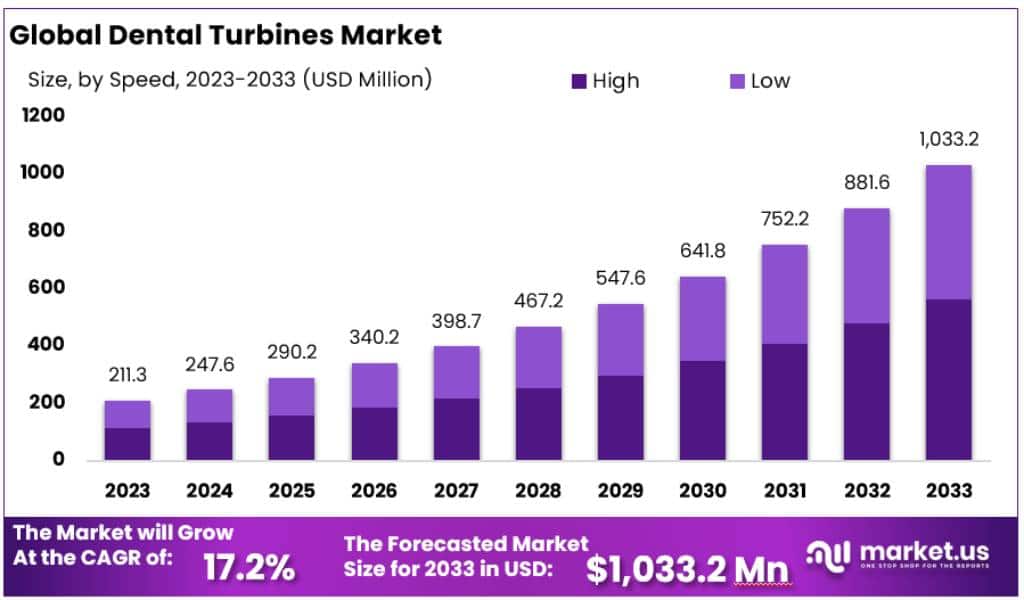
New York, NY – Jan 20, 2026 – The Global Dental Turbines Market size is expected to be worth around USD 1033.2 Million by 2033, from USD 211.3 Million in 2023, growing at a CAGR of 17.2% during the forecast period from 2024 to 2033.
Dental turbines are essential rotary instruments widely used in modern dentistry for restorative, prosthetic, and surgical procedures. These devices are primarily designed to deliver high-speed rotation required for cutting, grinding, and shaping hard dental tissues with precision and efficiency. The basic formation of a dental turbine consists of a compact handpiece body, a turbine rotor, bearings, a chuck mechanism, and an air or electric drive system.
The turbine rotor is considered the core component, as it converts compressed air or electric power into rotational motion. This rotor is supported by high-precision bearings, which are typically manufactured using ceramic or stainless-steel materials to ensure durability, reduced vibration, and extended operational life. The chuck mechanism securely holds the dental bur in place, enabling stable and accurate cutting during clinical procedures.
Dental turbines are generally categorized into air-driven and electric-driven systems. Air-driven turbines are widely adopted due to their lightweight structure, high rotational speed, and cost efficiency. In contrast, electric dental turbines provide consistent torque, lower noise levels, and enhanced control, making them suitable for advanced and specialized treatments.
The handpiece housing is ergonomically designed to support clinician comfort and reduce hand fatigue during prolonged procedures. Additionally, integrated cooling systems, such as water spray channels, are incorporated to minimize heat generation and protect both the patient and the dental bur.
Overall, the basic formation of dental turbines reflects a balance between engineering precision, clinical performance, and user comfort. Continuous technological advancements are expected to further enhance efficiency, reliability, and patient outcomes in dental care delivery.
Key Takeaways
- The global dental turbines market is expected to reach a value of approximately USD 1,033.2 million by 2033.
- In 2023, the market size was estimated at USD 211.3 million.
- Market expansion during the forecast period from 2024 to 2033 is projected at a strong compound annual growth rate (CAGR) of 17.2%.
- Dental turbines are high-speed rotary instruments powered by compressed air, capable of achieving rotational speeds of up to 400,000 revolutions per minute (rpm).
- High-speed turbine handpieces represented more than 54.4% of total market revenue in 2023.
- Hospitals accounted for over 52.3% of the overall market share in 2023, supported by well-established healthcare infrastructure and higher patient volumes.
- Oral health conditions, including dental caries and periodontal diseases, remain highly prevalent worldwide, impacting nearly 10% of the global population.
- North America dominated the global dental turbines market in 2023, capturing a leading share of 37.2%, supported by advanced dental care systems and increasing awareness of oral hygiene.
Regional Analysis
The North American dental turbines market continues to maintain a leading position globally, accounting for a substantial 37.2% share and reaching a valuation of USD 78.6 million in 2023. This leadership is primarily supported by the region’s well-established healthcare infrastructure, availability of highly trained dental professionals, and strong awareness of oral health. The United States remains the principal contributor, driven by the rising prevalence of dental disorders, an expanding geriatric population, increasing preference for cosmetic dental procedures, and the widespread adoption of advanced technologies such as CAD/CAM systems.
Market growth in North America is further reinforced by frequent product innovations, increasing investments, and strategic initiatives undertaken by major industry participants. Elevated awareness regarding oral hygiene also plays a critical role. According to data published by the Canadian Dental Association in 2021, approximately 85.7% of Canadians visited a dentist within a two-year period, reflecting consistent dental care utilization. Similarly, figures released by the American Dental Association in June 2021 indicate that nearly 85% of the U.S. population expresses a high level of concern for dental health, a factor expected to stimulate demand for cosmetic dentistry and, in turn, dental turbine equipment.
In contrast, the Asia Pacific region is projected to witness accelerated growth in the dental turbines market over the forecast period. Key growth drivers include the increasing incidence of oral diseases, comparatively lower treatment costs, rising demand for technologically advanced dental equipment, and a growing emphasis on dental aesthetics and preventive oral care. Additionally, the region’s large patient pool and improving healthcare infrastructure present significant growth opportunities for market participants.
Emerging Trends
- Advancements in Noise Reduction: Dental air turbine handpieces are widely recognized for generating high-frequency noise, which may cause discomfort for patients and contribute to long-term occupational risks for dental professionals. Recent research has applied vibroacoustic simulation techniques to analyze noise generation mechanisms in these devices. The findings indicate that resonance within internal air layers is a primary contributor to noise emission, with dominant peak frequencies identified at approximately 4,478.92 Hz. A deeper understanding of these resonance effects is supporting the development of low-noise turbine designs, thereby improving patient experience and workplace safety.
- Integration of Predictive Maintenance Technologies: The internal architecture of dental air turbine handpieces has become more complex due to continuous technological advancements. To improve reliability and minimize unexpected failures, predictive maintenance solutions based on temporal convolution network (TCN) models have been introduced. These machine learning models continuously assess the operational condition of key components, such as rotors and collets, enabling early fault detection. As a result, maintenance can be performed proactively, reducing equipment downtime, extending service life, and supporting consistent clinical performance.
- Emphasis on Infection Control: Heightened awareness of infection prevention has increased the focus on hygiene and sterilization in dental equipment design. Modern dental turbines are being engineered to withstand repeated sterilization processes, in line with regulatory and clinical guidelines. Regulatory authorities, including the U.S. Food and Drug Administration (FDA), recommend that dental handpieces be fully sterilizable between patient treatments. Compliance with these standards is essential to reduce the risk of cross-contamination and to ensure patient and practitioner safety.
Use Cases
- Cavity Preparation: Dental turbines are extensively used for the efficient removal of decayed tooth material during cavity preparation. Their high rotational speeds enable precise shaping of cavities, which is critical for successful restorative procedures. According to the FDA, these devices can operate at speeds of up to 450,000 revolutions per minute (RPM), allowing rapid and accurate removal of carious tissue.
- Crown and Bridge Preparation: In prosthodontic procedures, dental turbines play a key role in preparing teeth for crowns and bridges. The high-speed performance of these handpieces allows clinicians to contour tooth structures with a high degree of accuracy, ensuring proper fit, stability, and long-term functionality of the prosthetic restorations.
- Endodontic Procedures: During endodontic treatments, dental turbines are used to access the pulp chamber and assist in the removal of infected tissue. Their precision and speed support effective cleaning and shaping of root canals, which is essential for achieving successful treatment outcomes in complex root canal procedures.
- Orthodontic Applications: In orthodontic practice, dental turbines are applied in procedures such as enameloplasty, where minor enamel adjustments are required to improve alignment or aesthetics. The controlled cutting ability of these devices enables delicate modifications, supporting optimal orthodontic and cosmetic results.
Frequently Asked Questions on Dental Turbines
- What types of dental turbines are commonly available?
Dental turbines are primarily categorized into air-driven turbines and electric turbines. Air-driven models are widely adopted due to lower cost, while electric turbines offer consistent torque, improved precision, and reduced vibration during complex dental procedures. - What materials are used in manufacturing dental turbines?
Dental turbines are typically manufactured using stainless steel, titanium alloys, and ceramic bearings. These materials are selected to enhance durability, corrosion resistance, sterilization compatibility, and operational lifespan under repetitive clinical usage conditions. - What factors influence the lifespan of dental turbines?
The lifespan of dental turbines is influenced by maintenance practices, sterilization frequency, bearing quality, and operating pressure. Regular lubrication, proper cleaning, and adherence to manufacturer guidelines significantly improve turbine efficiency and long-term reliability. - What factors are driving growth in the dental turbines market?
The dental turbines market growth is driven by rising dental procedures, increasing oral health awareness, and technological advancements in dental equipment. Expansion of dental clinics and growing demand for minimally invasive treatments further support market development. - How does technological innovation impact the dental turbines market?
Technological advancements such as noise reduction, improved ergonomics, and enhanced rotational control have strengthened product differentiation. These innovations improve clinical outcomes and practitioner comfort, thereby increasing adoption rates across both developed and emerging dental markets. - Which end users contribute most to dental turbines market demand?
Dental clinics represent the largest end-user segment due to high patient volume and frequent equipment replacement cycles. Hospitals and academic dental institutions also contribute steadily, supported by growing investments in advanced dental infrastructure and training facilities. - What is the future outlook for the dental turbines market?
The dental turbines market is expected to register stable growth, supported by preventive dentistry trends and increasing cosmetic dental procedures. Emerging economies are projected to offer significant opportunities due to improving healthcare access and rising disposable incomes.
Conclusion
The dental turbines market reflects steady expansion, supported by rising oral health awareness, increasing procedural volumes, and continuous technological innovation. Advances in turbine design, including noise reduction, predictive maintenance integration, and enhanced infection control, have improved clinical efficiency, safety, and practitioner comfort.
Strong demand from dental clinics and hospitals, coupled with the growing prevalence of dental disorders, continues to drive market growth. North America maintains market leadership due to advanced infrastructure, while Asia Pacific presents high-growth potential. Overall, ongoing innovation and expanding access to dental care are expected to sustain long-term market development.
Discuss your needs with our analyst
Please share your requirements with more details so our analyst can check if they can solve your problem(s)




