


Table of Contents
Overview
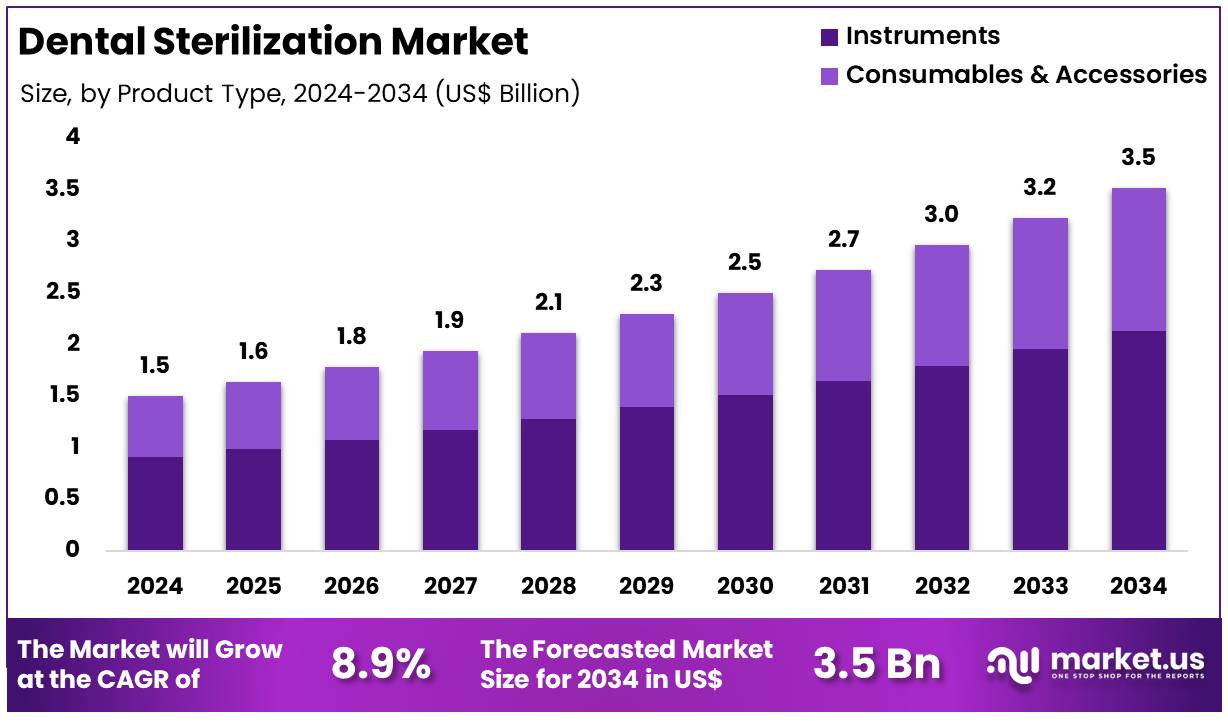
New York, NY – Dec 19, 2025 – Global Dental Sterilization Market size is expected to be worth around US$ 3.5 Billion by 2034 from US$ 1.5 Billion in 2024, growing at a CAGR of 8.9% during the forecast period 2025 to 2034. In 2024, North America led the market, achieving over 44.4% share with a revenue of US$ 0.7 Billion.
Dental sterilization is a fundamental process designed to ensure patient safety and maintain high standards of infection control within dental practices. It refers to the systematic procedures used to eliminate all forms of microorganisms, including bacteria, viruses, fungi, and spores, from dental instruments and clinical environments.
The basic formation of dental sterilization typically involves several standardized stages. First, instruments are subjected to pre-cleaning to remove visible debris and organic matter. This step is essential, as residual contaminants can reduce the effectiveness of subsequent sterilization processes. Cleaning is commonly performed using ultrasonic cleaners or automated washer-disinfectors.
Following cleaning, instruments are carefully inspected, packaged, and labeled. Proper packaging allows sterilizing agents to penetrate effectively while maintaining sterility after the cycle is complete. The most widely used sterilization methods in dentistry include steam sterilization (autoclaving), dry heat sterilization, and chemical vapor sterilization. Among these, steam sterilization is considered the gold standard due to its proven reliability, efficiency, and broad microbial effectiveness.
Once sterilization is completed, instruments are stored in controlled environments to prevent recontamination. Continuous monitoring using biological, chemical, and mechanical indicators is carried out to verify sterilization efficacy and compliance with regulatory standards.
The importance of dental sterilization has increased significantly due to heightened awareness of cross-contamination risks and stricter regulatory requirements. Effective sterilization practices contribute to improved patient trust, reduced healthcare-associated infections, and enhanced operational credibility for dental clinics.
Overall, dental sterilization forms the backbone of safe clinical practice and remains a critical component in delivering quality oral healthcare worldwide.
Key Takeaways
- In 2024, the global dental sterilization market was valued at US$ 1.5 billion. Supported by a compound annual growth rate (CAGR) of 8.9%, the market is projected to expand and reach approximately US$ 3.5 billion by 2034.
- By product type, the market is categorized into instruments and consumables & accessories. The instruments segment dominated the market in 2023, accounting for 60.5% of total revenue, reflecting its widespread adoption across dental care settings.
- Based on end user, the market is segmented into hospitals, dental laboratories, and dental clinics. Dental clinics emerged as the leading end-user segment, capturing a substantial 52.3% market share, driven by the high volume of routine dental procedures.
- From a regional perspective, North America maintained market leadership in 2024, holding a 44.4% share, supported by advanced healthcare infrastructure and strict infection control standards.
Regional Analysis
North America maintained a leading position in the global dental sterilization market in 2024, accounting for 44.4% of total revenue. This dominance is supported by a well-established healthcare system, early adoption of advanced sterilization technologies, and strict enforcement of infection prevention standards.
The United States represents the core of regional demand, driven by a large network of dental clinics and a substantial professional workforce. In 2023, more than 202,000 dentists were professionally active in the US, ensuring sustained demand for reliable sterilization equipment. Regulatory guidance from authorities such as the CDC has reinforced compliance, while continuous product innovation has strengthened market performance.
Advanced solutions, including rapid Class B sterilizers and automated systems, are increasingly adopted to improve efficiency and patient safety. High procedure volumes further support demand, as a significant share of adults require ongoing dental treatment.
In contrast, Asia Pacific is projected to record the fastest CAGR over the forecast period. Growth is being driven by expanding healthcare infrastructure, rising oral health awareness, and increasing access to dental services in urbanizing economies. Countries such as China and Japan are key contributors.
China benefits from a growing dentist base, rising incomes, and public initiatives to expand care access, while Japan’s aging population is accelerating demand for high-quality, automated sterilization systems. Continuous product launches and a stronger focus on infection control are expected to sustain robust market expansion across the region.
Emerging Trends
- Automated Compliance and Exception Notifications: Digital sterilization platforms are being implemented to automatically validate cycle parameters and generate real-time alerts when deviations are detected. This approach ensures regulatory compliance while minimizing dependence on manual supervision.
- Advanced Instrument Traceability: Sterilization workflows are increasingly supported by end-to-end tracking systems that link instruments to individual patients and clinical procedures. Complete sterilization cycle histories can be accessed for audit readiness and patient safety assurance.
- Continuous, Real-Time Quality Assurance: Modern sterilization solutions integrate biological monitoring data with automated maintenance scheduling to enable ongoing verification of process effectiveness, thereby strengthening quality control and safety performance.
- Sustainable and Environmentally Responsible Sterilization: The industry is progressing toward eco-efficient sterilization technologies, including energy-saving equipment, reduced water consumption systems, and emerging self-sterilizing concepts, in alignment with broader sustainability objectives.
- Compact and Portable Sterilization Systems for Operational Flexibility: Tabletop and other compact Class B sterilizers are gaining adoption, allowing rapid processing of small instrument loads and improving workflow efficiency during high-demand periods in dental practices.
Use Cases
- Digitally Integrated Sterilization Workflows: Automated sterilization systems enable end-to-end digital documentation, from cycle completion to deviation alerts, reducing human error and ensuring consistent adherence to sterilization protocols.
- Comprehensive Instrument-to-Patient Traceability: Detailed traceability supports accurate linkage between instruments, patients, and procedures, enhancing quality management and simplifying compliance audits.
- Preventive Quality Management and Maintenance: Real-time integration of biological indicators and predictive maintenance tools supports early detection of performance issues, reducing sterilization failures and improving operational reliability.
- Rapid Sterilization in Time-Critical Scenarios: Compact and portable Class B sterilizers can be deployed during peak workloads or emergency situations, ensuring timely availability of sterilized instruments without reliance on central units.
- Implementation of Eco-efficient Sterilization Solutions: Dental practices are adopting energy- and water-efficient sterilization technologies and evaluating innovative self-sterilizing designs to support environmental responsibility while maintaining stringent infection control standards.
Frequently Asked Questions on Dental Sterilization
- Why is sterilization critical in dental practices?
Sterilization is critical because dental procedures involve exposure to blood, saliva, and tissues. Proper sterilization reduces the risk of cross-contamination, healthcare-associated infections, and disease transmission between patients and dental professionals. - What are the commonly used dental sterilization methods?
Common dental sterilization methods include steam sterilization using autoclaves, chemical vapor sterilization, and dry heat sterilization. The choice depends on instrument material, clinic workflow, regulatory requirements, and cost-efficiency considerations. - How often should dental instruments be sterilized?
Dental instruments must be sterilized after every patient use. Reusable critical and semi-critical instruments require complete sterilization cycles to maintain infection control standards and comply with national and international dental healthcare regulations. - What standards regulate dental sterilization practices?
Dental sterilization practices are governed by standards from organizations such as CDC, WHO, and ISO. These guidelines define sterilization procedures, monitoring protocols, equipment validation, and documentation requirements to ensure consistent infection control. - What factors are driving market growth?
Market growth is driven by rising dental procedures, increasing awareness of infection control, stringent regulatory requirements, and expanding dental infrastructure. Technological advancements in automated and energy-efficient sterilization systems further support market expansion. - Which products dominate the dental sterilization market?
Autoclaves dominate the dental sterilization market due to their effectiveness, reliability, and regulatory acceptance. Consumables such as sterilization pouches, indicators, and chemical disinfectants also represent a significant and recurring revenue segment.
Conclusion
In conclusion, dental sterilization remains a cornerstone of safe and effective oral healthcare delivery. Standardized sterilization processes, supported by advanced technologies and strict regulatory frameworks, are essential for minimizing infection risks and maintaining patient trust.
Market growth is being driven by rising procedure volumes, heightened infection control awareness, and continuous innovation in automated, traceable, and eco-efficient sterilization systems. With dental clinics as the primary end users and North America leading adoption, sustained expansion is expected. Overall, effective dental sterilization will continue to underpin clinical quality, regulatory compliance, and operational credibility across global dental care settings.
Discuss your needs with our analyst
Please share your requirements with more details so our analyst can check if they can solve your problem(s)




