


Table of Contents
Overview
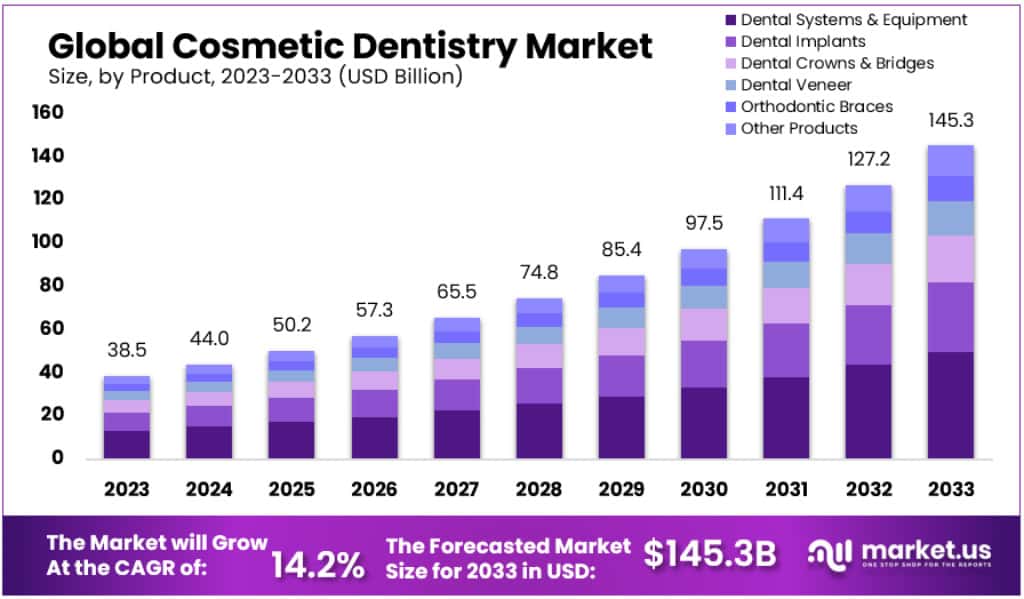
New York, NY – Jan 13, 2026 – The Global Cosmetic Dentistry Market size is expected to be worth around USD 145.3 Billion by 2033, from USD 38.5 Billion in 2023, growing at a CAGR of 14.2% during the forecast period from 2024 to 2033.
Cosmetic dentistry refers to dental procedures primarily focused on improving the appearance of teeth, gums, and overall smile aesthetics. The field has evolved steadily, supported by advancements in dental materials, digital imaging, and minimally invasive techniques. Basic cosmetic dentistry formation includes both clinical training and theoretical understanding, ensuring standardized and safe treatment outcomes.
At the foundational level, cosmetic dentistry formation covers core procedures such as teeth whitening, dental veneers, bonding, crowns, and smile alignment solutions. Training emphasizes dental anatomy, color matching, facial harmony, and occlusion principles. In addition, practitioners are trained in patient assessment, treatment planning, and the ethical communication of aesthetic expectations.
The growing demand for cosmetic dental services is attributed to rising awareness of oral aesthetics, increased disposable income, and the influence of social media and professional appearance standards. According to industry observations, cosmetic dental procedures are increasingly viewed as elective yet essential services, particularly in urban and semi-urban populations.
From a professional standpoint, structured cosmetic dentistry education supports consistency in service quality and enhances patient confidence. Certification programs and continuous professional development are commonly adopted to keep pace with evolving technologies such as digital smile design and advanced restorative materials.
Overall, basic formation in cosmetic dentistry plays a critical role in strengthening clinical competence, supporting market growth, and ensuring that aesthetic dental services meet both functional and visual standards. The segment is expected to remain an integral component of modern dental practice, aligned with broader trends in preventive and aesthetic healthcare.
Key Takeaways
- Current Market Value: The cosmetic dentistry market was valued at USD 38.5 billion in 2023.
- Expected Market Value: The market is projected to reach approximately USD 145.3 billion by 2033.
- Growth Rate: Expansion is expected at a compound annual growth rate (CAGR) of 14.2% during the period 2023–2033.
- Dominant Product Segment: Dental systems and equipment accounted for more than 34.3% of total market revenue in 2023.
- Key End-User Segment: Dental hospitals and clinics represented over 72% of the market share in 2023.
- North American Market Share: North America captured around 41% of the global market, valued at approximately USD 15.8 billion.
- Asia Pacific Growth Outlook: The Asia Pacific region is anticipated to register a CAGR of 13.8% from 2023 to 2030.
- Dental Implants Segment: This segment remains a major contributor, supported by increasing adoption rates and advancements in implant materials and techniques.
- Dental Crowns and Bridges Segment: Growth is driven by the rising incidence of dental caries and tooth loss.
- Dental Veneers Segment: Adoption is increasing due to strong aesthetic demand and continuous improvements in materials and application methods.
- Orthodontic Braces Segment: Market growth is supported by rising awareness of dental alignment and innovations such as clear and removable braces.
- Dental Laboratories Segment: This segment plays a vital role in prosthetic fabrication and benefits from ongoing advancements in digital dentistry.
- Annual U.S. Expenditure: Cosmetic dental services in the United States account for approximately USD 2.75 billion in annual spending.
- Technological Investments: Increased investment in CAD/CAM systems and advanced dental technologies continues to shape market development.
Regional Analysis
Technological Leadership and Strong Procedure Demand
In 2023, North America maintained a leading position in the aesthetic medicine market, capturing approximately 41% of the global share, with a market value of USD 15.8 billion. This leadership can be attributed to continuous technological innovation and a growing preference for cosmetic dentistry procedures among the population. High acceptance of aesthetic treatments, along with increased awareness of dental appearance and smile aesthetics, has further supported regional market expansion.
The introduction of advanced solutions, such as W&H’s Assistina One for rapid and efficient dental handpiece maintenance, has contributed to improved clinical efficiency and set new operational benchmarks. In addition, high disposable income levels, substantial healthcare expenditure, and a well-developed healthcare infrastructure continue to reinforce North America’s dominant market position.
Asia Pacific: Rapid Growth Supported by Infrastructure Expansion
Asia Pacific is projected to register the fastest growth, expanding at a CAGR of 13.8% between 2023 and 2030. Market growth in the region is supported by the rising number of dental clinics, increasing dental tourism, and growing investments in research and manufacturing capabilities. Greater awareness of oral health, combined with expanding access to technologically advanced healthcare facilities, is accelerating adoption across key markets.
Government and corporate initiatives in countries such as China and India are significantly enhancing dental care outreach and awareness. Strategic expansions, including large-scale dental clinic networks and digital platforms that enable online appointment scheduling and service accessibility, highlight the region’s shift toward modern, technology-driven dental healthcare delivery.
Emerging Trends in Cosmetic Dentistry
- Integration of Artificial Intelligence (AI): Artificial intelligence is increasingly applied across clinical workflows, including caries detection, periodontal assessment, and implant planning. The use of AI enhances diagnostic accuracy, supports predictive treatment planning, and improves overall clinical efficiency and consistency.
- Adoption of 3D Printing Technologies: 3D printing is transforming cosmetic dentistry by enabling in-house fabrication of crowns, bridges, veneers, and surgical guides. This advancement significantly shortens production timelines, reduces laboratory dependency, and lowers procedural costs while maintaining high precision.
- Rising Use of Digital and Intraoral Scanners: Digital and intraoral scanners are replacing conventional impression techniques due to improved accuracy and patient comfort. These systems streamline the design and manufacturing of dental restorations, supporting faster turnaround times and more predictable treatment outcomes.
- Expansion of Cone-Beam Computed Tomography (CBCT): CBCT technology provides high-resolution three-dimensional imaging that improves implant placement accuracy and diagnostic capabilities. Enhanced visualization of anatomical structures supports better clinical decision-making, although careful radiation management remains essential.
- Advancements in Photobiomodulation Therapy: Photobiomodulation devices are increasingly used to reduce post-procedural pain and accelerate tissue healing. This technology improves patient recovery experiences and supports more efficient treatment workflows following cosmetic and surgical dental procedures.
- Growth of Teledentistry Services: Teledentistry is expanding rapidly, enabling remote consultations, treatment planning, and follow-up care. This trend improves access to cosmetic dental services, particularly in underserved regions and among patients with mobility or scheduling constraints.
- Focus on Customized Patient-Centric Treatments: Digital technologies are enabling highly personalized cosmetic dentistry solutions. Advanced digital scans and treatment simulations allow clinicians to design tailored procedures that align closely with individual anatomical, functional, and aesthetic patient requirements.
Key Use Cases in Cosmetic Dentistry
- Teeth Whitening Procedures: Teeth whitening remains one of the most widely adopted cosmetic dental treatments due to its immediate aesthetic impact. The procedure effectively removes intrinsic and extrinsic stains, significantly improving tooth brightness and overall smile appearance.
- Dental Bonding Applications: Dental bonding is commonly used to repair chipped, cracked, or discolored teeth. The procedure involves applying a tooth-colored composite resin, which is shaped and hardened to restore both aesthetics and structural integrity.
- Veneer-Based Restorations: Veneers are thin shells, typically made from porcelain or composite materials, bonded to the front surface of teeth. They are widely used to correct discoloration, minor misalignment, gaps, and surface irregularities.
- Gum Contouring Treatments: Gum contouring procedures are performed to reshape the gum line and improve smile aesthetics. This treatment is particularly effective for correcting excessive gingival display, creating a more balanced and proportionate tooth appearance.
- Inlays and Onlays Restorations: Inlays and onlays, also referred to as indirect restorations, are used when tooth damage exceeds the capacity of standard fillings. Manufactured from materials such as porcelain, they provide strength, durability, and natural aesthetics.
- Dental Implant Solutions: Dental implants offer a long-term solution for missing teeth by replacing the tooth root with a biocompatible implant and crown. This approach restores functionality, aesthetics, and jawbone integrity, closely mimicking natural teeth.
- Digital Smile Design (DSD): Digital Smile Design utilizes advanced imaging and software to analyze facial and dental structures. This technique allows clinicians and patients to visualize and refine cosmetic outcomes before treatment, improving predictability and patient satisfaction.
Frequently Asked Questions on Cosmetic Dentistry
- What are the most common cosmetic dentistry procedures?
Common cosmetic dentistry procedures include teeth whitening, dental veneers, bonding, crowns, and orthodontic aligners. These treatments are widely adopted due to their minimally invasive nature, predictable outcomes, and increasing availability across dental clinics and specialty centers. - Is cosmetic dentistry safe for patients?
Cosmetic dentistry is considered safe when performed by licensed dental professionals using approved materials and technologies. Most procedures are non-invasive or minimally invasive, with low complication rates and high patient satisfaction when proper clinical protocols are followed. - How long do cosmetic dental treatments last?
The longevity of cosmetic dental treatments depends on the procedure type, material quality, and patient oral hygiene. Veneers and crowns may last over ten years, while whitening treatments typically require periodic maintenance to sustain results. - Who is an ideal candidate for cosmetic dentistry?
Ideal candidates for cosmetic dentistry include individuals with healthy gums and teeth seeking aesthetic enhancement. Patients with discoloration, chipped teeth, gaps, or mild alignment issues often benefit most, following proper dental evaluation and treatment planning. - What factors are driving market growth?
Market growth is driven by increasing demand for aesthetic dental procedures, technological advancements such as digital dentistry, and growing awareness of oral appearance. Additionally, social media influence and rising cosmetic healthcare spending contribute significantly to market expansion. - Which procedures generate the highest market revenue?
Teeth whitening and dental veneers account for a significant share of market revenue due to high procedure volumes and repeat demand. Orthodontic aligners and smile makeover treatments are also gaining traction, supported by strong consumer preference for aesthetic improvements. - Which regions dominate the cosmetic dentistry market?
North America dominates the cosmetic dentistry market due to advanced dental infrastructure, high treatment adoption rates, and favorable reimbursement trends. Europe follows closely, while Asia-Pacific is experiencing the fastest growth driven by urbanization and dental tourism. - What is the future outlook of the cosmetic dentistry market?
The cosmetic dentistry market is expected to witness sustained growth, supported by innovation in materials, AI-enabled diagnostics, and minimally invasive procedures. Increasing consumer focus on appearance and preventive aesthetics is anticipated to strengthen long-term demand.
Conclusion
Cosmetic dentistry has evolved into a core component of modern dental practice, balancing aesthetic enhancement with functional integrity. Structured foundational training ensures safe, standardized, and predictable outcomes while supporting practitioner competence and patient confidence. Market expansion is being driven by technological advancements, rising aesthetic awareness, and increasing healthcare investment across regions.
Strong growth in digital dentistry, AI integration, and patient-centric treatment planning continues to reshape service delivery. With sustained demand across both developed and emerging markets, cosmetic dentistry is expected to remain a resilient and high-growth segment aligned with broader preventive and aesthetic healthcare trends.
Discuss your needs with our analyst
Please share your requirements with more details so our analyst can check if they can solve your problem(s)




