


Table of Contents
Overview
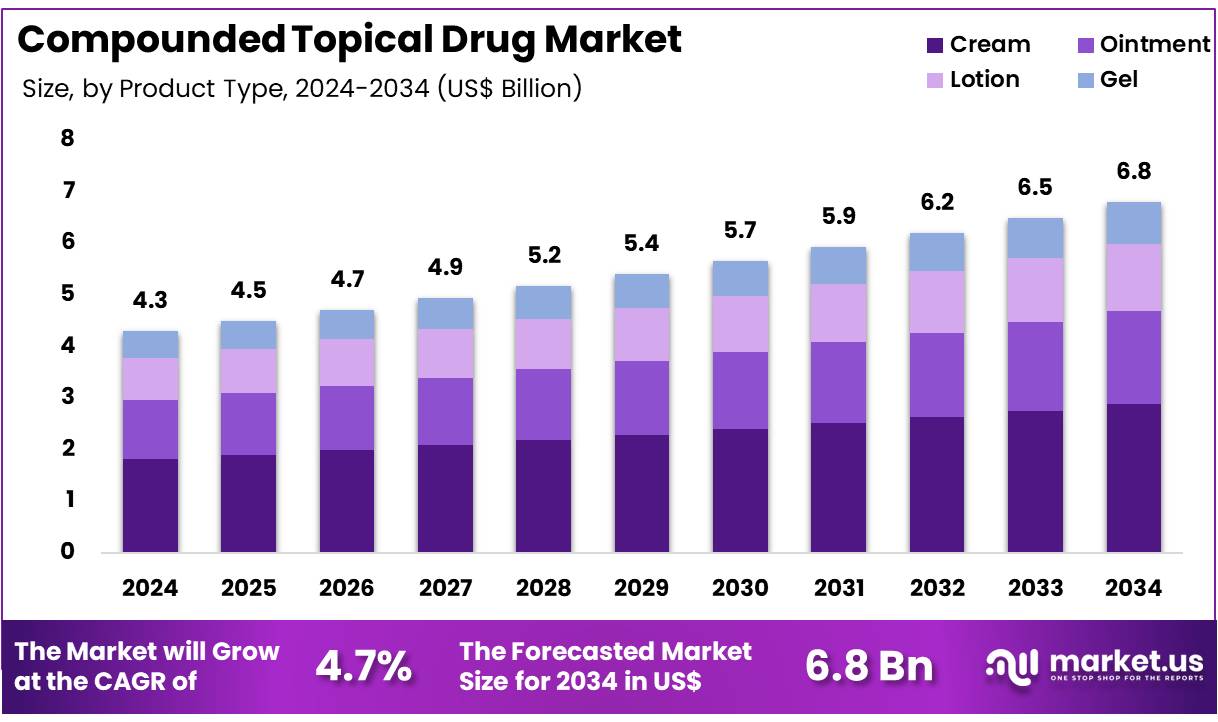
New York, NY – Dec 05, 2025 – Global Compounded Topical Drug Market size is expected to be worth around US$ 6.8 Billion by 2034 from US$ 4.3 Billion in 2024, growing at a CAGR of 4.7% during the forecast period 2025 to 2034. In 2024, North America led the market, achieving over 39.8% share with a revenue of US$ 1.7 Billion.
A new compounded topical drug formulation has been introduced to support clinicians seeking personalized therapeutic options for patients with localized dermatological and pain-related conditions. The formulation has been developed to provide targeted delivery, improved absorption, and enhanced patient compliance.
The compounded topical drug is prepared through a controlled process in which active pharmaceutical ingredients are combined within a stable cream-based vehicle. The development has been guided by standardized compounding procedures, and the stability profile of the formulation has been optimized to maintain consistent potency throughout its intended shelf life. The product has been designed to allow customizable concentrations of active agents, enabling prescribers to tailor treatment to individual clinical needs.
The growth of customized topical therapies has been driven by increasing demand for patient-specific solutions and improved therapeutic precision. The introduction of this formulation is expected to support healthcare providers seeking alternatives where commercially available products may not fully address patient requirements.
This announcement reflects the company’s continued commitment to high-quality compounding practices and adherence to established regulatory and safety standards. The compounded topical drug will be available to licensed healthcare professionals through authorized pharmacy channels.
Key Takeaways
- In 2024, the compounded topical drug market generated revenues of US$ 4.3 billion, and the market expansion has been supported by a CAGR of 4.7%. The market size is projected to reach US$ 6.8 billion by 2034, reflecting sustained demand for customized topical therapies.
- The product type segment comprises creams, ointments, lotions, and gels. Among these, creams dominated the market in 2024, accounting for 42.3% of total revenue, driven by their widespread use and favorable patient acceptability.
- Based on application, the market includes retail pharmacies, hospital pharmacies, online pharmacies, and other distribution channels. Retail pharmacies held a leading share of 38.7% in 2024, supported by high consumer accessibility and strong provider-patient interaction within this channel.
- From a regional perspective, North America led the global market, capturing 39.8% of total revenue in 2024. The region’s leadership can be attributed to advanced compounding practices, strong regulatory oversight, and increased adoption of personalized topical therapies.
Regional Analysis
North America Continues to Lead the Compounded Topical Drug Market
North America remained the leading regional market, capturing 39.8% of total revenue. The region’s dominance can be attributed to the rising demand for highly personalized medicine solutions. Physicians and patients increasingly seek customized formulations to address therapeutic requirements that are not met by commercially available products. These needs include dosage adjustments for pediatric and geriatric populations, allergen-free formulations for sensitive individuals, and the combination of multiple active ingredients into a single topical preparation for improved treatment convenience.
The adaptability of compounding pharmacies supports tailored therapeutic approaches across dermatology, pain management, and hormone replacement therapy. This strong emphasis on individualized treatment continues to drive market expansion within the region.
Asia Pacific Expected to Register the Fastest CAGR During the Forecast Period
The Asia Pacific market is projected to record the highest CAGR, driven by the region’s expanding healthcare infrastructure and growing awareness of personalized treatment options. The increasing prevalence of dermatological conditions has contributed to rising demand for customized topical preparations that accommodate unique patient sensitivities and specific therapeutic requirements.
Advancements in pharmaceutical compounding techniques and the growing availability of skilled compounding pharmacists across the region are expected to further strengthen market growth. The heightened focus on patient-centric care and the need for tailored medication solutions will play a significant role in accelerating the adoption of compounded topical formulations throughout Asia Pacific.
Use Cases
- Pain Management: Compounded topical pain creams are widely utilized as adjunct therapies for localized pain management. These formulations may include anesthetics such as lidocaine, NSAIDs such as naproxen, and adjuvant agents such as ketamine. A 2020 National Academies review indicated that such preparations can deliver local or regional analgesia with limited systemic exposure, thereby reducing reliance on oral opioids and minimizing associated adverse effects.
- Dermatological Conditions: Compounded formulations play a significant role in dermatology, particularly when approved products do not fully address clinical needs. Glycolic acid preparations have been used for epidermal melasma with favorable short-term safety, while custom tretinoin combinations have supported the management of photodamaged skin for several decades. Their adaptability enables precise therapeutic targeting across varied skin conditions.
- Pediatric and Geriatric Dosage Forms: Compounding is essential for patients requiring alternative dosage forms, especially those unable to swallow conventional oral tablets. Liquid topical suspensions and gels can be created to meet pediatric or geriatric requirements, ensuring accurate dosing and improved treatment adherence. However, systematic data on prescription volumes for these specialized formulations remain limited.
- Hormone Replacement and Aesthetic Dermatology: Customized topical hormone formulations, including testosterone and estrogen gels, are prescribed when commercial options are unsuitable or unavailable. Compounding also supports aesthetic dermatology through tailored blends containing hydroquinone, retinoids, and other agents designed to address pigmentation concerns, photodamage, and fine lines with individualized precision.
- Adverse Event Monitoring: Safety surveillance has identified cases of systemic absorption associated with compounded topical preparations. Among 24 reported adverse events involving compounded pain creams, 16 were submitted by healthcare professionals, with systemic absorption confirmed in 10 through serum or urine analysis. These findings underscore the need for careful monitoring, compound-specific pharmacokinetic evaluation, and comprehensive patient education regarding proper application.
Frequently Asked Questions on Compounded Topical Drug
- What is a compounded topical drug?
A compounded topical drug is a customized medication prepared by a licensed pharmacist to meet specific patient needs. It is formulated when commercially available products do not provide the exact strength, combination, or allergen-free options required for individualized treatment. - Why are compounded topical drugs used?
These formulations are used to address unique therapeutic needs, including dosage adjustments, allergen-free preparations, or combining multiple active ingredients. Their use supports tailored treatment approaches for dermatological conditions, pain management, and hormone therapy where standardized products may be insufficient. - Are compounded topical drugs FDA-approved?
Compounded topical drugs are not individually FDA-approved because they are customized for specific patients. However, the ingredients used are regulated, and pharmacies must comply with strict compounding standards to ensure safety, quality, and consistency throughout preparation. - Who can prescribe compounded topical drugs?
These medications can be prescribed by licensed healthcare professionals seeking personalized solutions for their patients. Prescribers may recommend them when standard medications fail to achieve desired results or when unique therapeutic combinations are required to improve treatment outcomes. - What conditions are commonly treated with compounded topical drugs?
Compounded topical drugs are frequently used for dermatological disorders, localized pain, inflammatory conditions, and hormone imbalances. Their customizable nature allows for targeted delivery and optimized formulation to match patient-specific sensitivities, clinical requirements, and therapeutic goals. - Which product type holds the largest market share?
Cream-based formulations held the largest share, accounting for 42.3% of the market. Their dominance is attributed to ease of application, strong patient acceptability, and effective delivery of active ingredients across various therapeutic applications requiring topical treatments. - Which distribution channel leads the market?
Retail pharmacies accounted for 38.7% of market revenue, reflecting high accessibility for patients and strong engagement between pharmacists and prescribers. Their established presence supports widespread distribution of customized topical therapies across diverse clinical and consumer segments. - Which region leads the global market?
North America led the market with a 39.8% revenue share in 2024. Strong regulatory frameworks, advanced compounding practices, and growing adoption of personalized medicine contribute to the region’s continued leadership in compounded topical drug utilization.
Conclusion
The compounded topical drug market continues to demonstrate steady growth, supported by rising demand for personalized therapies and expanding clinical applications across dermatology, pain management, hormone therapy, and specialized dosage needs. Strong adoption in North America and rapid development in Asia Pacific reflect global movement toward patient-centric treatment models.
Increasing utilization of customized formulations, advancements in compounding techniques, and heightened focus on safety monitoring further strengthen the market’s long-term potential. As healthcare providers increasingly seek tailored solutions unavailable in standard products, compounded topical drugs are expected to remain integral to precision-based therapeutic care in the coming decade.
Discuss your needs with our analyst
Please share your requirements with more details so our analyst can check if they can solve your problem(s)




