


Table of Contents
Overview
New York, NY – Feb 27, 2026 – The Global Cellulose Gel Market size is expected to be worth around US$ 2.4 Billion by 2033 from US$ 1.3 Billion in 2023, growing at a CAGR of 6.2% during the forecast period 2024 to 2033.
Cellulose gel is a hydrocolloid material derived from purified cellulose, the most abundant natural polymer found in plant cell walls. It is produced through controlled mechanical and chemical processes that modify cellulose fibers into a stable, water-dispersible structure. The basic formation process involves the purification of cellulose from wood pulp or cotton linters, followed by controlled hydrolysis and homogenization. This treatment reduces particle size and enhances the material’s ability to form a three-dimensional network when dispersed in water.
Upon hydration, cellulose particles interact through hydrogen bonding, creating a uniform gel matrix. This structure provides viscosity, suspension stability, and moisture retention properties. The gel formation does not require high temperatures or complex additives, which supports cost-effective and scalable production. The resulting product is odorless, tasteless, and non-toxic, meeting regulatory standards for use in food, pharmaceutical, and personal care applications.
Cellulose gel is widely utilized as a stabilizer, thickening agent, and fat replacer. In food applications, it improves texture and extends shelf life. In pharmaceutical formulations, it functions as a binder and controlled-release agent. The growth of cellulose gel demand is supported by increasing preference for plant-based and clean-label ingredients. Its renewable origin and biodegradable nature further strengthen its position in sustainable product development strategies across global markets.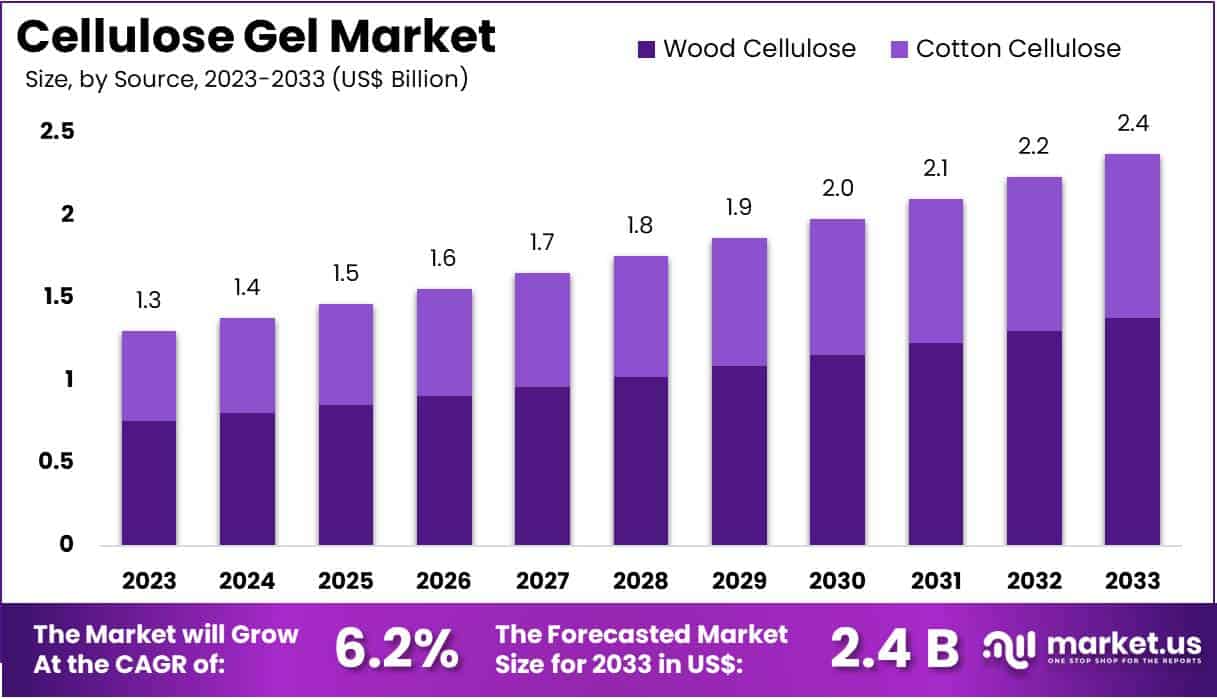
Key Takeaways
- In 2023, the global cellulose gel market was valued at US$ 1.3 billion. The market is projected to expand at a CAGR of 6.2% during the forecast period, reaching approximately US$ 2.4 billion by 2033.
- Based on source, the market is categorized into cotton cellulose and wood cellulose. Wood cellulose dominated the segment in 2023, accounting for 58.3% of the total market share.
- By application, the market is segmented into food & beverages, pharmaceuticals, paper & pulp, textile, and automobile industries. The food & beverages segment emerged as the leading application area, holding a 36.4% share in 2023.
- Regionally, North America accounted for the largest market share in 2023, contributing 38.4% of the global cellulose gel market revenue.
Regional Analysis
North America accounted for the largest share of the cellulose gel market in 2023, representing 38.4% of total revenue. Growth has been driven by strong demand from the food and beverage sector, particularly in the United States and Canada, where processed food production continues to expand.
The increasing preference for sustainable and clean-label ingredients has supported the adoption of cellulose gel as a stabilizer and thickening agent. According to Agriculture and Agri-Food Canada, Canada’s processed food and beverage exports reached US$ 54.3 billion in 2022, reflecting a 14.1% year-over-year increase, reinforcing demand for functional ingredients.
Asia Pacific is projected to register the fastest CAGR over the forecast period. Rising urbanization, growing disposable incomes in China and India, and expanding food, cosmetics, and textile industries are supporting regional growth. Product innovation, including launches by Birla Cellulose, is further strengthening sustainable cellulose-based applications across the region.
Emerging Trends
- Shift Toward Clean-Label Products: Rising consumer focus on ingredient transparency is accelerating demand for recognizable, plant-derived inputs. Cellulose gel replaces synthetic thickeners, enhances texture and stability, and aligns strongly with expanding clean-label preferences.
- Plant-Based Formulations Rising: Expanding adoption of vegan and vegetarian lifestyles is increasing demand for plant-based ingredients. Cellulose gel serves as a natural thickener in dairy alternatives and meat substitutes, supporting animal-free product innovation.
- Innovation in Textiles and Coatings: Applications are expanding into textiles and coatings, where cellulose gel improves softness, durability, and moisture retention. Its compatibility with biodegradable, water-based systems supports sustainable material development across industrial segments.
- Sustainable Manufacturing Practices: Manufacturers are implementing energy-efficient extraction and low-waste processing methods. Cellulose gel’s biodegradable, plant-based profile aligns with sustainability targets, strengthening its position as an environmentally responsible industrial ingredient.
- Growing Role in Drug Delivery Systems: Cellulose gel supports controlled drug release in tablets and capsules, enhancing therapeutic efficiency and stability. Increasing pharmaceutical focus on precision formulations is reinforcing its adoption in advanced delivery systems.
Use Cases
- Food and Beverages: Cellulose gel functions as a stabilizer and thickener in sauces, dairy alternatives, and low-fat foods. It improves mouthfeel, prevents phase separation, and supports clean-label positioning without altering flavor profiles.
- Pharmaceuticals: In pharmaceutical formulations, cellulose gel regulates drug release rates and improves content uniformity. Typical inclusion levels range from 3–5%, enabling sustained delivery, improved stability, and enhanced patient compliance outcomes.
- Cosmetics and Personal Care: Cellulose gel enhances viscosity, spreadability, and product stability in creams and lotions. Used at 0.5–1%, it prevents ingredient separation and supports natural, plant-based positioning in skincare formulations.
- Textile and Industrial Applications: At concentrations of 2–4%, cellulose gel improves fabric softness, binding efficiency, and moisture retention. It also enables biodegradable coatings, supporting environmentally responsible industrial manufacturing practices.
Frequently Asked Questions on Cellulose Gel
- What are the primary applications of Cellulose Gel?
Cellulose gel is widely utilized in processed foods, dairy products, bakery fillings, beverages, tablets, topical creams, and cosmetic formulations. Its multifunctional properties, including viscosity control and suspension stabilization, enable consistent product texture and enhanced shelf stability across diverse end-use industries. - What factors are driving growth in the Cellulose Gel Market?
Market growth is primarily driven by rising demand for clean-label ingredients, expanding processed food consumption, and increasing pharmaceutical production. The shift toward plant-based and low-calorie formulations has further accelerated adoption, particularly in developed and emerging economies. - Which regions dominate the Cellulose Gel Market?
North America and Europe represent mature markets due to established food processing and pharmaceutical industries. However, Asia-Pacific is witnessing accelerated growth, supported by rising urbanization, expanding manufacturing capacity, and increasing demand for packaged and convenience food products. - What are the key end-user industries in the Cellulose Gel Market?
The food and beverage sector accounts for a significant revenue share, followed by pharmaceuticals and personal care industries. Expanding applications in nutraceuticals and functional foods are expected to further strengthen demand over the forecast period. - How is sustainability influencing the Cellulose Gel Market?
Sustainability trends are positively influencing market expansion, as cellulose gel is derived from renewable plant sources and is biodegradable. Growing environmental awareness among consumers and manufacturers has increased preference for bio-based additives over synthetic stabilizing agents. - Who are the major companies operating in the Cellulose Gel Market?
Key market participants include Dow Inc., Ashland Inc., CP Kelco, and Ingredion Incorporated. Strategic expansions, product innovation, and mergers are commonly adopted to enhance global presence and strengthen competitive positioning.
Conclusion
The cellulose gel market is positioned for stable and sustained expansion, supported by strong fundamentals across food, pharmaceutical, personal care, and industrial sectors. Valued at US$ 1.3 billion in 2023, the market is projected to reach US$ 2.4 billion by 2033, reflecting a CAGR of 6.2%.
Dominance of wood-based cellulose and leadership of the food and beverage segment highlight core demand drivers. Regional strength in North America and rapid growth in Asia Pacific indicate balanced global development. Increasing emphasis on clean-label, plant-based, and sustainable formulations is expected to further reinforce long-term market growth and innovation opportunities.
Discuss your needs with our analyst
Please share your requirements with more details so our analyst can check if they can solve your problem(s)




