


Table of Contents
Overview
New York, NY – Jan 20, 2026 – The Global Cellular Health Screening Market size is expected to be worth around USD 7.5 Billion by 2033, from USD 3.0 Billion in 2023, growing at a CAGR of 9.5% during the forecast period from 2024 to 2033.
Cellular Health Screening is being positioned as a foundational approach to understanding overall health at the most basic biological level. The screening focuses on evaluating cellular function, oxidative stress, and nutritional balance, which are widely recognized as key indicators of long-term wellness.
The introduction of Cellular Health Screening reflects the growing emphasis on preventive healthcare. Rather than identifying disease at advanced stages, this screening is designed to highlight early cellular imbalances that may contribute to fatigue, reduced immunity, accelerated aging, and chronic health conditions. By assessing how efficiently cells produce energy and manage metabolic stress, actionable health insights can be generated.
Healthcare professionals have indicated that cellular-level data can support more personalized wellness strategies. The screening outcomes are typically used to guide lifestyle adjustments related to nutrition, supplementation, physical activity, and stress management. This approach allows interventions to be implemented earlier, when corrective measures are generally more effective.
The demand for non-invasive, data-driven health assessments continues to increase, supported by rising consumer awareness of preventive and functional health solutions. Cellular Health Screening aligns with this trend by offering measurable insights without complex procedures.
As healthcare systems increasingly shift toward prevention and early intervention, Cellular Health Screening is expected to gain relevance across wellness centers, diagnostic providers, and corporate health programs. Its role in supporting informed health decisions highlights its potential as a valuable component of modern preventive healthcare frameworks.
For individuals seeking a proactive understanding of their health, Cellular Health Screening provides a structured and science-based starting point.
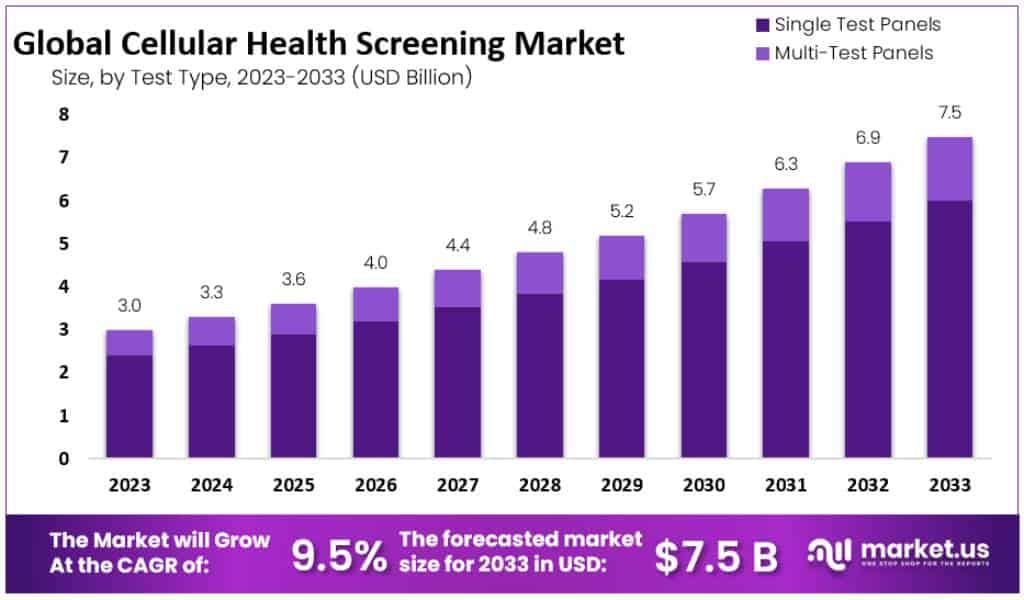
Key Takeaways
- Market Size: The Cellular Health Screening Market is projected to reach approximately USD 7.5 billion by 2033, expanding from USD 3.0 billion in 2023.
- Market Growth: The market is expected to grow at a compound annual growth rate (CAGR) of 9.5% during the forecast period from 2024 to 2033.
- Test Type Analysis: Single test panels accounted for a dominant position in the market, representing over 80.2% of the total market share.
- Sample Type Analysis: Blood-based samples led the Cellular Health Screening Market, capturing more than 48.3% of the market share in 2023.
- Collection Site Analysis: In 2023, hospitals emerged as the leading collection sites, holding over 40.5% of the overall market share.
- Regional Analysis: North America dominated the market with a 49.9% share, reaching a market value of USD 1.49 billion in 2023.
- Technological Advancements: Ongoing innovations in biomarker discovery and advanced diagnostic technologies are significantly improving the precision, reliability, and efficiency of cellular health screening solutions.
Regional Analysis
North America is expected to retain its leading position in the Cellular Health Screening Market, accounting for an estimated 49.9% market share, valued at USD 1.49 billion in 2023. This strong market presence is primarily supported by a large patient base, advanced healthcare infrastructure, and a rising prevalence of chronic diseases across the region.
According to the American Cancer Society, approximately 1.9 million new cancer cases were reported in the United States in 2022, highlighting the growing burden of chronic conditions. The increasing incidence of such diseases is driving demand for cellular health screening solutions, as these tools enable early detection and improved disease management, thereby supporting market expansion.
Further reinforcing this trend, data from the Centers for Disease Control and Prevention (CDC) indicates that coronary heart disease remains the most common form of heart disease in the U.S., affecting nearly 20.1 million adults aged 20 and above. Additionally, heart attacks occur every 40 seconds, impacting around 805,000 individuals annually, emphasizing the need for early diagnostic and preventive screening approaches.
Market growth is also supported by technological innovation, including advanced blood-based diagnostic tests capable of detecting multiple diseases. In contrast, the Asia Pacific region is projected to witness the fastest growth, driven by population expansion, improving healthcare infrastructure, increasing health awareness, and supportive government initiatives focused on disease prevention.
Emerging Trends
- Integration of Advanced Technologies: The integration of artificial intelligence and machine learning into cellular health diagnostics is improving screening accuracy and data interpretation. Advanced algorithms are increasingly used to detect early cellular abnormalities, enabling faster, more precise clinical decision-making.
- Growth of At-Home Testing Solutions: Rising demand for convenient healthcare solutions is accelerating the adoption of at-home cellular health testing kits. These products allow individuals to monitor key cellular biomarkers remotely, supporting proactive health management and reducing dependence on frequent clinical visits.
- Shift Toward Preventive Healthcare Models: Healthcare systems are progressively transitioning from reactive treatment approaches to preventive care frameworks. Cellular health screening is gaining importance as a foundational tool for early risk identification and long-term health optimization strategies.
- Expansion of Personalized Medicine: Cellular-level insights are enabling highly personalized medical interventions. By analyzing individual cellular health profiles, treatments and wellness plans can be tailored to specific biological needs, improving therapeutic effectiveness and patient outcomes.
- Ethical and Societal Implications: The widespread adoption of advanced health-monitoring technologies has introduced concerns related to data security, privacy, and mental well-being. Addressing these ethical challenges is becoming increasingly important as continuous health monitoring becomes more common.
Use Cases
- Early Cancer Detection: Advanced blood-based cellular screening methods, including extracellular vesicle analysis, are demonstrating high accuracy in detecting early-stage cancers. Early identification significantly improves treatment success rates and overall patient survival outcomes.
- Cardiovascular Health Assessment: Mobile health applications using photoplethysmography techniques enable non-invasive monitoring of cardiovascular parameters. These tools support early detection of potential abnormalities, promoting timely preventive interventions and improved heart health management.
- Chronic Disease Management: Regular cellular health monitoring supports effective management of chronic conditions such as diabetes and hypertension. Continuous tracking of cellular biomarkers allows timely adjustments to treatment plans, helping reduce complications and improve quality of life.
- Evaluation of Drug Effectiveness: Cellular health screening is increasingly used in pharmaceutical research to assess patient responses to new therapies. Cellular-level analysis helps validate drug safety and efficacy, supporting informed decision-making during clinical development stages.
Frequently Asked Questions on Cellular Health Screening
- Why is cellular health screening important?
Cellular health screening is important because many chronic conditions originate at the cellular level. Early detection of cellular dysfunction enables timely lifestyle or nutritional interventions, helping improve overall health outcomes and reduce long-term disease risk. - What parameters are measured in cellular health screening?
Cellular health screening typically measures oxidative stress markers, mitochondrial function, micronutrient levels, inflammation indicators, and cellular aging markers. These parameters provide insights into metabolic efficiency, immune resilience, and the body’s ability to repair cellular damage. - Who should consider cellular health screening?
Cellular health screening is suitable for individuals focused on preventive healthcare, aging populations, athletes, and those with chronic fatigue or metabolic concerns. It is also increasingly used by wellness-focused consumers seeking personalized health optimization solutions. - How often should cellular health screening be performed?
The frequency of cellular health screening depends on individual health goals and risk profiles. For preventive care, annual or biannual screening is commonly recommended to monitor cellular changes and assess the effectiveness of lifestyle or nutritional interventions. - What factors are driving the growth of the cellular health screening market?
Market growth is driven by rising awareness of preventive healthcare, increasing prevalence of chronic diseases, aging populations, and advancements in biomarker technologies. Growing consumer interest in personalized medicine further supports market expansion globally. - Which end users dominate the cellular health screening market?
Hospitals, diagnostic laboratories, wellness clinics, and preventive healthcare centers dominate market demand. Additionally, direct-to-consumer testing services are gaining traction as consumers increasingly adopt proactive health monitoring and personalized wellness solutions. - What is the future outlook for the cellular health screening market?
The market outlook remains cautiously optimistic, supported by sustained demand for early disease detection and personalized health insights. Continued investment in research, digital health integration, and consumer education is expected to drive steady long-term growth.
Conclusion
Cellular Health Screening is increasingly recognized as a core component of modern preventive healthcare, offering early insights into cellular function, metabolic efficiency, and long-term wellness risks. Strong market growth is being supported by rising chronic disease prevalence, technological advancements, and growing consumer preference for proactive, data-driven health assessments.
North America continues to lead adoption, while Asia Pacific presents significant growth potential. The integration of advanced diagnostics, personalized medicine, and at-home testing solutions further strengthens market relevance. Overall, Cellular Health Screening is well positioned to play a critical role in early intervention strategies and informed healthcare decision-making globally.
Discuss your needs with our analyst
Please share your requirements with more details so our analyst can check if they can solve your problem(s)




