


Table of Contents
Overview
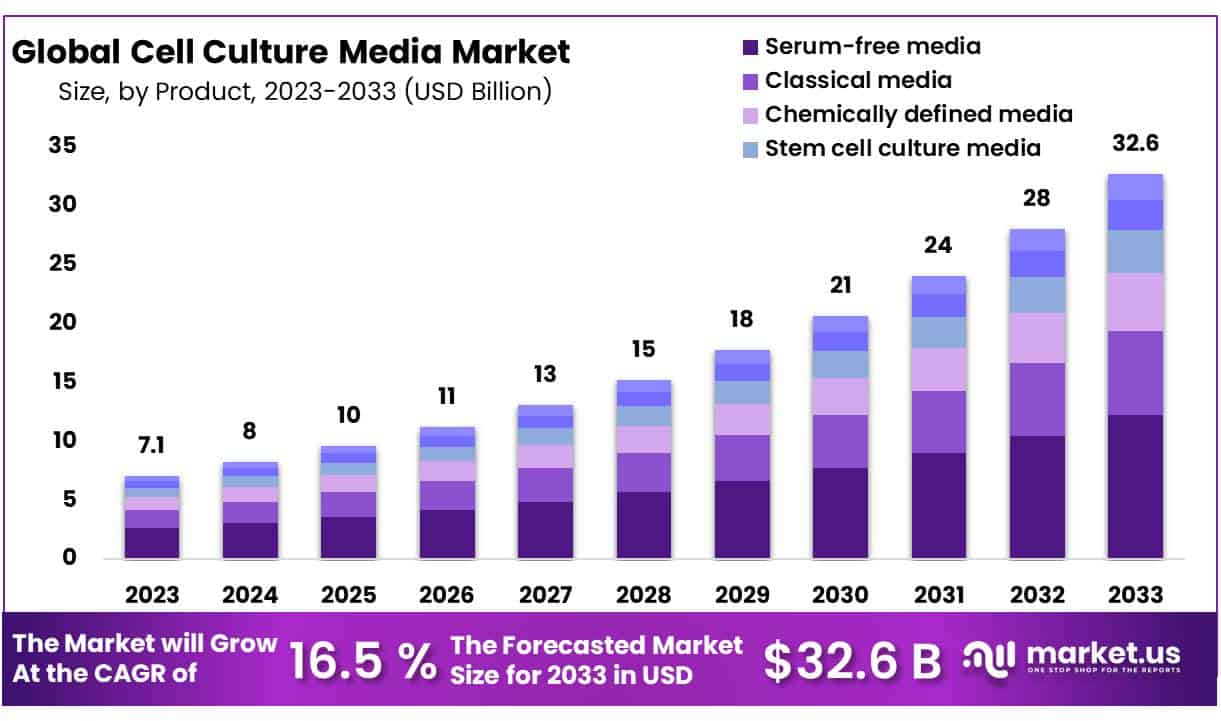
New York, NY – Dec 24, 2025 – The Global Cell Culture Media Market size is expected to be worth around USD 32.6 Billion by 2033 from USD 7.1 Billion in 2023, growing at a CAGR of 16.5% during the forecast period from 2024 to 2033.
Cell culture media are fundamental tools used to support the growth, proliferation, and maintenance of cells under controlled laboratory conditions. These media are designed to closely replicate the natural cellular environment, ensuring optimal physiological function and experimental reliability. The basic formulation of cell culture media is based on a balanced combination of nutrients, growth-supporting components, and environmental stabilizers.
At the core of cell culture media are basal nutrients, including amino acids, carbohydrates, lipids, vitamins, and inorganic salts. Amino acids support protein synthesis and metabolic activity, while carbohydrates primarily glucose serve as the main energy source. Vitamins act as essential cofactors in enzymatic reactions, and inorganic salts help maintain osmotic balance and regulate membrane potential.
Buffering systems, such as sodium bicarbonate or HEPES, are incorporated to stabilize pH levels, which is critical for maintaining cellular homeostasis during incubation. In addition, trace elements including iron, zinc, and selenium are added in small quantities to support enzymatic and cellular functions.
To enhance cell growth and viability, media are often supplemented with serum or serum-free alternatives. Serum provides growth factors, hormones, and attachment proteins, while serum-free formulations offer improved consistency, reduced contamination risk, and better regulatory compliance for advanced research and bioproduction applications.
Antibiotics and antimycotics may be included to minimize microbial contamination, particularly in routine laboratory workflows. Overall, the formulation of cell culture media is guided by the specific requirements of different cell types, ensuring reproducibility, scalability, and performance across research, diagnostics, and biopharmaceutical manufacturing environments.
Key Takeaways
- Market Size: The global cell culture media market is projected to reach approximately USD 32.6 billion by 2033, rising from USD 7.1 billion in 2023.
- Market Growth: Market expansion is anticipated at a robust compound annual growth rate (CAGR) of 16.5% over the forecast period spanning 2024 to 2033.
- Product Analysis: Serum-free media emerged as the leading product category, accounting for 37.4% of total market revenue in 2023.
- Application Analysis: Biopharmaceutical production was identified as the dominant application segment, holding the largest share of the market in 2023.
- Type Analysis: The liquid media segment maintained a significant market position, capturing 63.4% of the total share in 2023.
- End-Use Analysis: Pharmaceutical and biotechnology companies represented the leading end-use segment, collectively contributing 35.8% of the market share in 2023.
- Regional Analysis: North America remained the leading regional market, securing a substantial 36.4% share of global revenue in 2023.
- Technological Advancements: Ongoing innovations in cell culture media, particularly the development of serum-free and chemically defined formulations, are improving cell performance and productivity, thereby supporting market growth.
- Challenges: Market growth is restrained by factors such as the high cost of media components, formulation complexity, and the requirement for rigorous quality control to ensure consistency and reproducibility.
Regional Analysis
North America emerged as the leading region in the global cell culture media market, accounting for a substantial 36.4% market share in 2023. The region’s strong market position can be largely attributed to the well-established presence of key industry participants, including Thermo Fisher Scientific, Inc., Cytiva, and other prominent life science companies. Continuous investments in research and development, along with the frequent introduction of advanced and innovative cell culture media solutions, have strengthened the competitive landscape and reinforced North America’s leadership in the life sciences sector.
Market players operating in the region are actively pursuing strategic initiatives such as product innovation, partnerships, and acquisitions to sustain growth and enhance technological capabilities. These efforts have played a critical role in expanding biopharmaceutical manufacturing capacity and improving process efficiency across research and commercial applications.
In line with this trend, Cytiva, a leading provider of biomanufacturing and life science solutions, acquired CVEC Pharmaceuticals, a Germany-based company specializing in viral vector manufacturing technologies and high-performance cell line development. This strategic acquisition significantly enhances Cytiva’s expertise in advanced cell line and viral vector technologies, further solidifying its position as a global leader in end-to-end biomanufacturing solutions.
Emerging Trends in Cell Culture Media
- Shift from 2D to 3D Cell Culture Systems: Conventional two-dimensional (2D) cell cultures are increasingly being replaced by three-dimensional (3D) culture models. These advanced systems more closely replicate in vivo tissue architecture and cellular interactions, resulting in improved biological relevance. The adoption of 3D cultures is particularly pronounced in oncology research and preclinical drug evaluation, where accurate disease modeling is critical.
- Growing Adoption of Physiologic Media: There is a notable transition toward physiologic cell culture media designed to closely mimic the biochemical composition of the human body. This approach enhances the translational relevance of experimental outcomes by providing cellular environments that better reflect natural physiological conditions, thereby improving the reliability of laboratory findings.
- Integration of Machine Learning in Media Optimization: Machine learning and advanced data analytics are increasingly applied to optimize cell culture media formulations. By processing complex biological datasets, these technologies support the identification of optimal nutrient combinations, leading to enhanced cell growth performance, improved consistency, and higher product quality.
Key Use Cases of Cell Culture Media
- Vaccine Manufacturing: Cell culture–based production methods are gaining traction in vaccine development as an efficient alternative to traditional egg-based processes. These systems offer greater scalability, flexibility, and speed, making them particularly valuable during pandemic situations where rapid vaccine deployment is essential.
- Drug Discovery and Development: Cell culture media play a central role in pharmaceutical research by enabling the growth of cells used in drug screening and toxicity testing. The increasing use of 3D cell culture models in this segment allows for more accurate prediction of human responses, supporting better decision-making prior to clinical trials.
- Cancer Research Applications: In cancer research, cell culture media are used to maintain and study tumor cells under controlled laboratory conditions. Advances in 3D culture technologies enable the recreation of tumor microenvironments, facilitating targeted drug testing and the evaluation of therapies aimed at specific cancer signaling pathways.
Frequently Asked Questions on Cell Culture Media
- What are the main types of cell culture media?
Cell culture media is commonly classified into classical media, serum-containing media, serum-free media, chemically defined media, and specialty media, each optimized for specific cell types, research objectives, and production requirements. - Why is serum-free media increasingly preferred?
Serum-free media is increasingly adopted due to reduced variability, improved reproducibility, lower contamination risk, and better regulatory compliance, especially in biopharmaceutical manufacturing, vaccine development, and cell-based therapeutic applications. - What factors influence the selection of cell culture media?
The selection of cell culture media depends on cell type, metabolic requirements, growth characteristics, experimental goals, scalability needs, and regulatory standards, ensuring optimal cell viability, productivity, and consistency across research and production workflows. - How does cell culture media impact experimental outcomes?
Cell culture media directly influences cell morphology, growth rate, gene expression, and protein production, making media composition a critical determinant of experimental accuracy, reproducibility, and overall reliability in life science research. - What are the key drivers of the cell culture media market?
Market growth is driven by rising biopharmaceutical production, increasing investments in cell-based research, expanding vaccine development, and growing adoption of cell and gene therapies across clinical and commercial applications. - Which end-use industries dominate the market?
The pharmaceutical and biotechnology sectors dominate the cell culture media market due to extensive use in drug discovery, biologics manufacturing, monoclonal antibody production, and regenerative medicine research. - How is technological advancement shaping the market?
Technological advancements such as chemically defined media, customized formulations, and media optimization platforms are enhancing production efficiency, regulatory compliance, and scalability, thereby strengthening market expansion and competitive differentiation.
Conclusion
cell culture media remain a critical foundation for modern life science research, diagnostics, and biopharmaceutical manufacturing. Their carefully balanced formulations directly influence cell viability, productivity, and experimental reliability. Market growth is being strongly supported by rising biopharmaceutical production, increasing adoption of serum-free and chemically defined media, and advancements in 3D cell culture technologies.
North America continues to lead due to robust R&D infrastructure and strategic industry activities. Despite challenges related to cost and quality control, continuous innovation and technological integration are expected to sustain long-term market expansion and improve research and manufacturing outcomes globally.
Discuss your needs with our analyst
Please share your requirements with more details so our analyst can check if they can solve your problem(s)




