


Table of Contents
Overview
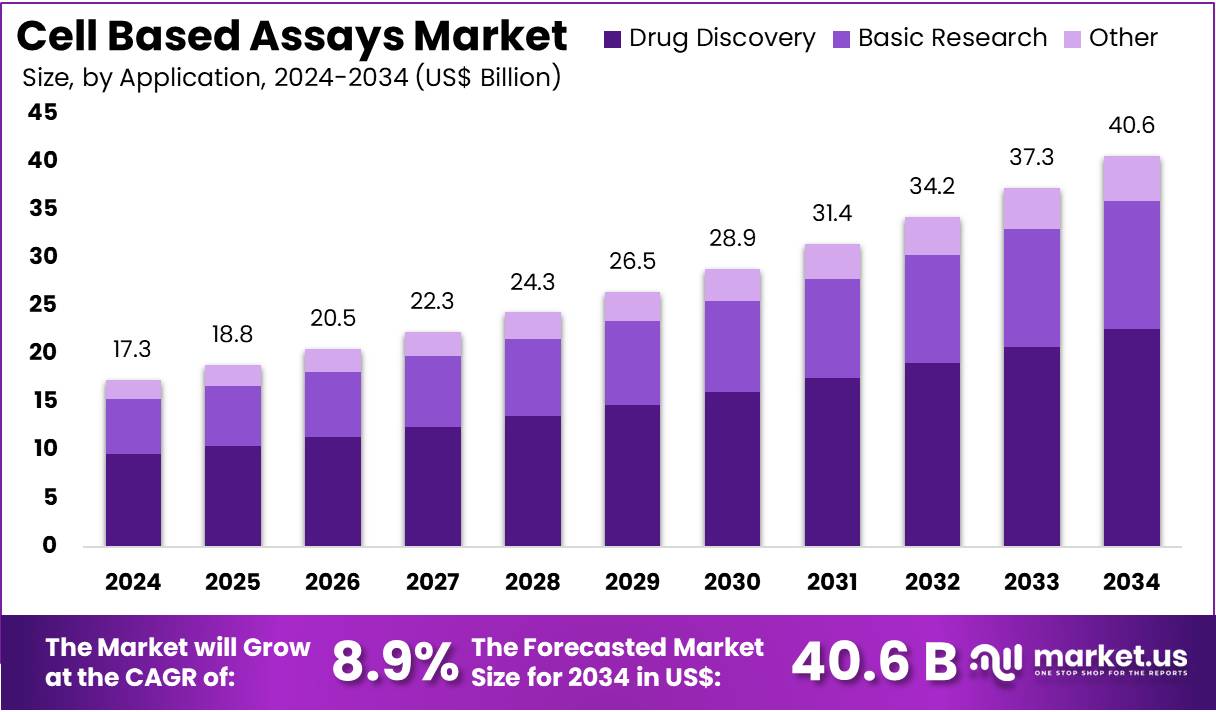
New York, NY – Dec 12, 2025 – The Cell Based Assays Market size is expected to be worth around US$ 40.6 Billion by 2034 from US$ 17.3 Billion in 2024, growing at a CAGR of 8.9% during the forecast period 2025 to 2034.
Cell-based assays are laboratory techniques widely used to evaluate biological activity in living cells. These assays are designed to measure cellular responses such as viability, proliferation, cytotoxicity, gene expression, and signal transduction. By using intact and functional cells, cell-based assays provide physiologically relevant data that closely reflects real biological processes.
The basic formation of a cell-based assay begins with the selection of an appropriate cell line. Cells may be primary cells, immortalized cell lines, or genetically modified cells, depending on the research objective. These cells are cultured under controlled conditions to maintain optimal growth and functionality. Once established, the cells are seeded into assay plates at defined densities to ensure consistency and reproducibility.
Following cell seeding, test compounds, drug candidates, or biological agents are introduced. The interaction between the cells and these substances triggers specific cellular responses. These responses are then measured using detection methods such as fluorescence, luminescence, or colorimetric readouts. Common detection technologies include reporter gene assays, enzyme activity assays, and cell viability assays.
Data generated from cell-based assays is analyzed to determine the biological effect of the tested compounds. Compared to traditional biochemical assays, cell-based assays offer higher predictive value, as they account for complex cellular mechanisms and signaling pathways. As a result, they are increasingly adopted in drug discovery, toxicology studies, and biomedical research.
With growing emphasis on precision medicine and biologically relevant testing models, cell-based assays continue to play a critical role in advancing pharmaceutical development and life science research.
Key Takeaways
- In 2024, the Cell Based Assays market recorded revenues of US$ 17.3 billion and is projected to expand at a CAGR of 8.9%, reaching US$ 40.6 billion by 2033.
- By product type, the market is categorized into reagents, assay kits, probes & labels, microplates, instruments & software, and cell lines, with assay kits emerging as the leading segment, accounting for 46.3% of the market share in 2024.
- Based on application, the market is segmented into basic research, drug discovery, and others, where drug discovery dominated with a substantial share of 55.7%.
- In terms of end use, the market is divided into pharmaceutical & biotechnology companies, contract research organizations (CROs), and academic & research institutes. Among these, pharmaceutical & biotechnology companies*held the largest revenue share at 63.8%.
- North America remained the leading regional market, capturing 42.3% of the global market share in 2024.
Regional Analysis
North America continues to lead the Cell Based Assays market, accounting for the largest revenue share of 42.3%. This dominance can be attributed to the widespread adoption of cell-based assays in drug discovery and development activities. Strong institutional support further reinforces market growth. The National Institutes of Health (NIH) plays a pivotal role by funding research programs that extensively utilize cell-based assay technologies.
In fiscal year 2023, the NIH operated with a budget of US$ 47.7 billion, a significant portion of which was directed toward extramural research focused on disease biology and therapeutic innovation. Such funding supports the development, validation, and application of advanced cell-based assays. In parallel, regulatory support strengthens market demand.
The U.S. Food and Drug Administration (FDA) emphasizes in vitro and cell-based models for assessing drug safety and efficacy, reinforcing their importance in regulatory submissions. Between 2022 and 2024, multiple FDA guidance documents referenced cell-based assays, underscoring their growing regulatory relevance.
The Asia Pacific region is projected to register the fastest compound annual growth rate during the forecast period. This growth is driven by increasing investments in pharmaceutical and biotechnology research, particularly in China and India. Government-led initiatives to strengthen biopharmaceutical capabilities, along with rising R&D spending reported at 2.54% of GDP in China in 2022 are expected to accelerate adoption. Additionally, the increasing burden of chronic diseases across the region is anticipated to further stimulate demand for cell-based assay technologies in drug development and translational research.
Emerging Trends
- Integration of Artificial Intelligence (AI): Artificial intelligence is increasingly being integrated into cell-based assays to improve data processing, pattern recognition, and result interpretation. The use of AI-driven immune system models, such as those developed through collaborations between pharmaceutical companies and AI firms, has improved the efficiency and accuracy of oncology drug development.
- Adoption of Three-Dimensional (3D) Cell Cultures: The transition from conventional two-dimensional cell cultures to three-dimensional models is gaining momentum. Three-dimensional cell cultures more closely replicate the in vivo cellular environment, thereby improving the physiological relevance and predictive value of assay outcomes.
- Expansion of High-Throughput Screening (HTS): The demand for high-throughput screening technologies continues to rise, particularly in drug discovery. Cell-based assays enable the rapid evaluation of large compound libraries, supporting faster identification of biologically active and viable drug candidates.
- Growing Emphasis on Personalized Medicine: Cell-based assays are increasingly designed to reflect patient-specific biological profiles. This trend supports the development of personalized therapeutic solutions by enabling the assessment of individual cellular responses to targeted treatments.
Key Use Cases
- Drug Discovery and Development: Cell-based assays play a critical role in the drug development pipeline by assessing the efficacy, mechanism of action, and safety of novel drug candidates at the cellular level.
- Toxicity and Safety Assessment: These assays are widely used to evaluate potential cytotoxic effects of chemical compounds at early stages of development, helping to minimize late-stage failures and reduce dependence on animal testing models.
- Cancer Research: In oncology research, cell-based assays are employed to analyze tumor cell proliferation, migration, and survival, as well as to evaluate the therapeutic potential of anticancer agents.
- Immunology and Immunotherapy Research: Cell-based assays support immunological studies by enabling the investigation of immune cell behavior and interactions. They are essential tools in the development and validation of immunotherapies.
- Personalized Therapeutic Applications: By utilizing patient-derived cells, cell-based assays allow for the prediction of individual treatment responses, facilitating customized therapy selection and improved clinical outcomes.
Frequently Asked Questions on Cell Based Assays
- What are cell-based assays?
Cell-based assays are experimental techniques that use living cells to measure biological activity, drug response, or toxicity. They provide physiologically relevant data by capturing complex cellular processes under controlled laboratory conditions. - Why are cell-based assays important in drug discovery?
Cell-based assays are important because they enable early evaluation of drug efficacy and safety. These assays help identify biologically active compounds, reduce late-stage failures, and improve the predictive accuracy of preclinical research outcomes. - What types of cell-based assays are commonly used?
Common cell-based assays include reporter gene assays, cell viability assays, apoptosis assays, and signaling pathway assays. Each type is designed to measure specific cellular responses such as gene expression, metabolic activity, or programmed cell death. - How do cell-based assays differ from biochemical assays?
Cell-based assays use living cells and reflect complex biological interactions, whereas biochemical assays rely on isolated proteins or enzymes. As a result, cell-based assays provide higher physiological relevance but require more controlled experimental conditions. - What is the cell-based assays market?
The cell-based assays market comprises products and services used to analyze cellular responses in research and drug development. It includes reagents, instruments, consumables, and software adopted by pharmaceutical, biotechnology, and academic institutions. - Which end users dominate the cell-based assays market?
Pharmaceutical and biotechnology companies dominate the market due to extensive use in drug screening and toxicity testing. Academic and research institutes also contribute significantly, supported by growing investments in life science research globally. - How does technology advancement impact the market?
Technological advancements such as 3D cell cultures, automated screening systems, and high-content analysis have improved assay accuracy and efficiency. These innovations enhance data quality, reduce testing timelines, and increase adoption across research settings. - What is the future outlook for the cell-based assays market?
The market is expected to grow steadily, supported by personalized medicine trends and increased biologics development. Continuous innovation and regulatory emphasis on reducing animal testing are anticipated to further strengthen long-term market prospects.
Conclusion
The cell-based assays market represents a critical pillar of modern biomedical and pharmaceutical research, offering high physiological relevance and improved predictive accuracy compared to traditional methods. Strong adoption in drug discovery, toxicity testing, and personalized medicine continues to drive market expansion.
Growth is further supported by technological advancements such as 3D cell cultures, high-throughput screening, and AI-enabled data analysis. With sustained funding, regulatory encouragement, and rising demand for biologically relevant testing models, the market is positioned for robust long-term growth, particularly across pharmaceutical and biotechnology industries and rapidly developing regions such as Asia Pacific.
Discuss your needs with our analyst
Please share your requirements with more details so our analyst can check if they can solve your problem(s)




