


Table of Contents
Overview
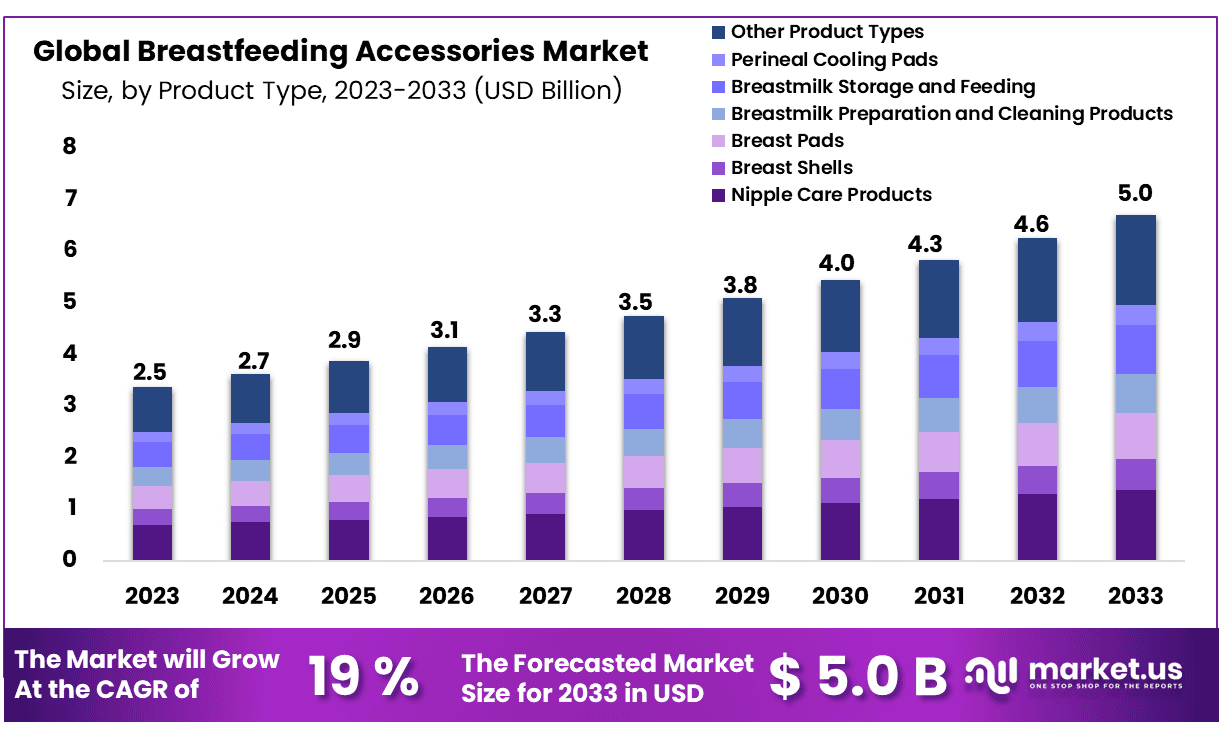
New York, NY – Jan 23, 2026 – The Global Breastfeeding Accessories Market size is expected to be worth around USD 5.0 Billion by 2033 from USD 2.5 Billion in 2023, growing at a CAGR of 19% during the forecast period from 2024 to 2033.
The breastfeeding accessories market is witnessing steady growth, supported by rising awareness of maternal and infant health and increasing preference for breastfeeding among new mothers. Breastfeeding accessories include products such as breast pumps, nursing pads, breast shells, nipple creams, milk storage bags, and feeding bottles. These products are designed to support lactating mothers by improving comfort, hygiene, and convenience during the breastfeeding period.
The growth of the market can be attributed to increasing female workforce participation, which has created strong demand for breast pumps and milk storage solutions. In addition, supportive government initiatives and recommendations from healthcare professionals have encouraged breastfeeding as the preferred method of infant nutrition, further driving product adoption. Technological advancements in electric and wearable breast pumps have also enhanced ease of use and efficiency, supporting market expansion.
Hospitals, maternity clinics, and retail pharmacies remain key distribution channels, while online platforms are gaining traction due to wider product availability and ease of comparison. The demand for reusable and eco-friendly breastfeeding accessories is also increasing, reflecting a broader shift toward sustainable maternal care products.
Regionally, developed markets continue to show stable demand due to high awareness levels and established healthcare infrastructure. Meanwhile, emerging economies are experiencing faster growth, supported by improving healthcare access, rising disposable income, and expanding urban populations.
Overall, the breastfeeding accessories market is expected to maintain positive momentum, driven by product innovation, supportive healthcare policies, and growing focus on maternal well-being. Manufacturers are increasingly investing in research and development to introduce safer, more comfortable, and user-friendly solutions, positioning the market for sustained long-term growth.
Key Takeaways
- Market Size: The breastfeeding accessories market is projected to reach approximately USD 5.0 billion by 2033, increasing from USD 2.5 billion recorded in 2023.
- Market Growth: The market is anticipated to expand at a compound annual growth rate (CAGR) of 19% over the forecast period spanning 2024 to 2033.
- Product Analysis: The breast milk storage and breastfeeding products segment accounted for a leading market share of 19.2% in 2023, reflecting strong consumer demand.
- Distribution Channel Analysis: Offline distribution channels dominated the global nursing accessories market in 2023, capturing the largest share due to strong retail and hospital-based sales.
- Regional Analysis: Asia Pacific emerged as the leading regional market, contributing over 41.5% of total revenue and generating approximately USD 1.04 billion in 2023.
- Growing Awareness and Preference for Breastfeeding: Rising awareness regarding the nutritional and health benefits of breastfeeding has significantly increased demand for breastfeeding accessories, with a growing number of mothers choosing breastfeeding.
- Technological Advancements: Continuous innovation, including the introduction of smart breast pumps and mobile application integration, has improved product convenience and efficiency, supporting market growth among technologically engaged consumers.
Regional Analysis
Asia Pacific emerged as the dominant regional market, accounting for more than 41.5% of global revenue and generating approximately USD 1.04 billion in 2023. This strong performance can be attributed to a large target population and the expansion of awareness campaigns promoting breastfeeding and maternal health. Market growth is further supported by rising birth rates across several countries in the region.
According to World Bank data, China’s fertility rate increased to 1.70 births per woman in 2019, up from 1.60 in 2000. In addition, data from the Australian Bureau of Statistics reported 294,369 registered births in Australia in 2020. As birth rates continue to rise across Asia Pacific, demand for breastfeeding accessories is expected to grow steadily over the forecast period.
The Middle East and Africa region is projected to register the highest compound annual growth rate (CAGR) of 8.3% during the forecast period. This growth is driven by changing lifestyles and increasing prevalence of health conditions that encourage greater focus on infant nutrition. In South Africa, historically low breastfeeding rates have been linked to a high number of HIV-positive mothers and concerns regarding disease transmission.
However, regulations introduced by the Department of Health in 2017 mandate breastfeeding for all mothers, which is expected to significantly increase demand for breastfeeding accessories. Furthermore, World Bank data indicates that Saudi Arabia recorded a fertility rate of 2.28 births per woman in 2019, supporting market expansion across the Middle East and Africa.
Overall, Asia Pacific offers the most attractive growth opportunities due to population growth, increasing participation of women in the workforce, and supportive government policies.
Emerging Trends
- Rising Participation of Women in the Workforce: The growing number of working mothers has increased the need for convenient and time-efficient breastfeeding solutions. Products such as breast pumps and milk storage bags allow mothers to maintain breastfeeding while managing professional responsibilities.
- Increasing Awareness of Breastfeeding Benefits: Widespread educational initiatives emphasizing the nutritional and health benefits of breastfeeding for infants and mothers have supported higher breastfeeding adoption, thereby accelerating demand for related accessories.
- Advancements in Product Design and Technology: Continuous innovation focused on comfort, efficiency, hygiene, and portability has improved product usability, making breastfeeding accessories more attractive to modern mothers.
- Supportive Government Initiatives: Favorable government policies, including extended maternity leave, workplace lactation facilities, and breastfeeding promotion programs, have positively influenced the adoption of breastfeeding accessories.
Use Cases
- Metastatic Renal Cell Carcinoma (mRCC): Sunitinib is widely used as a frontline therapy for mRCC. Clinical evidence indicates a significant improvement in progression-free survival among treated patients.
- Gastrointestinal Stromal Tumors (GIST): In cases where patients exhibit resistance to imatinib, sunitinib is employed as an alternative therapy, with studies demonstrating prolonged time to tumor progression.
- Pancreatic Neuroendocrine Tumors (pNET): Sunitinib is approved for the treatment of advanced pNET, where it has been shown to improve progression-free survival in clinical trials.
- Adjuvant Treatment in High-Risk Renal Cell Carcinoma: Following surgical intervention, sunitinib is administered to patients with high-risk renal cell carcinoma to reduce recurrence risk, with clinical studies reporting extended disease-free survival.
Frequently Asked Questions on Breastfeeding Accessories
- Why are breastfeeding accessories important for mothers?
Breastfeeding accessories are important as they improve feeding efficiency, enhance maternal comfort, and support milk management. These products help address challenges such as nipple pain, milk leakage, and time constraints for working mothers. - Which breastfeeding accessories are most commonly used?
The most commonly used breastfeeding accessories include manual and electric breast pumps, disposable and reusable nursing pads, milk storage containers, nipple creams, and breastfeeding pillows, driven by their daily necessity and convenience for lactating mothers. - Are breastfeeding accessories safe for newborns?
Breastfeeding accessories are generally safe for newborns when manufactured using medical-grade, BPA-free, and food-safe materials. Regulatory standards and quality certifications ensure product safety, hygiene, and suitability for infant feeding requirements. - How should breastfeeding accessories be cleaned and maintained?
Breastfeeding accessories should be cleaned using warm water and mild detergents after each use. Sterilization is recommended for pumps and feeding components to prevent bacterial growth and maintain hygiene standards. - What factors are driving the breastfeeding accessories market?
The breastfeeding accessories market is driven by rising breastfeeding awareness, increasing female workforce participation, supportive government initiatives, and growing demand for convenient infant feeding solutions across both developed and emerging economies. - Which product segment dominates the breastfeeding accessories market?
Breast pumps dominate the breastfeeding accessories market due to high adoption among working mothers, technological advancements in electric pumps, and increasing preference for efficient milk expression and storage solutions. - What role does e-commerce play in market growth?
E-commerce platforms play a significant role by improving product accessibility, offering wider brand choices, and enabling discreet purchasing. Online channels also support market growth through competitive pricing and increasing digital penetration.
Conclusion
The breastfeeding accessories market is positioned for sustained growth, driven by rising awareness of maternal and infant health, increasing workforce participation among women, and supportive healthcare policies. Continuous innovation in breast pumps and milk management solutions has enhanced convenience, comfort, and efficiency for modern mothers.
Strong demand across hospitals, retail outlets, and digital platforms has supported widespread adoption, while the shift toward eco-friendly products reflects evolving consumer preferences. Asia Pacific remains the most attractive region due to population growth and policy support, while emerging markets offer high growth potential, ensuring positive long-term market momentum.
Discuss your needs with our analyst
Please share your requirements with more details so our analyst can check if they can solve your problem(s)




