


Table of Contents
Overview
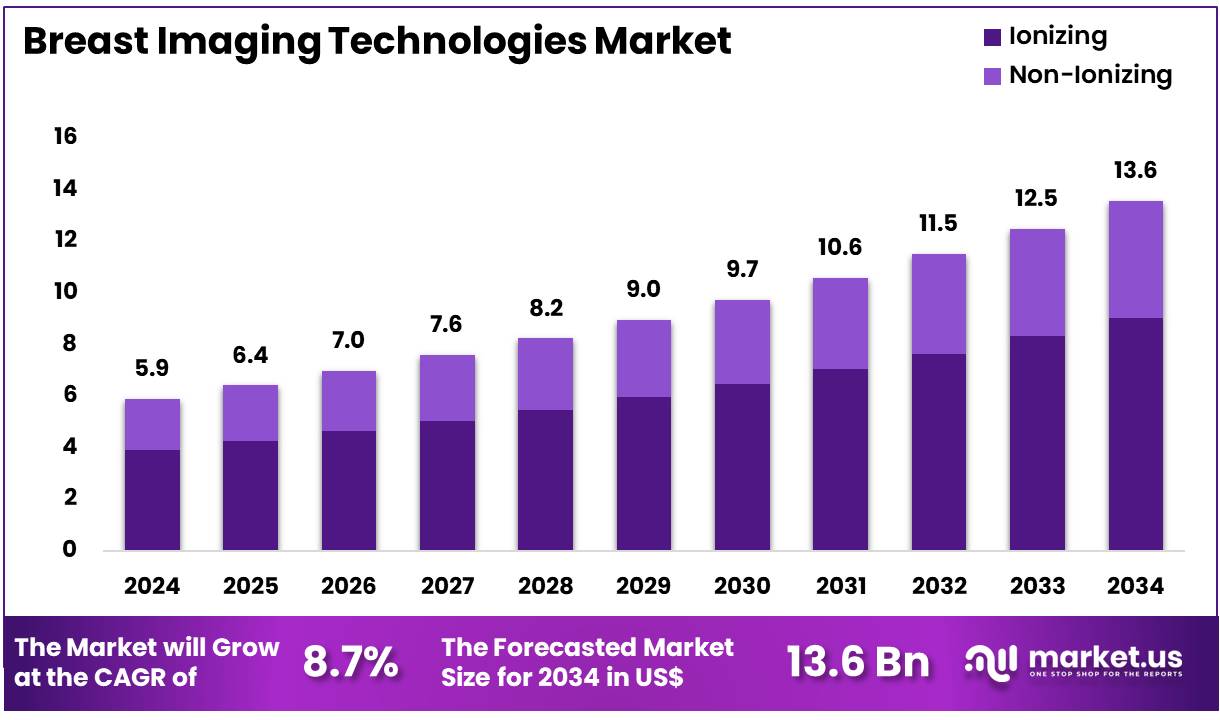
New York, NY – Dec 01, 2025 – Global Breast Imaging Technologies Market size is expected to be worth around US$ 13.6 billion by 2034 from US$ 5.9 billion in 2024, growing at a CAGR of 8.7% during the forecast period 2025 to 2034. In 2024, North America led the market, achieving over 42.1% share with a revenue of US$ 2.5 Billion.
Significant progress has been observed in breast imaging technologies, as continuous innovations have strengthened early detection and diagnostic precision in both screening and clinical settings. The adoption of advanced modalities has been driven by rising breast cancer incidence and the growing emphasis on minimally invasive diagnostic pathways. Technologies such as digital mammography, breast tomosynthesis, ultrasound, MRI, and molecular breast imaging have been integrated to deliver improved sensitivity and specificity across diverse patient populations.
Digital mammography remains the standard modality, supported by its wide accessibility and proven efficiency in population-level screening. The introduction of 3D breast tomosynthesis has further enhanced lesion visibility by reducing tissue overlap, which has contributed to a decline in recall rates. Ultrasound has been utilized as an adjunct technique, particularly for women with dense breast tissue, while MRI has been applied for high-risk assessment due to its superior contrast resolution. Molecular breast imaging has gained attention as a functional modality capable of detecting metabolic activity that may not be visible through anatomical imaging alone.
The overall market adoption has been supported by technological refinement, improved workflow integration, and increasing awareness regarding routine breast screening. Growth has also been encouraged by investments in research, the development of AI-enabled image analysis, and the expansion of patient-centric screening programs. As healthcare systems continue to prioritize early diagnosis, breast imaging technologies are expected to play a central role in achieving improved clinical outcomes and reducing mortality associated with breast cancer.
Key Takeaways
- In 2024, breast imaging technologies generated US$ 5.9 billion in revenue, supported by a CAGR of 8.7%, and the market is projected to reach US$ 13.6 billion by 2033.
- The market is categorized into ionizing and non-ionizing technologies, with ionizing modalities accounting for 66.5% of the total share in 2024.
- Based on end-use, the market is segmented into hospitals, diagnostic imaging centers, and breast care centers, with hospitals representing 47.1% of the market.
- North America dominated the global landscape by capturing 42.1% of the market share in 2024.
Regional Analysis
North America is leading the breast imaging technologies market
North America accounted for the largest revenue share of 42.1%, supported by the expansion of screening mammography programs across the region. The adoption of advanced technologies, particularly the integration of artificial intelligence (AI) for workflow optimization and improved diagnostic accuracy, has strengthened market growth. AI-assisted systems have enhanced radiologists’ ability to detect malignancies through the analysis of 3D screening data.
Guidelines issued by key health authorities have further encouraged adoption. The updated 2024 USPSTF recommendations, which advise women to begin biennial screening at age 40, have contributed to increased demand for breast imaging solutions. The American Cancer Society continues to highlight the high number of new cases diagnosed annually, reinforcing the importance of regular screening and advanced diagnostic modalities.
Asia Pacific is expected to witness the highest CAGR during the forecast period
Asia Pacific is projected to grow at the fastest pace due to rising breast cancer incidence, expanding healthcare infrastructure, and increasing awareness regarding early detection. According to GLOBOCAN 2022, the region recorded approximately 985.4 thousand new breast cancer cases, underscoring the need for improved screening and diagnostic capabilities.
Government-led initiatives promoting early detection, aligned with guidance from the World Health Organization’s Global Breast Cancer Initiative, are strengthening national screening programs. The adoption of advanced modalities such as digital breast tomosynthesis is increasing as healthcare access improves.
Regional collaborations, including the Asia-Pacific Women’s Cancer Coalition, are further promoting awareness and supporting broader access to screening technologies. These factors collectively position Asia Pacific as a high-growth market for breast imaging technologies over the forecast period.
Emerging Trends
- Three-Dimensional X-Ray Imaging: Three-dimensional X-ray imaging is gaining adoption as Digital Breast Tomosynthesis (DBT) and Dedicated Breast CT (BCT) are increasingly implemented to reduce tissue overlap challenges seen in conventional mammograms. DBT generates sectional breast images, while BCT provides full 3D visualization without compression, enabling improved detection of small lesions in dense tissue.
- Photon-Counting Detectors: Photon-counting detectors are emerging as a significant advancement because they register individual photons, resulting in superior image contrast and reduced radiation exposure. By discriminating photon energy levels, these systems improve tumor visibility and can reduce radiation dose by approximately 10 % while retaining image quality.
- Functional Optical Imaging: Functional optical imaging technologies, including diffuse optical imaging and near-infrared spectroscopy, are under development to measure physiological markers such as blood flow and oxygenation. These approaches identify elevated vascular activity linked to tumor growth and offer functional insights that complement structural imaging methods.
- Ultrasound Elastography: Ultrasound elastography is progressing toward broader clinical use due to its ability to map tissue stiffness by analyzing sound-wave propagation patterns. Because malignant lesions typically exhibit higher stiffness, elastography supports differentiation between benign and malignant masses, especially when mammographic findings remain inconclusive.
- AI-Assisted Detection in 3D Imaging: AI-enabled detection tools are expanding within 3D imaging workflows, supported by FDA-cleared CAD software for digital breast tomosynthesis. A notable approval in November 2020 allows automated analysis of tomosynthesis views, highlighting suspicious regions and assigning confidence scores to enhance radiologist efficiency and diagnostic accuracy.
Use Cases
- Routine Population Screening: Routine screening remains a primary application, with 76.5 % of U.S. women aged 50–74 reporting mammography within two years in 2022. Integration of 3D tomosynthesis into large-scale screening programs is intended to improve early detection performance and lower recall rates.
- Supplemental Screening in Dense Breasts: Supplemental screening technologies are increasingly applied for women with dense breast tissue. Evidence from 41 studies involving 228,508 women indicates that adding tomosynthesis or handheld ultrasound to routine mammography significantly raises cancer detection rates in this population.
- Diagnostic Mammography in Clinical Practice: Diagnostic mammography continues to be widely used in clinical practice, with 27.3 million physician office visits in 2019 involving ordered or performed mammograms. Advanced techniques such as contrast-enhanced mammography are being adopted to clarify uncertain findings and support more accurate diagnostic decisions.
- Government-Funded Screening Programs: Government-supported programs remain essential for improving access among underserved groups. Under the NBCCEDP, an estimated 5.3 % of U.S. women aged 40–64 qualified for free screening in 2016–2017, with 15 % receiving services, demonstrating the importance of targeted outreach in narrowing care gaps.
- Guideline-Driven MRI Use for High-Risk Women: Clinical guidelines encourage risk-stratified breast imaging pathways. The U.S. Preventive Services Task Force advises biennial mammography for women aged 40–74 at average risk, with supplemental MRI recommended for higher-risk individuals, supporting balanced detection strategies while reducing unnecessary interventions.
Frequently Asked Questions on Breast imaging technologies
- What are the main types of breast imaging technologies?
The primary breast imaging technologies include mammography, ultrasound, MRI, nuclear imaging, and emerging modalities such as digital breast tomosynthesis and optical imaging. These systems provide complementary capabilities that enhance diagnostic accuracy across varying tissue densities and patient profiles. - Why are breast imaging technologies important?
These technologies are essential because early and accurate detection of breast cancer significantly improves survival rates. Their application enables clinicians to identify lesions, classify abnormalities, and determine effective treatment strategies, supporting population-wide screening initiatives and personalized medical decision-making. - How do digital breast tomosynthesis systems work?
Digital breast tomosynthesis creates three-dimensional images of breast tissue by capturing multiple X-ray projections. This technique reduces tissue overlap, enhances visualization of small lesions, and improves diagnostic confidence, particularly among women with dense breast tissue requiring more advanced imaging evaluation. - Are breast imaging technologies safe?
Breast imaging technologies are generally considered safe, with radiation-based modalities operating within regulated exposure limits. Continuous equipment advancements ensure minimized patient risk, while ultrasound and MRI provide radiation-free alternatives suitable for specific clinical scenarios and sensitive patient groups. - What advancements are improving breast imaging accuracy?
Artificial intelligence, high-resolution detectors, advanced 3D visualization, and multimodal imaging integration are enhancing diagnostic precision. These innovations strengthen early detection capabilities, reduce false assessments, and enable more efficient clinical workflows across diagnostic and screening environments worldwide. - Which technologies are witnessing the highest demand?
Digital mammography, digital breast tomosynthesis, and MRI imaging systems are witnessing the highest demand. Their improved sensitivity, enhanced workflow efficiency, and suitability for various breast densities contribute to their rising adoption across diagnostic and screening facilities. - Which regions dominate the breast imaging technologies market?
North America leads the market due to established healthcare systems, high awareness, and rapid technological adoption. Europe follows closely, while Asia-Pacific demonstrates the fastest growth driven by expanding screening programs and increasing healthcare investment in emerging economies. - How is AI impacting the breast imaging technologies market?
AI is reshaping the market by enhancing image interpretation, reducing diagnostic errors, and optimizing workflow efficiency. Regulatory approvals and integration into imaging systems strengthen provider confidence, increasing adoption of AI-enabled breast imaging solutions across global healthcare facilities.
Conclusion
The global breast imaging technologies market is positioned for steady expansion as advancements in digital modalities, AI-assisted diagnostics, and functional imaging continue to enhance early detection capabilities. Growth has been supported by rising breast cancer incidence, strengthened screening guidelines, and broader adoption of 3D imaging techniques.
North America maintains leadership, while Asia Pacific is set to experience the fastest acceleration due to expanding healthcare access and government-led screening initiatives. Continued innovation in photon-counting systems, elastography, and multimodal integration is expected to improve diagnostic precision, supporting better clinical outcomes and sustained market growth through the forecast period.
Discuss your needs with our analyst
Please share your requirements with more details so our analyst can check if they can solve your problem(s)




