


Table of Contents
Overview
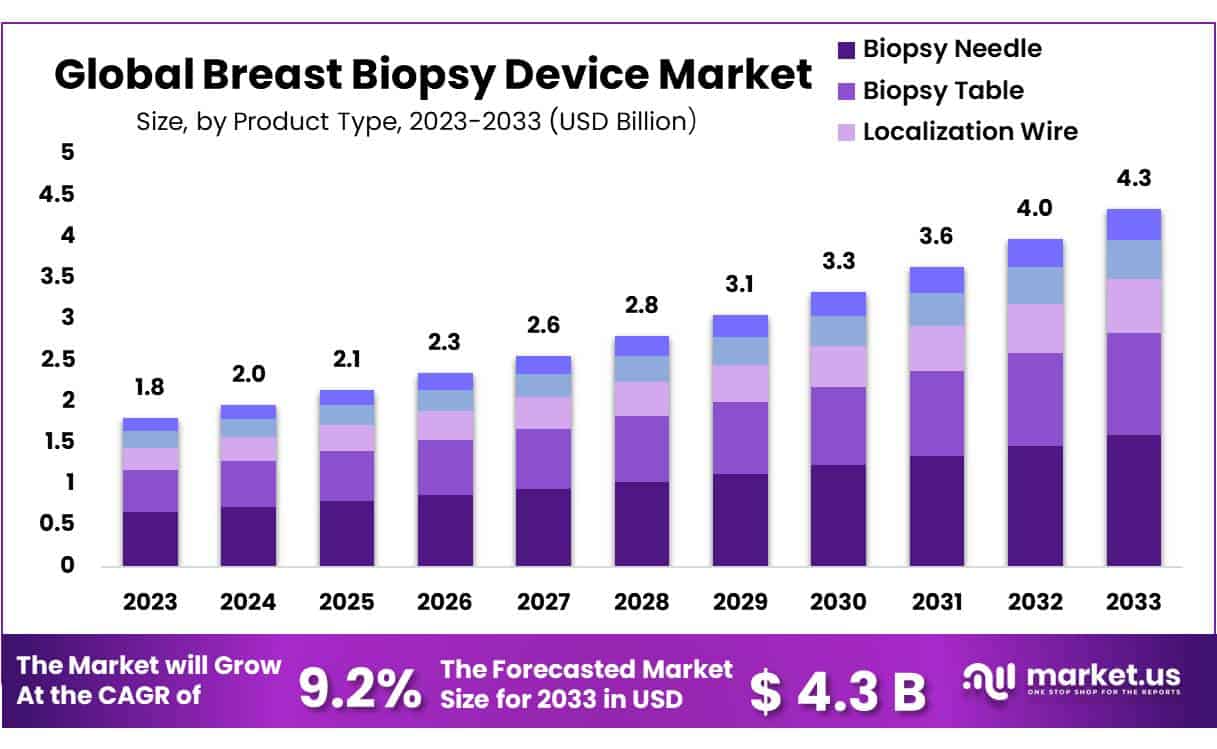
New York, NY – Jan 28, 2026 – The Global Breast Biopsy Device Market size is expected to be worth around USD 4.3 Billion by 2033 from USD 1.8 Billion in 2023, growing at a CAGR of 9.2% during the forecast period from 2024 to 2033.
The breast biopsy device is a specialized medical instrument designed to obtain tissue samples from suspicious breast lesions for diagnostic evaluation. These devices play a critical role in the early detection and accurate diagnosis of breast cancer, supporting clinicians in making informed treatment decisions.
Breast biopsy devices are generally composed of a handheld probe, a sampling needle or vacuum-assisted mechanism, and an imaging guidance interface. The probe is engineered to ensure precision and stability during the procedure, while the needle system is designed to extract adequate tissue samples with minimal trauma. In vacuum-assisted systems, continuous suction allows multiple tissue samples to be collected through a single insertion, improving diagnostic yield and procedural efficiency.
These devices are commonly used in conjunction with imaging modalities such as ultrasound, mammography, or magnetic resonance imaging (MRI). Image guidance enhances targeting accuracy, particularly for non-palpable or small lesions. The integration of advanced imaging and biopsy technology has contributed to reduced procedure times, lower complication rates, and improved patient comfort.
The adoption of minimally invasive breast biopsy devices has increased significantly in clinical settings, as they offer advantages over traditional surgical biopsies. These benefits include reduced scarring, faster recovery, and lower overall healthcare costs. Technological advancements have also focused on ergonomic design, disposable components for infection control, and improved sample integrity.
Overall, breast biopsy devices are an essential component of modern breast care pathways. Their continued development is expected to support early diagnosis initiatives, improve clinical outcomes, and align with the growing emphasis on patient-centric, minimally invasive diagnostic solutions in oncology care.
Key Takeaways
- Market Size: The breast biopsy device market is projected to reach approximately USD 4.3 billion by 2033, increasing from an estimated USD 1.8 billion in 2023.
- Market Growth: Market expansion is expected to occur at a compound annual growth rate (CAGR) of 9.2% over the forecast period spanning 2024 to 2033.
- Product Type Analysis: Biopsy needles represent the leading product category, accounting for a significant 36.9% share of the overall market.
- Guidance Technology Analysis: Ultrasound-based guidance technology remains the most widely adopted approach, capturing a dominant 41% market share.
- End-Use Analysis: Hospitals and clinics constitute the primary end-use segment, collectively holding an impressive 65.7% share of total market demand.
- Regional Analysis: North America leads the global market with a 33.4% share, generating approximately USD 0.6 billion in revenue.
Regional Analysis
The report provides comprehensive coverage of North America, Europe, Asia Pacific, South America, and the Middle East & Africa (MEA). Among these regions, the Asia Pacific breast biopsy device market is expected to register the fastest growth rate during the forecast period. This accelerated growth is primarily driven by the increasing incidence of breast cancer among women, along with improving access to diagnostic services and expanding healthcare infrastructure across emerging economies.
North America accounted for the largest share of global market revenue in 2023, maintaining its position as the leading regional market. The region held a 33.4% market share, representing approximately USD 0.6 billion in revenue. Market dominance in North America can be largely attributed to high awareness levels supported by widespread cancer screening programs, early adoption of advanced diagnostic technologies, and the presence of favorable government initiatives aimed at strengthening breast cancer detection and management.
Emerging Trends
- Integration of Artificial Intelligence (AI): Artificial intelligence is increasingly being integrated into breast cancer diagnostics to improve diagnostic accuracy and operational efficiency. Large-scale initiatives, such as national trials in England, are evaluating AI systems on hundreds of thousands of mammograms to benchmark their performance against radiologists. The adoption of AI is expected to reduce diagnostic workloads, enhance consistency in image interpretation, and shorten diagnosis timelines.
- Advancements in Imaging Technologies: Technological progress in breast imaging, including digital breast tomosynthesis (3D mammography) and contrast-enhanced mammography (CEM), is significantly improving lesion visualization. These advanced imaging modalities enable more precise biopsy targeting, improve lesion characterization, and contribute to lower false-negative rates, thereby supporting more accurate clinical decision-making.
- Shift Toward Minimally Invasive Procedures: There is a growing preference for minimally invasive breast biopsy techniques, such as vacuum-assisted biopsy and ultrasound-guided core needle biopsy. These approaches require smaller incisions, reduce procedural trauma, and are associated with shorter recovery times and improved patient comfort, aligning with broader trends toward outpatient and patient-centric care.
- Emergence of Liquid Biopsies: Liquid biopsy technologies are being increasingly adopted for the detection and monitoring of breast cancer–related genetic mutations. By identifying circulating tumor DNA through blood samples, liquid biopsies reduce reliance on invasive tissue sampling and support personalized treatment strategies, representing a notable advancement in precision oncology.
Use Cases
- Stereotactic Breast Biopsy: Stereotactic breast biopsy is a minimally invasive diagnostic procedure that combines mammographic imaging with computer-assisted guidance to sample suspicious, non-palpable breast lesions. The procedure is typically completed within one hour, is performed under local anesthesia, and is associated with minimal patient discomfort.
- Vacuum-Assisted Biopsy (VAB): Vacuum-assisted biopsy utilizes a vacuum-powered device to obtain larger tissue samples through a single, small incision. This technique improves diagnostic yield compared to conventional needle biopsies and offers benefits such as reduced scarring, fewer repeat procedures, and faster post-procedure recovery.
- Ultrasound-Guided Core Needle Biopsy (US-CNB): Ultrasound-guided core needle biopsy employs real-time ultrasound imaging to accurately localize and sample breast abnormalities, particularly those not visible on mammography. The procedure is widely used due to its precision, lower cost, reduced patient discomfort, and minimal recovery requirements.
- Liquid Biopsies for Mutation Detection: Liquid biopsy applications enable the identification of actionable genetic mutations, such as ESR1, through non-invasive blood testing. This approach supports the selection of targeted therapies, including oral treatments designed to address specific mutations, and is expected to benefit a growing number of patients annually by enabling more personalized and adaptive treatment pathways.
Frequently Asked Questions on Breast Biopsy Device
- How does a breast biopsy device work?
The device uses a needle-based or vacuum-assisted mechanism, guided by imaging technologies, to precisely extract tissue from the targeted breast area. This minimally invasive approach reduces patient discomfort while ensuring high diagnostic accuracy. - What are the main types of breast biopsy devices available?
Breast biopsy devices primarily include biopsy needles, vacuum-assisted biopsy systems, and wire localization devices. Among these, biopsy needles are most widely used due to their simplicity, effectiveness, and compatibility with multiple imaging guidance techniques. - Which imaging technologies are commonly used with breast biopsy devices?
Breast biopsy devices are commonly used with ultrasound, mammography, and magnetic resonance imaging guidance. Ultrasound guidance is most preferred due to its real-time visualization, cost-effectiveness, and widespread availability in clinical settings. - What factors are driving growth in the breast biopsy device market?
Market growth is driven by rising breast cancer prevalence, increasing emphasis on early diagnosis, technological advancements in minimally invasive procedures, and expanding screening programs supported by healthcare institutions and government initiatives. - Which end-use segment dominates the breast biopsy device market?
Hospitals and clinics represent the dominant end-use segment, as these facilities manage a high volume of diagnostic procedures and are equipped with advanced imaging systems and trained professionals to perform breast biopsy interventions efficiently. - Which region leads the global breast biopsy device market?
North America leads the global market due to high awareness of breast cancer screening, early adoption of advanced diagnostic technologies, strong healthcare infrastructure, and supportive reimbursement and government-led cancer prevention programs. - What is the future outlook for the breast biopsy device market?
The market outlook remains positive, supported by continuous innovation, growing adoption of minimally invasive diagnostics, and rapid growth in Asia Pacific driven by improving healthcare access and rising breast cancer incidence among women.
Conclusion
The breast biopsy device market is positioned for sustained growth, supported by rising breast cancer incidence, increasing emphasis on early diagnosis, and continuous technological advancements. The transition toward minimally invasive procedures, coupled with improved imaging guidance and emerging liquid biopsy solutions, is enhancing diagnostic accuracy and patient outcomes.
Strong adoption across hospitals and clinics, particularly in North America, reinforces market stability, while rapid healthcare infrastructure development in Asia Pacific is expected to drive future expansion. Overall, continued innovation, supportive screening initiatives, and growing awareness are expected to strengthen the role of breast biopsy devices within modern oncology care pathways.
Discuss your needs with our analyst
Please share your requirements with more details so our analyst can check if they can solve your problem(s)




