


Table of Contents
Overview
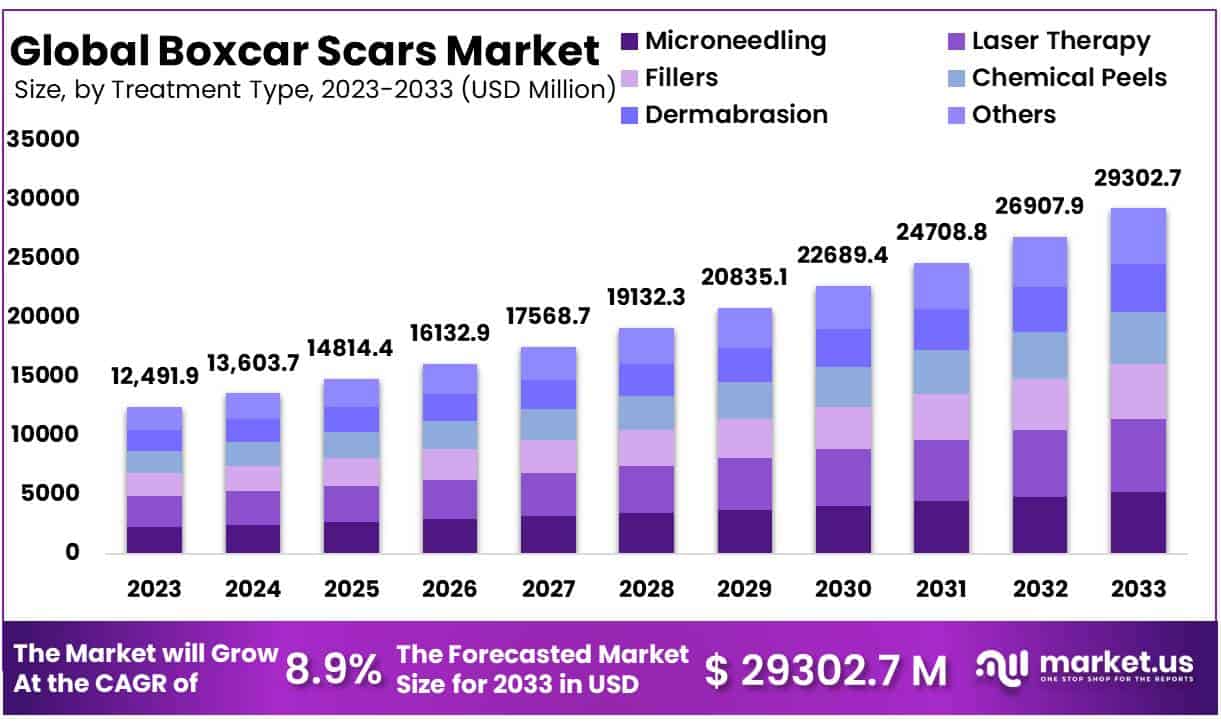
New York, NY – Jan 30, 2026 – The Global Boxcar Scars Market size is expected to be worth around USD 29,302.7 Million by 2033 from USD 12,491.9 Million in 2023, growing at a CAGR of 8.9% during the forecast period from 2024 to 2033.
The boxcar scars market is fundamentally shaped by the biological formation of this common type of atrophic acne scar and the growing demand for corrective dermatological solutions. Boxcar scars are formed as a result of moderate to severe inflammatory acne, where damage occurs deep within the dermal layer of the skin. This damage disrupts collagen fibers that are essential for skin regeneration, leading to permanent, well-defined depressions on the skin surface.
During acne inflammation, lesions such as cysts or nodules destroy surrounding tissue. As the skin heals, insufficient collagen synthesis prevents full tissue restoration. This collagen deficit results in broad, shallow to deep scars with sharp edges, clinically identified as boxcar scars. The depth and severity of these scars are influenced by the intensity of inflammation, duration of untreated acne, and individual healing response.
From a market perspective, the high prevalence of acne across adolescent and adult populations directly contributes to the rising incidence of boxcar scars. Increasing awareness of aesthetic appearance, combined with improved access to dermatology services, is accelerating demand for diagnosis and treatment solutions. The market is further supported by advancements in scar assessment technologies that allow for accurate identification of boxcar scars based on their structural characteristics.
Understanding the biological formation of boxcar scars is critical for market stakeholders, as it underpins the development of targeted therapies, including energy-based devices, injectable treatments, and regenerative procedures. As clinical understanding improves, the boxcar scars market is expected to experience steady growth driven by both preventive acne management and corrective aesthetic interventions.
Key Takeaways
- Market Size: The Boxcar Scars Market is projected to reach approximately USD 29,302.7 million by 2033, increasing from USD 12,491.9 million in 2023.
- Market Growth: The market is anticipated to expand at a compound annual growth rate (CAGR) of 8.9% during the forecast period from 2024 to 2033.
- Treatment Type Analysis: In 2023, laser therapy dominated the market, accounting for 25.6% of the total revenue share.
- Distribution Channel Analysis: Hospitals represented the leading distribution channel, contributing 62.4% of the overall market share.
- Regional Analysis: North America emerged as the largest regional market in 2023, holding a 38.4% share of the global Boxcar Scars Market.
Regional Analysis
North America accounted for the largest share of the Boxcar Scars Market, capturing 38.4% in 2023. This regional dominance is driven by several key factors. A high prevalence of acne across North America significantly contributes to demand for scar treatment solutions.
According to data published by the National Institutes of Health, approximately 80–90% of teenagers in Western countries are affected by acne-related scarring. In addition, the strong presence of major industry participants such as Lumenis and CeraVe supports market expansion through continuous product innovation and wide product availability.
Moreover, North America benefits from a highly developed healthcare system and advanced medical infrastructure, which improves patient access to modern dermatological treatments and experienced medical professionals specializing in boxcar scar management. These combined factors continue to support sustained market growth in the region.
Europe is recognized as the second-largest regional market, supported by rising healthcare investments and growing awareness regarding acne and scar treatment options. According to an article published by the European Union, Germany and France recorded the highest healthcare expenditure as a percentage of GDP in 2020, at 12.8% and 12.2%, respectively. Such strong healthcare spending levels enhance access to dermatological care, thereby supporting the growth of the Boxcar Scars Market across Europe.
Emerging Trends
- Combination Therapies: The integration of multiple treatment modalities, including microneedling, subcision, and laser-based procedures, has demonstrated superior clinical outcomes compared to single-modality approaches. Clinical evidence indicates that the combination of subcision with platelet-rich plasma (PRP) resulted in a 32% improvement in scar appearance over a two-year period, compared with an 8.3% improvement achieved with subcision alone.
- Radiofrequency (RF) Microneedling: RF microneedling technologies are increasingly being adopted due to their ability to deliver controlled thermal energy to deeper dermal layers, thereby stimulating collagen and elastin production. Clinical studies suggest that microneedle bipolar RF and fractional RF systems provide notable improvements in boxcar-type acne scars.
- Shift Toward Minimally Invasive Procedures: Market demand is progressively favoring minimally invasive treatment options that offer reduced downtime and lower procedural risk. Techniques such as microneedling and superficial to medium-depth chemical peels are gaining traction due to their favorable safety profiles and consistent clinical efficacy.
- Personalized Treatment Protocols: Customized treatment planning based on scar morphology, skin type, and individual patient expectations is becoming an established standard of care. This personalized approach is associated with improved treatment outcomes and higher patient satisfaction rates.
- Advancements in Laser Technologies: Technological advancements in laser systems, including fractional CO₂ and Er:YAG platforms, have improved treatment precision and safety. These newer systems deliver effective scar remodeling with a reduced incidence of adverse effects, expanding their applicability across diverse patient populations.
Key Use Cases
- Subcision Combined with PRP: A clinical study involving 45 patients demonstrated that subcision combined with PRP achieved a 32% improvement in acne scar appearance over a two-year follow-up period, significantly outperforming subcision alone, which showed an 8.3% improvement.
- Microneedling: Microneedling induces controlled dermal micro-injuries that stimulate collagen synthesis and tissue remodeling. Most patients require between three and six treatment sessions, with measurable improvements observed in scar depth and overall skin texture.
- Chemical Peels: Medium-depth chemical peels, particularly those using trichloroacetic acid (TCA) or glycolic acid, facilitate epidermal turnover and dermal regeneration. A 2015 clinical review reported that five sequential sessions of 70% glycolic acid administered biweekly yielded superior outcomes compared to alternative peeling agents.
- Laser Resurfacing: Fractional ablative laser treatments, including CO₂ and Er:YAG lasers, have shown strong efficacy in managing boxcar scars by promoting collagen remodeling. However, these procedures are typically associated with longer recovery periods and require careful patient selection.
- Dermal Fillers: Injectable dermal fillers are used to temporarily elevate depressed acne scars, delivering immediate aesthetic improvement. The duration of effect generally ranges from six to eighteen months, making this option suitable for patients seeking short- to medium-term results.
Frequently Asked Questions on Boxcar Scars
- What causes boxcar scars to develop?
Boxcar scars develop due to severe acne inflammation that damages collagen during the skin’s healing process. Delayed treatment, repeated acne flare-ups, and improper lesion handling significantly increase the likelihood of boxcar scar formation. - Are boxcar scars permanent?
Boxcar scars are generally permanent without medical intervention. However, their appearance can be significantly reduced through dermatological treatments such as laser therapy, microneedling, chemical peels, and dermal fillers, depending on scar depth and skin type. - Which treatments are most effective for boxcar scars?
Laser therapy, microneedling, and subcision are among the most effective treatments for boxcar scars. These procedures stimulate collagen production, improve skin texture, and reduce scar depth, offering visible improvement over multiple treatment sessions. - Can boxcar scars be prevented?
Boxcar scars can be partially prevented through early acne management, avoiding skin picking, and timely dermatological care. Proper treatment reduces inflammation and minimizes collagen damage, lowering the risk of permanent scarring. - Which treatment segment dominates the Boxcar Scars Market?
Laser therapy represents a leading treatment segment due to its clinical effectiveness, non-invasive nature, and increasing adoption in dermatology clinics. Continuous innovation in laser technologies further supports its strong revenue contribution. - Which distribution channel holds the largest market share?
Hospitals dominate the distribution landscape due to access to advanced medical equipment, trained dermatologists, and comprehensive post-treatment care. Their credibility and infrastructure make them the preferred choice for scar treatment procedures. - Which region leads the Boxcar Scars Market?
North America leads the global Boxcar Scars Market, supported by advanced healthcare infrastructure, high acne prevalence, strong presence of key market players, and widespread adoption of aesthetic dermatology treatments.
Conclusion
The boxcar scars market is being steadily driven by the high global prevalence of acne, deeper clinical understanding of scar biology, and rising demand for effective aesthetic dermatology solutions. Damage to dermal collagen during inflammatory acne remains the fundamental cause, directly shaping treatment innovation and adoption.
Advancements in laser systems, minimally invasive procedures, and combination therapies have improved clinical outcomes and patient satisfaction. Strong healthcare infrastructure, particularly in North America and Europe, continues to support market expansion. Overall, sustained technological progress, growing awareness, and personalized treatment approaches are expected to maintain robust market growth over the forecast period.
Discuss your needs with our analyst
Please share your requirements with more details so our analyst can check if they can solve your problem(s)




