


Table of Contents
Overview
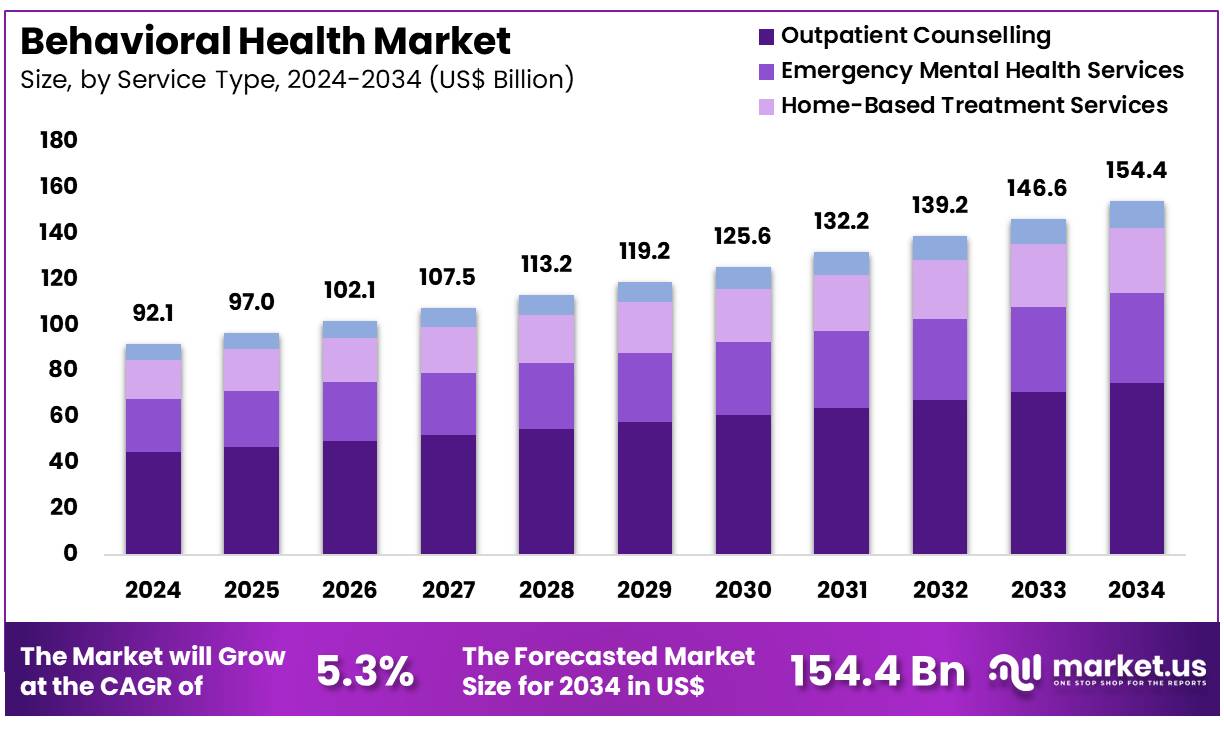
New York, NY – Dec 18, 2025 – Global Behavioral Health Market size is expected to be worth around US$ 154.4 Billion by 2034 from US$ 92.1 Billion in 2024, growing at a CAGR of 5.3% during the forecast period 2025 to 2034. In 2024, North America led the market, achieving over 45.3% share with a revenue of US$ 41.7 Billion.
The expansion of behavioral health services has been formally announced to address the growing need for accessible, comprehensive mental and emotional care. The initiative is designed to improve early identification, treatment, and long-term management of behavioral health conditions across diverse population groups.
Behavioral health encompasses mental health, emotional well-being, and substance use care. Rising awareness of anxiety, depression, stress-related disorders, and substance use challenges has highlighted the importance of integrated and patient-centered care models. Through this initiative, services are being enhanced to ensure timely access, evidence-based treatment, and coordinated support systems.
The program focuses on prevention, early intervention, and recovery-oriented care. Clinical services will include counseling, psychiatric evaluation, therapy programs, and community-based support. Digital health tools and telehealth platforms are also being incorporated to extend reach and reduce barriers to care, particularly in underserved areas.
Healthcare professionals, community organizations, and policymakers are aligned in strengthening behavioral health infrastructure. The approach emphasizes stigma reduction, improved care continuity, and measurable outcomes that support long-term health improvement.
The expansion of behavioral health services reflects a sustained commitment to public health and social well being. By prioritizing mental and emotional health alongside physical care, communities are expected to experience improved quality of life, productivity, and resilience.
Key Takeaways
- In 2024, the behavioral health market generated revenue of US$ 92.1 billion and is projected to expand at a compound annual growth rate (CAGR) of 5.3%, reaching US$ 154.4 billion by 2034.
- By service type, the market is categorized into outpatient counselling, emergency mental health services, home-based treatment services, and others. Among these, outpatient counselling dominated in 2024, accounting for a 48.5% market share.
- Based on application, the market includes depression & anxiety disorder, substance abuse disorder, post-traumatic stress disorder, eating disorder, bipolar disorder, and others. The depression & anxiety disorder segment emerged as the leading category, capturing a 40.3% share.
- In terms of end users, the market is segmented into outpatient clinics, hospitals, homecare settings, and rehabilitation centers. Outpatient clinics represented the largest revenue contributor, holding a 52.8% share of the overall market.
- Regionally, North America maintained market leadership, securing a 45.3% share of global revenue in 2024.
Behavioral Health Statistics
- Prevalence of Mental Health Disorders: Mental health conditions remain highly prevalent across the United States. An estimated 57.8 million U.S. adults, representing nearly 20% of the adult population, experience some form of mental illness each year. Among younger populations, approximately 20% of U.S. youth are affected by mental health disorders, with major depressive disorder impacting nearly 1 in 10 adolescents. Looking ahead, it is projected that 25% of Americans will require behavioral health services by 2026, reflecting a 1.2% increase compared to 2021 levels.
- Treatment Gaps and Access Challenges: Despite the high prevalence, access to care remains limited. More than 54.7% of adults with mental illness in the U.S. do not receive adequate treatment. Among youth, access challenges are even more pronounced, with nearly 60% of adolescents experiencing major depression lacking access to mental health services. Overall, approximately 72% of the U.S. population resides in areas with insufficient mental health resources, underscoring systemic capacity constraints.
- Substance Use and Co-occurring Disorders: Substance use disorders (SUDs) frequently coexist with mental health conditions. Approximately 47 million Americans are affected by SUDs, and over 50.5% of these individuals also experience a diagnosable mental illness. Among younger populations, the overlap is more severe, with over 66% of youth with substance use disorders also facing co-occurring mental health conditions.
- Youth Mental Health Concerns: Mental health disorders affect 1 in 6 children and adolescents aged 6–17 annually in the United States. Suicide represents a critical public health issue, ranking as the second leading cause of death among individuals aged 10–34 and the third leading cause among those aged 15–24. Despite these risks, more than two-thirds of young people do not seek mental health support. Each year, approximately 19% of youth report suicidal thoughts or attempts, with 80% exhibiting clear warning signs prior to crises.
- Rising Demand and Workforce Constraints: Demand for behavioral health services is expected to increase by 62% by 2036, driven by population growth, increased awareness, and higher diagnosis rates. However, workforce capacity is projected to decline, with a 13% reduction in full-time behavioral health professionals by 2036, further intensifying service shortages and access challenges.
- Impact of COVID-19: The COVID-19 pandemic significantly exacerbated mental health conditions worldwide. Global rates of depression and anxiety increased by approximately 25%, while diagnoses of anxiety and depression among U.S. adolescents rose by 25% following the onset of the pandemic.
- Global Mental Health Landscape: Globally, data availability remains limited. Only 6.7% of prevalence data for mental disorders among children aged 5–17 is currently available worldwide. In sub-Saharan Africa, mental health prevalence data coverage remains below 2%, highlighting major gaps in surveillance and reporting. On a global scale, suicide is the second leading cause of death among individuals aged 15–29, accounting for an estimated 800,000 deaths annually.
- Economic Burden of Mental Illness: Serious mental illnesses impose a substantial economic cost. In the United States alone, they result in nearly USD 200 billion in lost earnings each year. Evidence suggests that a modest investment of USD 2–4 per capita in mental health services across low- and middle-income countries could deliver significant population-level benefits.
- Treatment Effectiveness: Mental health treatment demonstrates high effectiveness when accessible. Studies indicate that 80–90% of individuals who seek mental health treatment return to normal or improved functioning. Similarly, 70–90% of patients receiving appropriate care report meaningful symptom reduction, reinforcing the value of early and sustained intervention.
- Barriers and Stigma: Social stigma and entrenched stereotypes remain key barriers to care, particularly among younger populations. Notably, evidence indicates that only 3–5% of violent acts are attributable to individuals with serious mental illnesses, challenging widespread misconceptions and emphasizing the need for public education.
- Emerging Behavioral Health Trends: The behavioral health sector is experiencing notable growth. Staffing-related revenues increased by 121.2% year-over-year in 2023, reflecting heightened demand and investment. Importantly, approximately 75% of lifetime mental health conditions manifest by age 24, underscoring the critical importance of early diagnosis, prevention, and intervention strategies.
Regional Analysis
The behavioral health market in North America, representing a substantial 45.3% share, experienced significant growth in 2024. This expansion was primarily driven by heightened awareness of mental health conditions and substance use disorders, reduced stigma, and improved access to care through various modalities. Data from the National Institute of Mental Health (NIMH) indicates that in 2022, an estimated 59.3 million adults aged 18 or older in the United States lived with a mental illness, representing 23.1% of the adult population. This widespread prevalence underscores the persistent need for comprehensive behavioral health services.
Government initiatives and funding have played a crucial role in expanding access, with the Substance Abuse and Mental Health Services Administration (SAMHSA) requesting a total of US$10.8 billion in its Fiscal Year 2024 President’s Budget to address the mental health and overdose crises. Telehealth services have also significantly broadened reach, with the US Department of Health and Human Services (HHS) permanently allowing Medicare patients to receive behavioral and mental telehealth services in their homes, effective from March 2025.
Leading providers in the sector have demonstrated strong financial performance, reflecting this growing demand. Universal Health Services, Inc. reported that net revenues generated from its behavioral health care services, on a same-facility basis, increased by 10.7% to US$3.2 billion in 2024, driven by robust demand and capacity expansion.
The Asia Pacific region is expected to experience the highest CAGR during the forecast period
The behavioral health market in Asia Pacific is expected to grow considerably during the forecast period. This anticipated expansion is primarily fueled by increasing awareness of mental health issues, a reduction in societal stigma, and substantial government initiatives aimed at improving mental healthcare infrastructure and accessibility. Many countries in the region are recognizing the significant burden of mental and neurological conditions, which accounted for a quarter of the non-fatal disease burden in Asia Pacific in 2021, as reported by the OECD’s Health at a Glance: Asia/Pacific 2024. This recognition is prompting governments to prioritize mental health in their national healthcare agendas.
For example, the World Health Organization (WHO) South-East Asia Region adopted the Paro Declaration, committing to universal access to people-centered mental health services, and has seen 72.3 million more people gain access to newly available local services by the end of 2024 through its Special Initiative for Mental Health.
Furthermore, the rising adoption of digital health solutions and telemedicine platforms is projected to bridge geographical gaps and increase the reach of mental health support. As healthcare systems mature and populations become more urbanized, the demand for diverse behavioral health services, including counseling, therapy, and specialized treatments, will likely continue to rise across Asia Pacific.
Use Cases
- Telepsychiatry and Remote Counseling: Access to behavioral health services is expanded through telepsychiatry and remote counseling platforms. This approach is particularly effective in areas with shortages of mental health professionals and supports individuals facing geographic, mobility, or transportation barriers.
- Integrated Care Models: Behavioral health services are embedded within primary care settings to enable a holistic treatment approach. This model improves patient outcomes by aligning mental and physical healthcare and enhancing coordination across care providers.
- School-Based Behavioral Health Services: Behavioral health programs are implemented within educational institutions to support student mental well-being. Early identification and timely intervention of mental health concerns are facilitated in a familiar and accessible environment.
- Crisis Intervention Teams: Mobile crisis intervention teams are deployed to respond rapidly to individuals experiencing acute behavioral health crises. These teams often collaborate with law enforcement to ensure appropriate clinical care while minimizing unnecessary involvement with the justice system.
- Substance Use Disorder Treatment Programs: Specialized programs are developed to address substance use disorders, including opioid dependence. Treatment typically integrates medication-assisted therapy, behavioral counseling, and social support services to improve recovery outcomes.
- Workplace Behavioral Health Initiatives: Mental health resources are incorporated into workplace environments to address occupational stress and promote employee well-being. Programs commonly include stress management initiatives and access to mental health professionals.
- Peer Support and Community Health Worker Models: Peer support specialists and community health workers are engaged to provide counseling and guidance, particularly in underserved and rural areas. This approach strengthens community-level capacity for mental health support.
- Digital Behavioral Health Tools for Self-Management: Digital platforms and applications are adopted to support self-monitoring and self-management of mental health conditions. These tools enable greater patient engagement through online therapy and mental health tracking solutions.
- Behavioral Health Services for the Elderly: Programs are designed to address the unique behavioral and cognitive health needs of the aging population. Services are commonly delivered through senior care facilities or home-based care models.
- Veteran-Focused Behavioral Health Programs: Targeted behavioral health initiatives are established for veterans to address conditions such as PTSD, depression, and anxiety. These programs are structured to reflect the specific psychological challenges associated with military service.
Frequently Asked Questions on Behavioral Health
- What conditions are covered under Behavioral HealthA services?
Behavioral HealthA services address conditions such as depression, anxiety disorders, bipolar disorder, schizophrenia, substance use disorders, and stress-related conditions. These services focus on early diagnosis, long-term management, and relapse prevention through evidence-based therapies. - Who provides Behavioral HealthA services?
Behavioral HealthA services are delivered by licensed professionals including psychiatrists, psychologists, counselors, social workers, and psychiatric nurses. Care delivery often involves multidisciplinary teams to ensure comprehensive, coordinated, and patient-centered treatment approaches. - What treatment approaches are used in Behavioral HealthA?
Treatment approaches in Behavioral HealthA include psychotherapy, cognitive behavioral therapy, medication management, behavioral interventions, and digital therapeutics. Integrated care models combining physical and mental health services are increasingly adopted to improve clinical effectiveness. - Why is Behavioral HealthA important in healthcare systems?
Behavioral HealthA plays a critical role in healthcare systems by reducing disease burden, improving quality of life, and lowering overall healthcare costs. Effective behavioral health interventions are associated with improved productivity, reduced hospitalizations, and better long-term health outcomes. - What factors are driving the growth of the Behavioral HealthA market?
Market growth is driven by rising mental health disorder prevalence, increasing awareness, supportive government policies, and expanding insurance coverage. Technological advancements such as telehealth and digital therapeutics have further improved access to behavioral health services globally. - How is technology impacting the Behavioral HealthA market?
Technology is transforming the Behavioral HealthA market through telepsychiatry, mobile mental health applications, artificial intelligence tools, and remote patient monitoring. These innovations enhance accessibility, reduce care gaps, and improve treatment adherence across diverse patient populations. - Which end users dominate the Behavioral HealthA market?
Hospitals, specialty clinics, community health centers, and outpatient facilities represent major end users in the Behavioral HealthA market. Increasing adoption by employers and educational institutions is also contributing to expanded demand for behavioral health solutions. - What is the future outlook for the Behavioral HealthA market?
The Behavioral HealthA market is expected to experience sustained growth due to increasing mental health prioritization and continued investment. Integration of digital health solutions and value-based care models is anticipated to strengthen long-term market expansion.
Conclusion
The expansion of behavioral health services reflects a strategic and sustained response to the rising global burden of mental health and substance use disorders. Market growth is being supported by increasing prevalence, improved awareness, favorable government policies, and the integration of digital health solutions.
Outpatient counseling, depression and anxiety treatment, and outpatient clinics continue to dominate service demand, particularly in North America, while Asia Pacific is positioned for the fastest growth. Despite workforce and access challenges, evidence-based care models, telehealth adoption, and early intervention strategies are strengthening service delivery. Overall, behavioral health remains a critical pillar of public health systems, supporting long-term societal well-being and economic resilience.
Discuss your needs with our analyst
Please share your requirements with more details so our analyst can check if they can solve your problem(s)




